Is Jupiter Really a Star? It Depends on How One Defines a Star
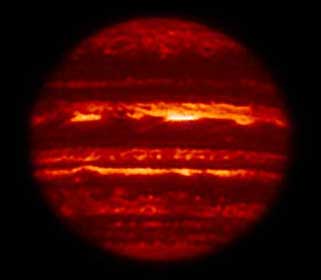
So this week we found out that poor little Pluto is really not a planet after all. I guess in the back of our minds we always did know that there was something just a little peculiar about Pluto. But maybe we should keep an eye on Jupiter, that other strange "planet" at the other extreme of the range. It turns out that Jupiter shares more similarities with the Sun than with the other planets. So, is Jupiter really a star? It depends on how we define a star.
Comments:
I would have to say if there is no thermonuclear reaction occuring, it is NOT a star.<br>-Alan
STOP THE MADNESS! Evolutionary biologists recognize that 'species' are neither immutable nor isolated. Why not then have a quantized continuum for astronomically interesting objects? Gas nebulae, stars, planets, plutons, whathaveyou. And teach that the boundaries are 'fuzzy' (which is all the rage in categorization these days).<br><br>Is it a giant planet or a brown dwarf? A large globular or a tiny elliptical? Tastes Great or Less Filling?<br><br>There are more important things to think about, on earth and in heaven...<br><br>Jess Tauber, Fool on the Hill
Careful Guy, that is a very slippery slope. What's next? Criteria for what makes a REAL telescope? Is 80 mm a dwarf telescope? Is 16 inches a "star" telescope? What impact does GOTO or APO have? Just when I thought I had it all figured out....Roofy
<blockquote class="blockquote"><div class="italic"><i>Sharon Bourgeois said:</i><br><br>Careful Guy, that is a very slippery slope. What's next? Criteria for what makes a REAL telescope? Is 80 mm a dwarf telescope? Is 16 inches a "star" telescope? What impact does GOTO or APO have? Just when I thought I had it all figured out....Roofy</div></blockquote><br>A telescope may not:<br> 1) Focus closer than 100 meters<br> 2) Contain more than one objective optical path<br> 3) Be made in China<br> 4) Have more gravity than the strength of its materials<br><br>A telescope must:<br> 1) Gather more light than 100 unaided eyes<br> 2) Create a focused image on the human retina<br> 3) Focus all visible light within 3 airy disc diameters from infinity<br> 4) Be available for purchase off the shelf.<br><br>How's that for an arbitrary start? 8O
-Nice enjoyable article -- appreciate the humor.<br>-It appears the King of Planets is not a classic star (no fusion) but has some of the same characteristics as a star (including self-generated heat and a typical hydrogen/helium ratio). Perhaps in keeping with the new definition of dwarf planets (hey -- isn't "dwarf" kind of politically incorrect??), perhaps we should come up with a new category for Jupiter.<br>-Alas, Jupiter doesn't quite have the defined quantity (?) of mass to be a real brown dwarf, either. Rather than say it is a dwarf brown dwarf, couldn't we say that Jupiter is maybe a "light tan dwarf" or maybe a "beige dwarf?" <br>-Anyway I'm glad this beautiful catcher of stray comets is around, and hope all this doesn't cause it to have an identity crisis. It's still a delight to look at. Thanks.
The dimmest stars Hubble can see are 8.3% solar mass. Jupiter is ~1.9*10^27 and 8.3% of sol is 1.65X10^29 (thanks Google). Therefor, we need ~87 Jupiters to equal the mass of a *DIM* star...<br><br>Dwarf stars are another matter, do they even have fusion reactions?<br><br>-Guy
