ISON -- Comet of the Century? Or Just Another Dud?
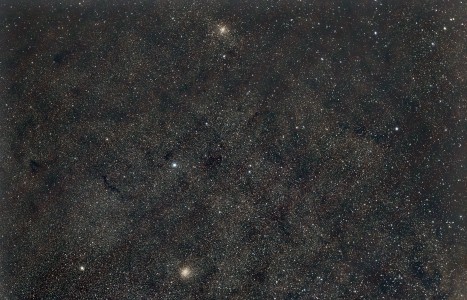
Out near the orbit of Jupiter, a faint speck of light is moving through the black of space. At first glance it doesn't look like much, no brighter than a thousand distant stars speckling the velvet sky behind it. Indeed, it takes a big telescope to make out that it is a comet.
But what a comet it could turn out to be...
Later this year, "Comet ISON" could blossom into a striking naked eye object visible even in broad daylight.
"Comet ISON is a sungrazer," explains Karl Battams of the Naval Research Lab. "The orbit of the comet will bring it very close to the sun, which we know can be a spectacular thing."
Russian astronomers Vitali Nevski and Artyom Novichonok found the comet in Sept. 2012. It bears the name of their night-sky survey program, the International Scientific Optical Network.
As 2013 unfolds, the comet is still very far away, near the orbit of Jupiter. That's why it looks like a speck. "But for an object at such extreme distance, it is actually very bright," says Battams. The comet's glow suggests that is spewing gas and dust from a fairly large nucleus -- in the 1 to 10 km range," estimates Matthew Knight of the Lowell Observatory.
On Nov. 28, 2013, this "dirty snowball" will fly through the sun's atmosphere little more than a million km from the stellar surface. If the comet survives -- a big IF -- it could emerge glowing as brightly as the Moon, briefly visible near the sun in broad daylight. The comet's dusty tail stretching into the night sky could create a worldwide sensation.
Some reporters have started calling ISON the "Comet of the Century," but Don Yeomans of NASA Near-Earth Object Program thinks that's premature.
"I'm old enough to remember the last Comet of the Century," he says. In 1973, a distant comet named Kohoutek looked like it would put on a great show, much like ISON. The actual apparition was such a let-down that Johnny Carson made jokes about it on the Tonight Show. "It fizzled," says Yeomans. "Comets are notoriously unpredictable."
"Comet ISON has the potential to live up to the hype, but it also has the potential to do nothing," agrees Battams.
Comet ISON is now approaching the inner solar system. Discovered last year, the comet remains unusually active for its distance from the sun. If current trends continue, ISON could rank as one of the brightest comets in decades when it makes its close approach to the sun in late November. This animation shows the comet's approach and departure from the inner solar system from various perspectives. (Image Credit: NASA's Goddard Space Flight Center Scientific Visualization Studio)
One hazard is the sun. Tidal forces and solar radiation have been known to destroy comets. A recent example is Comet Elenin, which broke apart and dissipated in 2011 as it approached the sun. Elenin, however, was a much smaller comet.
A better comparison, perhaps, is Comet Lovejoy, which flew through the sun's atmosphere in 2011. Lovejoy emerged intact and wowed observers with a garish tail for weeks.
"Comet ISON is probably at least twice as big as Comet Lovejoy and will pass a bit farther from the sun's surface" notes Knight. "This would seem to favor Comet ISON surviving and ultimately putting on a good show."
One of the most exciting possibilities would be a partial break-up. "If Comet ISON splits, it might appear as a string of pearls when viewed through a telescope," speculates Battams. "It might even resemble the famous Comet Shoemaker-Levy 9 that hit Jupiter in 1994."
A break-up would pose no threat to Earth, assures Yeomans. "Comet ISON is not on a collision course. If it breaks up, the fragments would continue along the same safe trajectory as the original comet."
NASA's Deep Impact spacecraft has acquired its first images of comet C/2012 S1 (ISON). The images were taken by the spacecraft's Medium-Resolution Imager over a 36-hour period on Jan. 17 and 18, 2013, from a distance of 493 million miles (793 million kilometers). Many scientists anticipate a bright future for comet ISON. The spaceborne conglomeration of dust and ice may put on quite a show as it passes through the inner solar system this fall.
"This is the fourth comet on which we have performed science observations (with NASA's Deep Impact spacecraft) and the farthest point from Earth from which we've tried to transmit data on a comet," said Tim Larson, project manager for the Deep Impact spacecraft at NASA's Jet Propulsion Laboratory in Pasadena, Calif. "The distance limits our bandwidth, so it's a little like communicating through a modem after being used to DSL. But we're going to coordinate our science collection and playback so we maximize our return on this potentially spectacular comet."
Deep Impact has executed close flybys of two comets - Tempel 1 and Hartley 2 - and its mission scientists, led by University of Maryland Astronomer Michael A'Hearn, have performed scientific observations on two more - comet Garradd and now ISON. The ISON imaging campaign is expected to yield infrared data, and light curves (which are used in defining the comet's rotation rate) in addition to visible-light images. A movie of comet ISON was generated from initial data acquired during this campaign. Preliminary results indicate that although the comet is still in the outer solar system, more than 474 million miles (763 million kilometers) from the sun, it is already active. As of Jan. 18, the tail extending from ISON's nucleus was already more than 40,000 miles (64,400 kilometers) long.
javascript:copy(),overlay('copyEmbedCodeHolder','copyembedcode','fe_text','copyembedcodebutton','copylinkbutton')
NASA's Deep Impact Spacecraft Images of Comet ISON - This series of images of comet C/2012 S1 (ISON) was taken by the Medium-Resolution Imager of NASA's Deep Impact spacecraft over a 36-hour period on Jan. 17 and 18, 2013. At the time, the spacecraft was 493 million miles (793 million kilometers) from the comet. (Image credit: NASA/JPL-Caltech/UMD)
Astronomers from the University of Maryland at College Park (UMCP) and Lowell Observatory have also used NASA's Swift satellite to check out comet C/2012 S1 (ISON).
Using images acquired over the last two months from Swift's Ultraviolet/Optical Telescope (UVOT), the team has made initial estimates of the comet's water and dust production and used them to infer the size of its icy nucleus.
"Comet ISON has the potential to be among the brightest comets of the last 50 years, which gives us a rare opportunity to observe its changes in great detail and over an extended period," said Lead Investigator Dennis Bodewits, an astronomer at UMCP.
Additional factors, including an encounter with Mars followed by a scorching close approach to the sun, make comet ISON an object of special interest. In late February, at NASA's request, a team of comet experts initiated the Comet ISON Observing Campaign (CIOC) to assist ground and space based facilities in obtaining the most scientifically useful data.
Like all comets, ISON is a clump of frozen gases mixed with dust. Often described as "dirty snowballs," comets emit gas and dust whenever they venture near enough to the sun that the icy material transforms from a solid to gas, a process called sublimation. Jets powered by sublimating ice also release dust, which reflects sunlight and brightens the comet.
Typically, a comet's water content remains frozen until it comes within about three times Earth's distance to the sun. While Swift's UVOT cannot detect water directly, the molecule quickly breaks into hydrogen atoms and hydroxyl (OH) molecules when exposed to ultraviolet sunlight. The UVOT detects light emitted by hydroxyl and other important molecular fragments as well as sunlight reflected from dust.
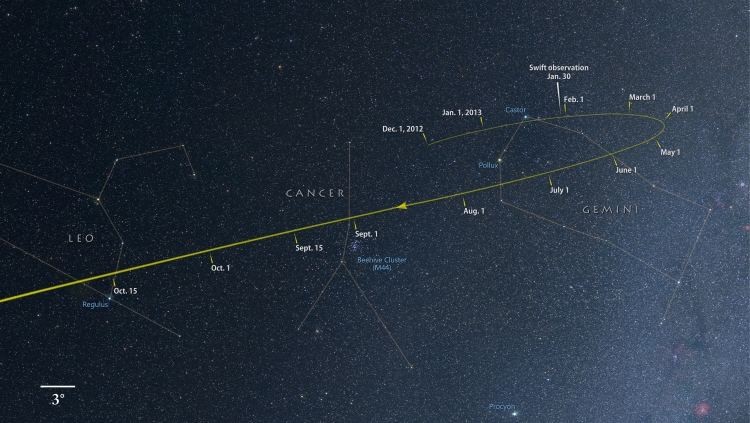
The Jan. 30, 2013 UVOT observations reveal that ISON was shedding about 112,000 pounds (51,000 kg) of dust, or about two-thirds the mass of an unfueled space shuttle, every minute. By contrast, the comet was producing only about 130 pounds (60 kg) of water every minute, or about four times the amount flowing out of a residential sprinkler system.
"The mismatch we detect between the amount of dust and water produced tells us that ISON's water sublimation is not yet powering its jets because the comet is still too far from the sun," Bodewits said. "Other more volatile materials, such as carbon dioxide or carbon monoxide ice, evaporate at greater distances and are now fueling ISON's activity."
At the time, the comet was 375 million miles (604 million km) from Earth and 460 million miles (740 million km) from the sun. ISON was at magnitude 15.7 on the astronomical brightness scale, or about 5,000 times fainter that the threshold of human vision.
Similar levels of activity were observed in February, and the team plans additional UVOT observations.
While the water and dust production rates are relatively uncertain because of the comet's faintness, they can be used to estimate the size of ISON's icy body. Comparing the amount of gas needed for a normal comet to blow off dust at the rate observed for ISON, the scientists estimate that the nucleus is roughly 3 miles (5 km) across, a typical size for a comet. This assumes that only the fraction of the surface most directly exposed to the sun, about 10 percent of the total, is actively producing jets.
An important question is whether ISON will continue to brighten at the same pace once water evaporation becomes the dominant source for its jets. Will the comet sizzle or fizzle?
"It looks promising, but that's all we can say for sure now," said Matthew Knight, an astronomer at Lowell Observatory in Flagstaff, Ariz., and a member of the Swift and CIOC teams. "Past comets have failed to live up to expectations once they reached the inner solar system, and only observations over the next few months will improve our knowledge of how ISON will perform."
Based on ISON's orbit, astronomers think the comet is making its first-ever trip through the inner solar system. Before beginning its long fall toward the sun, the comet resided in the Oort comet cloud, a vast shell of perhaps a trillion icy bodies that extends from the outer reaches of the planetary system to about a third of the distance to the star nearest the sun.
Formally designated C/2012 S1 (ISON), the comet was discovered on Sept. 21, 2012, by Russian astronomers Vitali Nevski and Artyom Novichonok using a telescope of the International Scientific Optical Network located near Kislovodsk.
The first of several intriguing observing opportunities occurs on Oct. 1, 2013 when the inbound comet passes about 6.7 million miles (10.8 million km) from Mars.
"During this close encounter, comet ISON may be observable to NASA and ESA spacecraft now working at Mars," said Michael Kelley, an astronomer at UMCP and also a Swift and CIOC team member. "Personally, I'm hoping we'll see a dramatic postcard image taken by NASA's latest Mars explorer, the Curiosity rover."
Fifty-eight days later, on Nov. 28, 2013 ISON will make a sweltering passage around the sun. The comet will approach within about 730,000 miles (1.2 million km) of its visible surface, which classifies ISON as a sungrazing comet. In late November, its icy material will furiously sublimate and release torrents of dust as the surface erodes under the sun's fierce heat, all as sun-monitoring satellites look on. Around this time, the comet may become bright enough to glimpse just by holding up a hand to block the sun's glare.
Sungrazing comets often shed large fragments or even completely disrupt following close encounters with the sun, but for ISON neither fate is a forgone conclusion.
"We estimate that as much as 10 percent of the comet's diameter may erode away, but this probably won't devastate it," explained Knight. Nearly all of the energy reaching the comet acts to sublimate its ice, an evaporative process that cools the comet's surface and keeps it from reaching extreme temperatures despite its proximity to the sun.
Following ISON's solar encounter, the comet will depart the sun and move toward Earth, appearing in evening twilight through December. It will swing past Earth on Dec. 26, 2013 approaching within 39.9 million miles (64.2 million km) or about 167 times farther than the moon.
Whatever happens, northern sky watchers will get a good view. For months after it swings by the sun, Comet ISON will be well placed for observers in the northern hemisphere. It will pass almost directly over the North Pole, making it a circumpolar object visible all night long.
Whether we'll look back on ISON as a "Comet of the Century" or as an overhyped cosmic dud remains to be seen, but astronomers are planning to learn the most they can about this unusual visitor no matter what happens.
For more information:
http://science.nasa.gov/science-news/science-at-nasa/2013/18jan_cometison/
http://www.nasa.gov/mission_pages/swift/bursts/ison.html
http://www.nasa.gov/mission_pages/asteroids/news/asteroid20130205.html
http://solarsystem.nasa.gov/scitech/display.cfm?ST_ID=2504
http://www.astromart.com/news/news.asp?news_id=1299
http://www.astromart.com/news/news.asp?news_id=1328
AstroMart News Archive:
http://www.astromart.com/news/search.asp?search=.+
Funding Member
