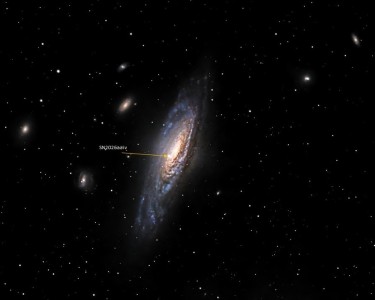
It Came From a Black Hole... And No, This is Not an April Fool's Joke

The baffling and strange behavior of black holes has become somewhat less mysterious recently. As we know, super-massive black holes don't give off any light themselves, but are often encircled by disks of hot, glowing material. The gravity of a black hole pulls swirling gas into it, heating this material and causing it to shine brightly in multiple wavelengths. Another source of radiation near a black hole is the corona, which is made up of highly energetic particles that generate massive amounts of X-rays. In September 2014, NASA's Explorer missions Swift and NuSTAR caught Markarian 335, a super-massive black hole near the constellation Pegasus, in a huge flare. After careful scrutiny, the astronomers realized they were seeing the ejection, and eventual collapse, of the black hole's corona shooting away at about 20 percent the speed of light.