Japanese Astronomers Measure the Velocity of a Supernova Shockwave
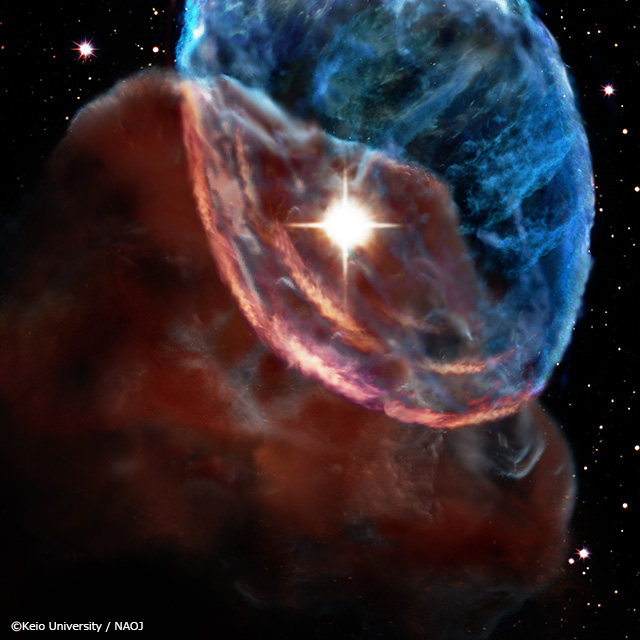
A research team led by Tomoro Sashida and Tomoharu Oka (Keio University) has succeeded in precisely measuring the expansion velocity of the shockwave of supernova remnant W44. The remnant is located in the constellation of Aquila, approximately 10,000 light-years away from our solar system. The team observed the high-temperature and high-density molecular gas in the millimeter and sub-millimeter wave ranges. The analysis shows that the expansion velocity of the W44 shockwave is 12.9 km/sec. In addition, other molecular gas with an extremely high velocity greater than 100 km/sec was also detected, but the origin of this super-high-velocity molecular gas remains unclear at the present time.
A star with a mass of more than eight times that of the Sun releases tremendous energy when it is dying and undergoes a supernova explosion. The shockwave caused by the supernova explosion expands, having a strong impact on the physical state of all surrounding interstellar materials. The supernova also emits kinetic energy into interstellar space. "Galactic winds" blasting out large amounts of gas are often observed in galaxies where explosively active star formations take place. The energy source of this galactic wind is thought to be the result of multiple supernova explosions.
Although supernova explosions have an immense influence on interstellar space, there has been no quantitative research on the expansion velocity and kinetic energy of supernova shockwaves. This is because a wide area must be observed in order to study the expansion velocity and kinetic energy of a supernova shockwave. Wide area observations with the existing equipment require quite long observation times and observations of interstellar gas influenced by a supernova shockwave have been limited to a narrow area.
The research team started its observations mainly with radio telescopes in late 1990s. The purpose was to study interaction of the supernova remnant W44 and an adjacent Giant Molecular Cloud (GMC). W44 is a roughly 6,500 to 25,000-year-old supernova remnant located approximately 10,000 light-years away from the solar system. Attached to the remnant is a GMC with a mass of approximately 300,000 times the mass of the Sun. Since observation began, molecular spectrum lines with a wide velocity width have been detected in the W44 molecular cloud in various places. They have been interpreted to be gas that has been accelerated by the passage of the supernova shockwave.
The research team used the 45 meter Telescope at Nobeyama Radio Observatory (NRO) - National Astronomical Observatory of Japan (NAOJ) and the 10 meter ASTE (Atacama Sub-millimeter Telescope Experiment) telescope to make high-sensitivity video imaging observations of the full area of W44.
The observations revealed that spectrum lines with a wide velocity width were detected throughout the whole area where W44 overlapped the GMC. The research team calculated velocity centroids from these spectrum lines and examined their spatial distribution. From the distribution, a clear velocity gradient was found throughout from the center to the edge of W44. This can be thought as the expansion activity of shocked gas, or molecular gas affected by a shockwave.
Based upon the uniform expansion model of the rotating spheroid, the expansion velocity of 12.9 km/sec was estimated. The mass of shocked gas was evaluated as 1.2 times the mass of the Sun based on the spectral intensity. From these values, the team was able to estimate the whole kinetic energy transmitted from the supernova remnant to interstellar materials.
In addition, the observations detected a molecular gas component with an extremely high velocity of greater than 100 km/sec. These positions of super-high-velocity molecular gas are the exact locations where the sources of continuum radiation and a molecular hydrogen oscillation emission line are also detected. This indicates that very strong shockwaves existed locally. The origin of the super-high-velocity component remains a mystery at the present time.
The research team plans to plow ahead with this research to uncover the nature of this mysterious high velocity component. Furthermore, the team will observe a larger number of shocked gases surrounding the supernova to compare these observational results with theoretical models of a supernova shockwave.
For more information:
http://www.nao.ac.jp/en/news/science/2013/20130809-nro.html
AstroMart News Archive:
http://www.astromart.com/news/search.asp?search=.+
