Jupiter-like Gas Giants or Brown Dwarfs – How Does One Tell Them Apart?
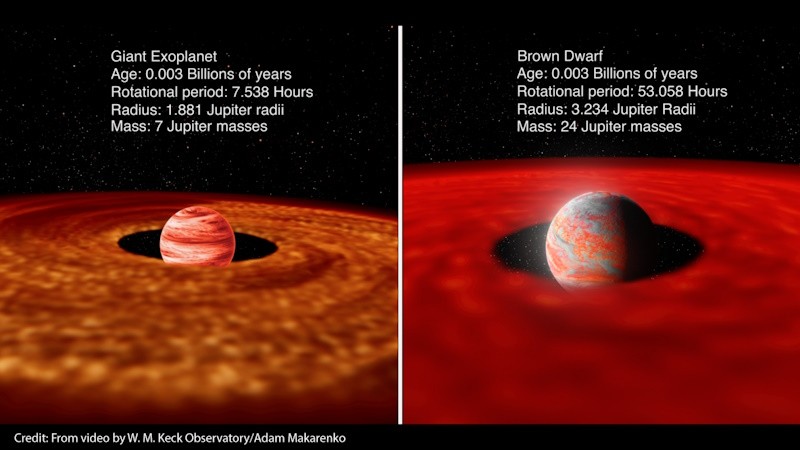
For decades, astronomers have struggled to differentiate giant planets from brown dwarfs, a class of objects more massive than planets but too small to ignite nuclear fusion like true stars. Through a telescope, these cosmic look-alikes can have overlapping brightness, temperatures, and even atmospheric fingerprints. The striking similarity leaves astronomers unsure if they have observed an over-sized planet or an undersized star. In our Solar System, Jupiter is the largest planet, being about 318 times as massive as the Earth and lying about five times farther from the Sun than does the Earth. Brown dwarfs are similar in many ways to Jupiter-like gas giants, but range from 13 to 90 times the mass of Jupiter… And while they can be up to a tenth the mass of the Sun, they lack the nuclear fusion in their core to burn as a star, so they lie somewhere between a diminutive star and a super-planet. Now, a Northwestern University-led team has uncovered a crucial clue that separates the two: how fast they spin.
Comments:
Funding Member