Jupiter's Great Red Spot is Shrinking
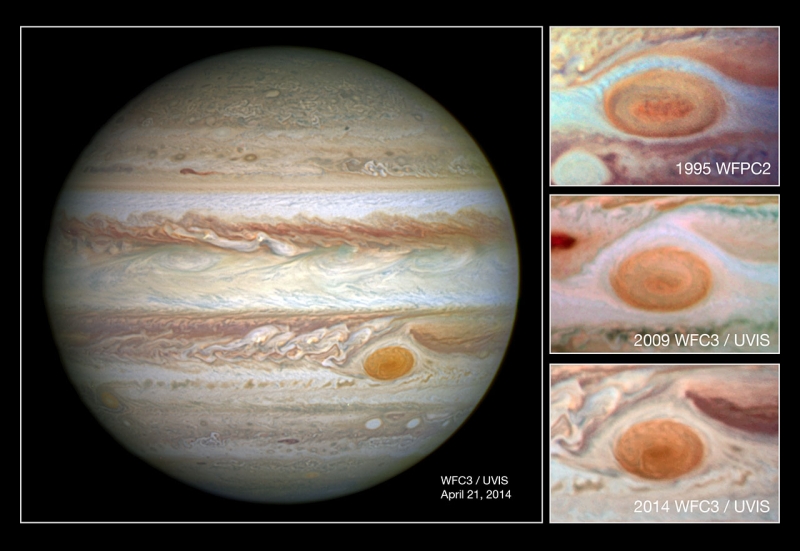
Jupiter's trademark Great Red Spot - a swirling storm feature larger than Earth - is shrinking. This downsizing, which is changing the shape of the spot from an oval into a circle, has been known from about the 1930s, but now these striking new NASA/ESA Hubble Space Telescope images capture the spot at a smaller size than ever before.
Jupiter's Great Red Spot is a high-pressure anticyclone. It rotates in an anti-clockwise direction in Jupiter's southern hemisphere. It shows up in images of the giant planet as a conspicuous deep red eye embedded in swirling layers of pale yellow, orange and white. Winds inside this Jovian storm rage at immense speeds, reaching several hundreds of kilometers per hour.
The Great Red Spot itself may have been mentioned in writings before the late 1800s. There are references to Jupiter's "permanent spot" dating back as far as the late 1600s, although some astronomers disagree that the permanent spot mentioned is the Great Red Spot. Historic observations as far back as the late 1800s gauged this turbulent spot to span about 41,000 kilometers at its widest point -- wide enough to fit three Earths comfortably side by side. In 1979 and 1980 the NASA Voyager fly-bys measured the spot at a shrunken 23,335 kilometers across. Now, Hubble has spied this feature to be smaller than ever before.
"Recent Hubble Space Telescope observations confirm that the spot is now just under 16,500 kilometers across, the smallest diameter we've ever measured," said Amy Simon of NASA's Goddard Space Flight Center in Maryland.
Amateur observations starting in 2012 revealed a noticeable increase in the spot's shrinkage rate. The spot's "waistline" is getting smaller by just under 1000 kilometers per year. The cause of this shrinkage is not yet known.
"In our new observations it is apparent that very small eddies are feeding into the storm," said Simon. "We hypothesized that these may be responsible for the accelerated change by altering the internal dynamics of the Great Red Spot."
Simon's team plans to study the motions of these eddies, and also the internal dynamics of the spot, to determine how the stormy vortex is fed with or sapped of momentum.
For more information:
http://www.spacetelescope.org/images/heic1410b/
http://www.astromart.com/news/news.asp?news_id=469
http://www.astromart.com/news/news.asp?news_id=545
http://www.astromart.com/news/news.asp?news_id=1067
http://www.astromart.com/news/news.asp?news_id=845
AstroMart News Archive:
http://www.astromart.com/news/search.asp?search=.+
Funding Member
