Kiss the Sky Tonight -- Month of August 2018
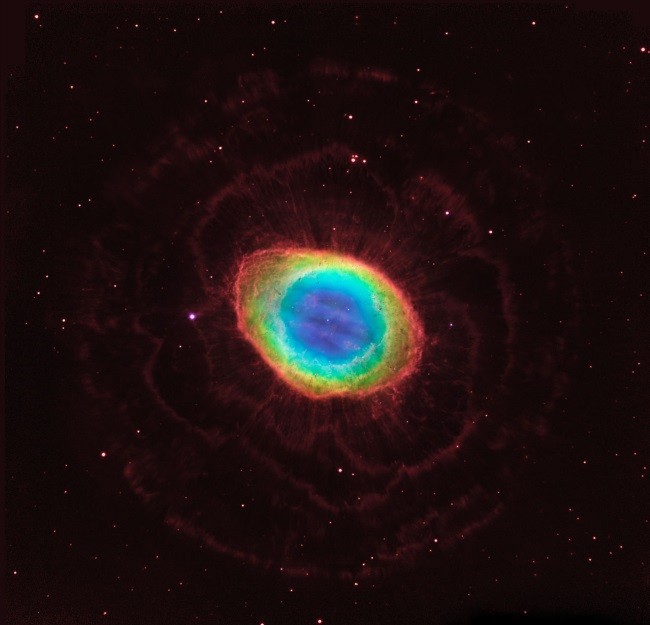
In this composite image, visible-light observations by NASA's Hubble Space Telescope are combined with infrared data from the ground-based Large Binocular Telescope in Arizona to assemble a dramatic view of the well-known Ring Nebula (M57, NGC 6720). The distinctive shape of the Ring Nebula makes it a popular illustration for astronomy books. Observations by NASA's Hubble Space Telescope show a glowing gas shroud surrounding an old, dying, sun-like star. The Ring Nebula is about 2000 light-years from Earth and measures roughly 1 light-year across. Located in the constellation Lyra, the nebula is a popular target for amateur astronomers. The outer rings of the nebula were formed when fast moving gas slammed into slower-moving material. The nebula is expanding at more than 43,000 miles an hour, but the center is moving faster than the expansion of the main ring. The Ring Nebula will continue to expand for another 10,000 years or so and will become fainter and fainter until it merges with the interstellar medium. (Credits: NASA and the Office of Public Outreach - STScI). (Image Credit: NASA, ESA, and the Hubble Heritage (STScI / AURA) – ESA / Hubble Collaboration)
Welcome to the night sky report for August 2018 -- Your guide to the constellations, deep sky objects, planets, and celestial events that are observable during the month. Mid-month, the Perseid meteor shower—an always-anticipated feature of the August night sky—will peak. Backyard telescopes will also reveal sunlight reflecting off the clouds of Venus’s thick atmosphere and the Ring Nebula, an expanding shell of glowing gas in the constellation Lyra. The night sky is truly a celestial showcase. Get outside and explore its wonders from your own backyard.
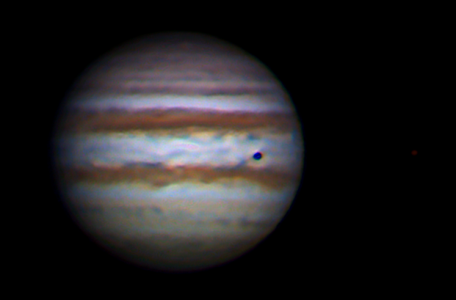
Bright Venus hangs low in the western sky at nightfall. A backyard telescope reveals the sunlight reflecting off the clouds of Venus’s thick atmosphere. Jupiter, largest of the planets, shines in the southwest. On the 15th, Jupiter, Venus, and the crescent moon form a beautiful arc in the sky. A small telescope reveals Jupiter’s major cloud bands.
In the southeast, Mars and Saturn shine on either side of Sagittarius. Telescope views show two very different planets -- One a gas giant with rings… The other is a much smaller terrestrial, or Earth-like, world.
Stargazing on a hot August night reveals a multitude of wonders. Lyra, the Small Harp, lies high in the late evening sky. Its main star is the great Vega, one of the brightest in the sky. Look for Lyra by locating Vega and then the parallelogram of stars nearby. Epsilon Lyrae, the bright star near Vega, is actually a wonderful quadruple star system, known as the Double-Double. In the parallelogram of Lyra lies the dramatic Ring Nebula. It is an expanding shell of glowing gas expelled by the dying star at its center.
The great constellation Cygnus, the Swan, flies high through the August night. Using bright Vega as your guide star, look for the cross just to the east. Cygnus is also known as the Northern Cross. Albireo, at the head of the Swan, is a showpiece for small telescopes. This spectacular pair of stars features contrasting colors of sapphire and golden topaz. Deneb, the Swan’s tail, is a supergiant star. If Deneb replaced the Sun in the center of our solar system, it would engulf Mercury and Venus.
On a clear night, hazy patches of nebulae can be seen by casually panning across the Cygnus area with binoculars. The most prominent is the North America Nebula, an area of gas and dust illuminated by the nearby, brilliant star Deneb.
Cygnus also hosts several clusters of stars. The easiest to find are M29 and M39. M29 is found near the center of the Northern Cross. When viewed in a small telescope, it resembles a small square. Best seen in binoculars, M39 is a loosely bound cluster of about 30 stars, just to the north of Deneb.
Just south of Cygnus lies the small constellation Vulpecula, the Little Fox, first charted by Polish
astronomer Johannes Hevelius in the 17th century. Vulpecula hosts the Dumbbell Nebula, which can be seen as a faint smudge in binoculars. A small telescope reveals its double-lobed shape.
Aquila, the Eagle, was known to the ancient Greeks as the great bird of Zeus. Altair, the brightest star in Aquila, is only 16 light-years from Earth. The bright stars of the summer night sky, Vega, Altair, and Deneb, make up the Summer Triangle. Use binoculars to look for the Coathanger, located halfway between Altair and Albireo. This remarkable little group of stars forms a familiar pattern from our point of view.
Comet Giacobini-Zinner may become visible this month as it approaches the Sun in its 6 and a half year orbit. Its path will take it past Cassiopeia and Perseus during August, and then past Auriga in early September. Use binoculars to look for its fuzzy glowing head and short, dim tail.
On August 11, skywatchers in remote northern Canada and Russia will be able to witness a partial solar eclipse as the Moon passes between the Earth and the Sun. Shortly after, the Perseid meteor shower -- an always anticipated feature of the August night sky – will peak. Look for meteors during the early morning hours of August 12 and 13. With the Moon out of the way, the sky will be dark, and several dozen meteors per hour may be seen under good conditions.
The night sky is always a celestial showcase. Explore its wonders from your own backyard.
The following Deep Sky Objects are found in constellations that peak during the month. Some can be viewed with a small telescope, but the majority will require a moderate to large telescope. The following is adapted from my personal viewing list: "The Guy Pirro 777 Best and Brightest Deep Sky Objects."
Constellation: Aquila
NGC 6709 Open Cluster P1
NGC 6724 Open Cluster P205
NGC 6735 Open Cluster P206
NGC 6738 Open Cluster P18
NGC 6741 Planetary Nebula P207 Phantom Streak Nebula
NGC 6755 Open Cluster Herschel 400 H19-7
NGC 6756 Open Cluster Herschel 400 H62-7
NGC 6760 Globular Cluster P19
NGC 6781 Planetary Nebula Herschel 400 H743-3
NGC 6790 Planetary Nebula P208
NGC 6803 Planetary Nebula P209
NGC 6840 Open Cluster P124
NGC 6843 Open Cluster P125
Constellation: Capricornus
NGC 7099 Globular Cluster M30
Constellation: Cygnus
IC 1318 Diffuse Nebula P24 Gamma Cygni Nebula
IC 1369 Open Cluster P11
IC 4996 Open Cluster P16
IC 5067 Diffuse Nebula P79 Pelican Nebula
- IC 5070 Diffuse Nebula - Part of P79
IC 5117 Planetary Nebula P223
IC 5146 Open Cluster C19 Cocoon Nebular Cluster
NGC 6811 Open Cluster P10 Hole Cluster
NGC 6819 Open Cluster P12
NGC 6826 Planetary Nebula C15, Herschel 400 H73-4 Blinking Planetary Nebula
NGC 6834 Open Cluster Herschel 400 H16-8
NGC 6866 Open Cluster Herschel 400 H59-7
NGC 6871 Open Cluster P9
NGC 6874 Open Cluster P142
NGC 6883 Open Cluster P17
NGC 6888 Diffuse Nebula C27 Crescent Nebula
NGC 6910 Open Cluster Herschel 400 H56-8
NGC 6913 Open Cluster M29
NGC 6914 Diffuse Nebula P143
NGC 6960 Diffuse Nebula C34 Veil Nebula (West)
NGC 6989 Open Cluster P144
NGC 6992 Diffuse Nebula C33 Veil Nebula (East)
- NGC 6995 Diffuse Nebula - Part of C33
NGC 6996 Open Cluster P224
NGC 6997 Open Cluster P145
NGC 7000 Diffuse Nebula C20, Herschel 400 H37-5 North America Nebula
NGC 7008 Planetary Nebula Herschel 400 H192-1
NGC 7024 Open Cluster P146
NGC 7026 Planetary Nebula P147
NGC 7027 Planetary Nebula P25
NGC 7031 Open Cluster P148
NGC 7037 Open Cluster P225
NGC 7039 Open Cluster P13
NGC 7044 Open Cluster Herschel 400 H24-6
NGC 7048 Planetary Nebula P226
NGC 7062 Open Cluster Herschel 400 H51-7
NGC 7063 Open Cluster P14
NGC 7067 Open Cluster P149
NGC 7071 Open Cluster P227
NGC 7082 Open Cluster P15
NGC 7086 Open Cluster Herschel 400 H32-6
NGC 7092 Open Cluster M39
NGC 7127 Open Cluster P150
NGC 7128 Open Cluster Herschel 400 H40-7
NGC 7175 Open Cluster P151
Constellation: Delphinus
NGC 6891 Planetary Nebula P152
NGC 6905 Planetary Nebula Herschel 400 H16-4 Blue Flash Nebula
NGC 6934 Globular Cluster C47, Herschel 400 H103-1
NGC 7006 Globular Cluster C42, Herschel 400 H52-1
Constellation: Lyra
NGC 6720 Planetary Nebula M57 Ring Nebula
NGC 6779 Globular Cluster M56
NGC 6791 Open Cluster P162
Constellation: Sagitta
IC 4997 Planetary Nebula P246
NGC 6838 Globular Cluster M71
NGC 6879 Planetary Nebula P181
NGC 6886 Planetary Nebula P247
Constellation: Vulpecula
NGC 6802 Open Cluster Herschel 400 H14-6 Coat Hanger Cluster
NGC 6823 Open Cluster Herschel 400 H18-7
NGC 6830 Open Cluster Herschel 400 H9-7
NGC 6853 Planetary Nebula M27 Dumbell Nebula
NGC 6882 Open Cluster Herschel 400 H22-8
NGC 6885 Open Cluster C37, Herschel 400 H20-8
NGC 6940 Open Cluster Herschel 400 H8-7
For more information:
Northern Latitudes:
http://hubblesite.org/videos/tonights_sky
https://nightsky.jpl.nasa.gov/planner.cfm
https://www.youtube.com/playlist?list=PLTiv_XWHnOZrT_ppDGiT__fI3yjD4t7dI
https://www.cfa.harvard.edu/skyreport
https://www.cfa.harvard.edu/skyreport/whats-new
http://outreach.as.utexas.edu/public/skywatch.html
http://griffithobservatory.org/sky/skyreport.html
http://www.beckstromobservatory.com/whats-up-in-tonights-sky-2/
http://www.jb.man.ac.uk/astronomy/nightsky/
http://blogs.cardiff.ac.uk/physicsoutreach/engagement/the-sky-tonight/
http://www.schoolsobservatory.org.uk/learn/astro/nightsky/maps
Equatorial Latitudes:
http://www.caribbeanastronomy.com/index.php?option=com_content&task=blogcategory&id=30&Itemid=51
Southern Latitudes:
https://www.stardome.org.nz/astronomy/star-charts/
Astromart News Archives:
https://www.astromart.com/news/search?category_id=3&q=.
Do you enjoy reading these News Items?
Then click here and buy the Astromart staff a cup of coffee (and maybe even some donuts):
https://www.astromart.com/support-options
Funding Member