Kiss the Sky Tonight -- Month of November 2018
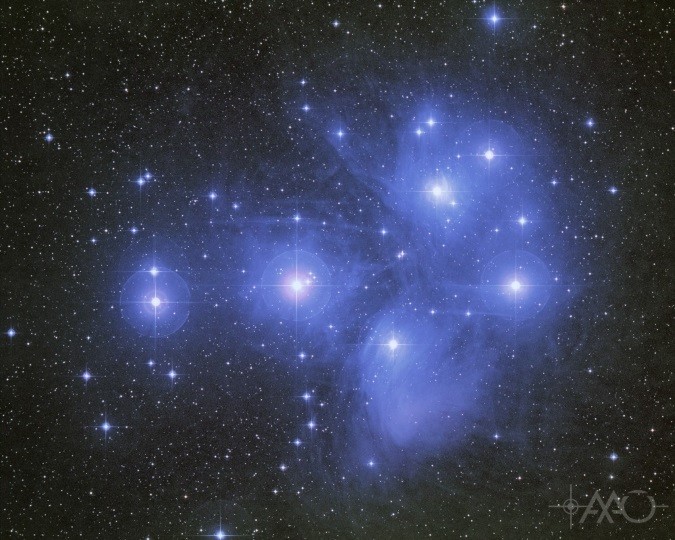
Perhaps the most famous star cluster in the night sky, the Pleiades can be seen without binoculars from even the depths of a light-polluted city. Also known as the Seven Sisters and Messier 45, the Pleiades is one of the finest examples of a reflection nebula associated with a cluster of young stars. The cluster is a group of many hundreds of stars about 400 light years away in the direction of the constellation Taurus. The actual number of Pleiades stars visible may be more or less than seven, depending on the darkness of the surrounding sky and, of course, the observer's eyesight. The nebulosity seen here is light reflected from the particles in the cloud of cold gas and dust into which the cluster has drifted. In western literature and legend, the stars bear the names of the Seven Sisters, the daughters of Atlas and Pleone. They were also half-sisters to the goddesses of the nearby Hyades (Caldwell 41). The delicate beauty of the stars has them identified as a group of women in many cultures, from Australian Aborigine to Native American. To the Japanese they are known as “Subaru,” a conglomerate or collection of stars. Some Chinese legends refer to the Pleiades as a swarm of bees. Maori and some Pacific Islands people call the Pleiades “Matariki,” the star cluster that heralds the start of the Maori New Year. (Credits: NASA and the Office of Public Outreach – STScI, NASA Jet Propulsion Laboratory - JPL) (Image Credit: Australian Astronomical Observatory - AAO, David Malin)
Kiss the Sky Tonight -- Month of November 2018
Welcome to the night sky report for November 2018 -- Your guide to the constellations, deep sky objects, planets, and celestial events that are observable during the month. Some fish (Pisces), a ram (Aries), and a triangle (Triangulum) are all found in the November night sky. Also be sure to catch the Taurid meteor shower, which features 5 to 10 meteors per hour on its peak night of November 5 to 6. In addition, meteors will be radiating from the constellation Leo on the evening of November 17th and the early morning of November 18th. The night sky is truly a celestial showcase. Get outside and explore its wonders from your own backyard.
Saturn shines clear above the southwest horizon at nightfall. Watch as it shifts lower in the sky each night, preparing to depart the evening sky. Small telescopes show off its rings.
Red Mars retains its position in the south as it moves into Aquarius, recedes, and dims. Backyard telescopes still show a tiny disk, but surface features may be difficult to resolve.
Venus pops back into the predawn sky in November, spending the month in the vicinity of the bright star Spica in Virgo, especially around mid-month. Modest telescopes will reveal its crescent moon-like phase.
As for constellations, some fish, a ram, and a triangle can all be found in the November night sky.
Pisces, in ancient mythology, are twin fish tied together. They represent two Greek gods fleeing fire. Look for the circlets of stars high in the southern sky.
Just to the east of Pisces lies Aries, the golden ram of the Greek gods. It is a dim constellation. Pisces and Aries are in the zodiac, the band of sky through which the Sun appears to travel.
Triangulum, a simple geometric constellation, has been identified since ancient times. Look for it next to the Ram and the Fish. The lovely Triangulum Galaxy resides here. It belongs to the same cluster of galaxies that includes our own Milky Way. Also known as M33, the galaxy is about 3 million light-years distant. It can be seen in a dark sky with binoculars.
November boasts two meteor showers. The Taurid meteor shower, spread over weeks, features 5 to 10 meteors per hour on its peak night of November 5 to 6. The meteors will streak across the sky from the direction of Taurus the bull, in the eastern sky at nightfall.
While the shower is fairly minor, it is known for bright fireballs, and the sky will be dark with the Moon out of the way.
The Leonid meteor shower is the result of Earth’s annual passage through the dust trails left by Comet Tempel-Tuttle, which returns to the inner solar system every 33 years. Look for meteors radiating from the constellation of Leo the lion in the evening of November 17 and early morning of November 18.
The night sky is always a celestial showcase. Explore its wonders from your own backyard.
The following Deep Sky Objects are found in constellations that peak during the month. Some can be viewed with a small telescope, but the majority will require a moderate to large telescope. The following is adapted from my personal viewing list: "The Guy Pirro 777 Best and Brightest Deep Sky Objects."
Constellation: Aries
NGC 772 Galaxy Herschel 400 H112-1
- NGC 770 Galaxy - Paired with H112-1
NGC 821 Galaxy P234
Constellation: Cetus
IC 1613 Galaxy C51
NGC 157 Galaxy Herschel 400 H3-2
NGC 246 Planetary Nebula C56, Herschel 400 H25-5
NGC 247 Galaxy C62, Herschel 400 H20-5
NGC 584 Galaxy Herschel 400 H100-1
NGC 596 Galaxy Herschel 400 H4-2
NGC 615 Galaxy Herschel 400 H282-8
NGC 720 Galaxy Herschel 400 H105-1
NGC 779 Galaxy Herschel 400 H101-1
NGC 908 Galaxy Herschel 400 H153-1
NGC 936 Galaxy Herschel 400 H23-4
- NGC 941 Galaxy - Paired with H23-4
NGC 1022 Galaxy Herschel 400 H102-1
NGC 1042 Galaxy P221
NGC 1052 Galaxy Herschel 400 H63-1
NGC 1055 Galaxy Herschel 400 H1-1
NGC 1068 Galaxy M77 Cetus A Seyfert Galaxy
Constellation: Fornax
NGC 1097 Galaxy C67
NGC 1201 Galaxy P153
NGC 1316 Galaxy P30 Fornax A Galaxy
NGC 1326 Galaxy P154
NGC 1340 Galaxy P83
NGC 1350 Galaxy P155
NGC 1360 Planetary Nebula P84
NGC 1365 Galaxy P51
NGC 1380 Galaxy P85
NGC 1399 Galaxy P32
NGC 1398 Galaxy P33
NGC 1404 Galaxy P86
Constellation: Leo
NGC 2903 Galaxy Herschel 400 H56-1
NGC 2964 Galaxy Herschel 400 H114-1
- NGC 2968 Galaxy - Paired with H114-1
NGC 3190 Galaxy Herschel 400 H44-2
- NGC 3187 Galaxy - Paired with H44-2
NGC 3193 Galaxy Herschel 400 H45-2
NGC 3226 Galaxy Herschel 400 H28-2 Paired with H29-2
NGC 3227 Galaxy Herschel 400 H29-2 Leo Seyfert Galaxy Paired with H28-2
NGC 3351 Galaxy M95
NGC 3368 Galaxy M96
NGC 3377 Galaxy Herschel 400 H99-2
NGC 3379 Galaxy M105, Herschel 400 H17-1
NGC 3384 Galaxy Herschel 400 H18-1
NGC 3412 Galaxy Herschel 400 H27-1
NGC 3489 Galaxy Herschel 400 H101-2
NGC 3521 Galaxy Herschel 400 H13-1
NGC 3593 Galaxy Herschel 400 H29-1
NGC 3607 Galaxy Herschel 400 H50-2 Paired with H51-2
NGC 3608 Galaxy Herschel 400 H51-2 Paired with H50-2
NGC 3623 Galaxy M65
NGC 3626 Galaxy C40, Herschel 400 H52-2
NGC 3627 Galaxy M66
NGC 3628 Galaxy Herschel 400 H8-5
NGC 3640 Galaxy Herschel 400 H33-2
- NGC 3641 Galaxy - Paired with H33-2
NGC 3655 Galaxy Herschel 400 H5-1
NGC 3686 Galaxy Herschel 400 H160-2
NGC 3810 Galaxy Herschel 400 H21-1
NGC 3900 Galaxy Herschel 400 H82-1
NGC 3912 Galaxy Herschel 400 H342-2
Constellation: Perseus
IC 348 Open Cluster P95
IC 2003 Planetary Nebula P237
NGC 650 Planetary Nebula M76 Little Dumbell Nebula
NGC 651 Planetary Nebula Herschel 400 H193-1 Part of M76
NGC 744 Open Cluster P96
NGC 869 Open Cluster C14a, Herschel 400 H33-6 Double Cluster (West)
NGC 884 Open Cluster C14b, Herschel 400 H34-6 Double Cluster (East)
NGC 957 Open Cluster P97
NGC 1023 Galaxy Herschel 400 H156-1
NGC 1039 Open Cluster M34 Spiral Cluster
NGC 1220 Open Cluster P238
NGC 1245 Open Cluster Herschel 400 H25-6
NGC 1275 Galaxy C24 Perseus A Seyfert Galaxy
NGC 1342 Open Cluster Herschel 400 H88-8
NGC 1444 Open Cluster Herschel 400 H80-8
NGC 1496 Open Cluster P174
NGC 1499 Diffuse Nebula P44 - California Nebula
NGC 1513 Open Cluster Herschel 400 H60-7
NGC 1528 Open Cluster Herschel 400 H61-7
NGC 1545 Open Cluster Herschel 400 H85-8
NGC 1582 Open Cluster P45
NGC 1605 Open Cluster P239
NGC 1624 Open Cluster P240
Constellation: Pisces
NGC 488 Galaxy Herschel 400 H252-3
NGC 524 Galaxy Herschel 400 H151-1
NGC 628 Galaxy M74
NGC 676 Galaxy P175
Constellation: Taurus
Messier 45 Open Cluster M45 Pleiades
Caldwell 41 Open Cluster C41 Hyades
IC 1995 Diffuse Nebula P64
NGC 1514 Planetary Nebula P120
NGC 1554 Diffuse Nebula P200 Von Struve’s Lost Nebula
NGC 1555 Diffuse Nebula P201 Hind’s Variable Nebula
NGC 1647 Open Cluster Herschel 400 H8-8
NGC 1750 Open Cluster Herschel 400 H43-8
NGC 1807 Open Cluster P65
NGC 1817 Open Cluster Herschel 400 H4-7
NGC 1952 Diffuse Nebula M1 Crab Nebula
Constellation: Triangulum
NGC 598 Galaxy M33 Herschel 400 H17-5 Triangulum Galaxy
NGC 925 Galaxy P66
For more information:
Northern Latitudes:
http://hubblesite.org/videos/tonights_sky
https://nightsky.jpl.nasa.gov/planner.cfm
https://www.youtube.com/playlist?list=PLTiv_XWHnOZrT_ppDGiT__fI3yjD4t7dI
https://www.cfa.harvard.edu/skyreport
https://www.cfa.harvard.edu/skyreport/whats-new
http://outreach.as.utexas.edu/public/skywatch.html
http://griffithobservatory.org/sky/skyreport.html
http://www.beckstromobservatory.com/whats-up-in-tonights-sky-2/
http://www.jb.man.ac.uk/astronomy/nightsky/
http://blogs.cardiff.ac.uk/physicsoutreach/engagement/the-sky-tonight/
http://www.schoolsobservatory.org.uk/learn/astro/nightsky/maps
https://www.astromart.com/news/search?category_id=3&q=kiss+the+sky&from=&to
Equatorial Latitudes:
http://www.caribbeanastronomy.com/index.php?option=com_content&task=blogcategory&id=30&Itemid=51
Southern Latitudes:
https://www.stardome.org.nz/astronomy/star-charts/
Astromart News Archives:
https://www.astromart.com/news/search?category_id=3&q=.
Do you enjoy reading these News Items?
Then click here and buy the Astromart staff a cup of coffee (and maybe even some donuts):
https://www.astromart.com/support-options