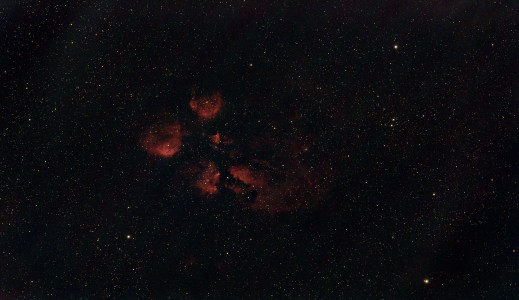
Kiss the Sky Tonight -- Month of September 2018
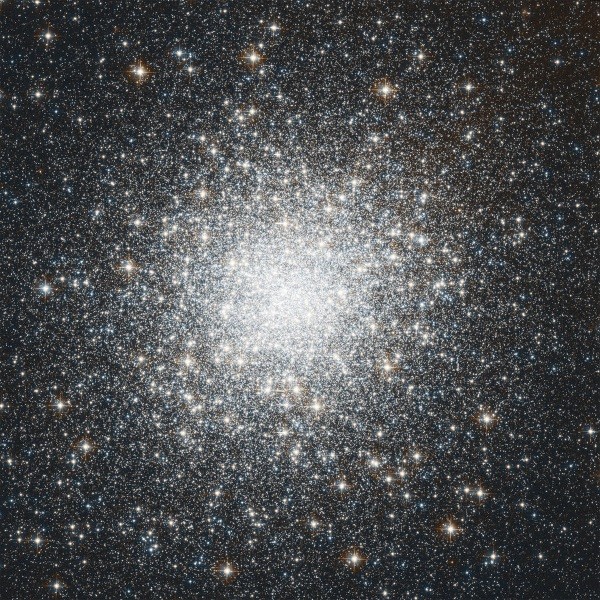
NGC 7089, or M2, was the first globular cluster to be included in the Messier catalog. It is located roughly 37,000 light-years from Earth in the constellation Aquarius. A globular cluster is a spherical group of stars that are bound together by their mutual gravitational attraction. M2 has a diameter of over 150 light-years and is one of the largest clusters of its kind. M2 orbits our Milky Way Galaxy like nearly 200 other globular clusters left over from the early days of our universe. The globular cluster was discovered in 1746 by the French astronomer Jean Dominique Maraldi while he was observing a comet. This Hubble image of M2’s core was created using observations taken at visible and infrared wavelengths. M2 contains over 150,000 stars and most of the cluster’s mass is concentrated at its center, with shimmering streams of stars extending outward into space. It has an apparent magnitude of 6.3 and can be seen with the naked eye in ideal viewing conditions. Large telescopes will resolve the cluster’s individual stars. (Credits: NASA and the Office of Public Outreach – STScI, NASA Jet Propulsion Laboratory - JPL) (Image Credit: NASA, ESA, STScI, A. Sarajedini - University of Florida)
Kiss the Sky Tonight -- Month of September 2018
Welcome to the night sky report for September 2018 -- Your guide to the constellations, deep sky objects, planets, and celestial events that are observable during the month. Spot Venus, Jupiter, Saturn, and Mars with the naked eye. This month your binoculars will reveal the rusty surface of Mars, iconic rings of Saturn, the waxing Moon, and the comet Giacobini-Zinner, which passes through the constellation of Auriga. Then, set your sights beyond the solar system and take a late summertime road trip of the constellations along the Milky Way. The night sky is truly a celestial showcase. Get outside and explore its wonders from your own backyard.
Venus, blazing in the western sky around sunset for much of the year, bows out by months’ end. Jupiter, not far from Venus in the southwestern sky, moves lower as the month progresses. A small telescope reveals large-scale atmospheric features of Jupiter and the sunlit clouds of Venus.
Saturn and Mars shine in the southern sky against the stars of Sagittarius. The waxing moon passes each in turn on the 17th and 19th of the month. The rusty surface of Mars and iconic rings of Saturn are easily visible, even in small telescopes.
September nights feature the “wet quarter” of the sky -- Two neighboring constellations bear ancient reference to water. Aquarius is one of the oldest constellations, recognized even by early civilizations. In ancient mythologies, Aquarius was the god of the waters. Look for the Water Jar, a group of stars shaped like a Y.
A rich, compact cluster of stars can be seen in Aquarius. Known as M2, it contains about 150,000 stars located about 37,500 light-years away. Binoculars present it well, but a small telescope reveals much more detail in the cluster’s compact center.
Nearby is the great constellation Capricornus. Known in mythology as the Water Goat, it represents a creature that fed and watered the infant Zeus, ruler of the Greek gods. Algedi is the brightest star in Capricornus. It’s visible in binoculars as an elongated star. This odd shape is due to a visual trick. From our distant vantage point, two unrelated stars appear to be close together. Capricornus also hosts a dense cluster of stars, M30. A small telescope easily resolves individual stars in the cluster.
Comet Giacobini-Zinner, which became visible last month, should reach its brightest in September as it passes through the constellation of Auriga and between Gemini and Orion. It may be barely visible to the naked eye, but possible to see with binoculars. Look for the comet in the east after midnight.
The night sky is always a celestial showcase. Explore its wonders from your own backyard.
The following Deep Sky Objects are found in constellations that peak during the month. Some can be viewed with a small telescope, but the majority will require a moderate to large telescope. The following is adapted from my personal viewing list: "The Guy Pirro 777 Best and Brightest Deep Sky Objects."
Constellation: Aquarius
NGC 6981 Globular Cluster M72
NGC 6994 Open Cluster M73
NGC 7009 Planetary Nebula C55, Herschel 400 H1-4 Saturn Nebula
NGC 7089 Globular Cluster M2
NGC 7293 Planetary Nebula C63 Helix Nebula
NGC 7606 Galaxy Herschel 400 H104-1
NGC 7723 Galaxy Herschel 400 H110-1
NGC 7727 Galaxy Herschel 400 H111-1
- NGC 7724 Galaxy - Paired with H111-1
Constellation: Capricornus
NGC 7099 Globular Cluster M30
Constellation: Cepheus
Caldwell 9 Diffuse Nebula C9 Cave Nebula
IC 1396 Open Cluster P6 Elephant Trunk Cluster
NGC 40 Planetary Nebula C2 Herschel 400 H58-4 Bow Tie Nebula
NGC 188 Open Cluster C1
NGC 2300 Galaxy P220
- NGC 2276 Galaxy - Paired with P220
NGC 6939 Open Cluster Herschel 400 H42-6
NGC 6946 Galaxy C12, Herschel 400 H76-4
NGC 7023 Open Cluster C4 Iris Nebular Cluster
NGC 7142 Open Cluster Herschel 400 H66-7
NGC 7160 Open Cluster Herschel 400 H67-8
NGC 7226 Open Cluster P140
NGC 7235 Open Cluster P7
NGC 7261 Open Cluster P8
NGC 7380 Open Cluster Herschel 400 H77-8
NGC 7510 Open Cluster Herschel 400 H44-7
NGC 7762 Open Cluster P141
Constellation: Lacerta
IC 1434 Open Cluster P159
IC 1442 Open Cluster P160
IC 5217 Planetary Nebula P230
NGC 7209 Open Cluster Herschel 400 H53-7
NGC 7243 Open Cluster C16, Herschel 400 H75-8
NGC 7245 Open Cluster P161
NGC 7296 Open Cluster Herschel 400 H41-7
Constellation: Pegasus
NGC 7078 Globular Cluster M15
NGC 7217 Galaxy Herschel 400 H207-2
NGC 7331 Galaxy C30, Herschel 400 H53-1
NGC 7448 Galaxy Herschel 400 H251-2
NGC 7457 Galaxy P173
NGC 7479 Galaxy C44, Herschel 400 H55-1
NGC 7814 Galaxy C43
Constellation: Sagittarius
IC 4684 Diffuse Nebula P182
IC 4725 Open Cluster M25
IC 4776 Planetary Nebula P183
NGC 6440 Globular Cluster Herschel 400 H150-1
NGC 6445 Planetary Nebula Herschel 400 H586-2 Little Gem Nebula
NGC 6469 Open Cluster P184
NGC 6494 Open Cluster M23
NGC 6507 Open Cluster P185
NGC 6514 Diffuse Nebula M20, Herschel 400 H41-1 Trifid Nebula
NGC 6520 Open Cluster Herschel 400 H7-7
NGC 6522 Globular Cluster Herschel 400 H49-1
NGC 6523 Diffuse Nebula M8 Lagoon Nebula
NGC 6528 Globular Cluster Herschel 400 H200-2
NGC 6530 Open Cluster P49
NGC 6531 Open Cluster M21
NGC 6540 Globular Cluster Herschel 400 H198-2
NGC 6544 Globular Cluster Herschel 400 H197-2
NGC 6546 Open Cluster P106
NGC 6553 Globular Cluster Herschel 400 H12-4
NGC 6558 Globular Cluster P107
NGC 6561 Open Cluster P186
NGC 6563 Planetary Nebula P187
NGC 6565 Planetary Nebula P248
NGC 6567 Planetary Nebula P188
NGC 6568 Open Cluster Herschel 400 H30-7
NGC 6569 Globular Cluster Herschel 400 H201-2
NGC 6583 Open Cluster Herschel 400 H31-7
NGC 6590 Open Cluster P50
NGC 6603 Open Cluster M24 Small Sagittarius Star Cloud
NGC 6613 Open Cluster M18
NGC 6618 Open Cluster M17 Omega Nebula
NGC 6624 Globular Cluster Herschel 400 H50-1
NGC 6626 Globular Cluster M28
NGC 6629 Planetary Nebula Herschel 400 H204-2
NGC 6637 Globular Cluster M69
NGC 6638 Globular Cluster Herschel 400 H51-1
NGC 6642 Globular Cluster Herschel 400 H205-2
NGC 6645 Open Cluster Herschel 400 H23-6
NGC 6647 Open Cluster P108
NGC 6652 Globular Cluster P31
NGC 6656 Globular Cluster M22
NGC 6681 Globular Cluster M70
NGC 6715 Globular Cluster M54
NGC 6716 Open Cluster P109
NGC 6717 Globular Cluster P110
NGC 6723 Globular Cluster P52
NGC 6809 Globular Cluster M55
NGC 6818 Planetary Nebula Herschel 400 H51-4
NGC 6822 Galaxy C57 Barnard’s Galaxy
NGC 6864 Globular Cluster M75
For more information:
Northern Latitudes:
http://hubblesite.org/videos/tonights_sky
https://nightsky.jpl.nasa.gov/planner.cfm
https://www.youtube.com/playlist?list=PLTiv_XWHnOZrT_ppDGiT__fI3yjD4t7dI
https://www.cfa.harvard.edu/skyreport
https://www.cfa.harvard.edu/skyreport/whats-new
http://outreach.as.utexas.edu/public/skywatch.html
http://griffithobservatory.org/sky/skyreport.html
http://www.beckstromobservatory.com/whats-up-in-tonights-sky-2/
http://www.jb.man.ac.uk/astronomy/nightsky/
http://blogs.cardiff.ac.uk/physicsoutreach/engagement/the-sky-tonight/
http://www.schoolsobservatory.org.uk/learn/astro/nightsky/maps
https://www.astromart.com/news/search?category_id=3&q=kiss+the+sky&from=&to
Equatorial Latitudes:
http://www.caribbeanastronomy.com/index.php?option=com_content&task=blogcategory&id=30&Itemid=51
Southern Latitudes:
https://www.stardome.org.nz/astronomy/star-charts/
Astromart News Archives:
https://www.astromart.com/news/search?category_id=3&q=.
Do you enjoy reading these News Items?
Then click here and buy the Astromart staff a cup of coffee (and maybe even some donuts):
https://www.astromart.com/support-options