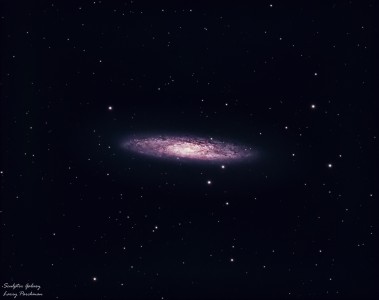
Large Ground-Based Telescopes May Become Worthless in 40 Years
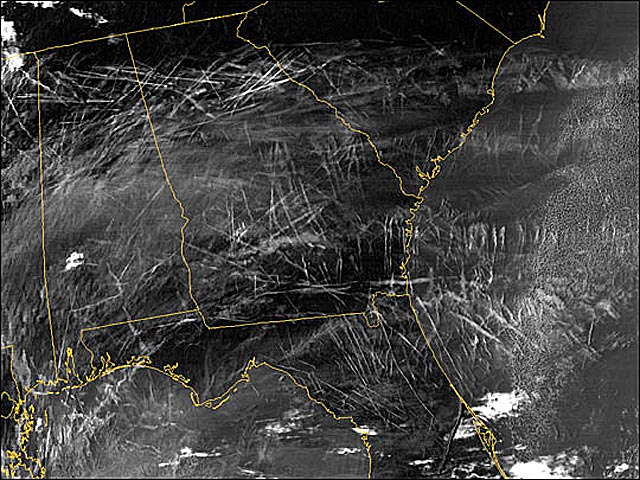
When hot and humid aircraft exhaust mixes with very cold ambient air, water condenses on tiny exhaust particles, immediately freezes, and a condensation trail is visible behind the aircraft. In dry air it disappears after a few seconds. But if the air is moist enough it grows and spreads out mainly due to aircraft turbulence. After a while, contrails become indistinguishable from natural cirrus clouds. The wings of a plane can similarly create contrails by dropping the temperature and causing small ice-crystals to form. These thin clouds allow the sun's radiance to reach the earth virtually unhindered, but do effectively reduce the heat flow from the earth into space.
Global warming and artificial clouds created by jet contrails may increase so dramatically in the next decades that they may change the Earth's climate and seriously hinder our ability to study the skies from large ground-based telescopes.
The effect on climate is a topic of much research. "It is already clear that the lifetime of large ground-based telescopes is finite and is set by global warming," according to Gerry Gilmore, an Astrophysicist at the University of Cambridge. "There are two factors. Climate change is increasing the amount of cloud cover globally. The second factor is cheap air travel.”
"You get these contrails from the jets. The rate at which they're expanding in terms of their fractional cover of the stratosphere is so large that if predictions are right, in 40 years it won't be worth having telescopes on Earth anymore - it's that soon.”
According to Gilmore "You either give up your cheap trips to Majorca, or you give up astronomy. You can't do both."
Holger Pedersen, an astronomer at the Nils Bohr Institute in the University of Copenhagen, added "You can recognize the jet contrails when they are young. So you can stop your observation and then restart as soon as the contrail has passed the field of view of the telescope.”
"Worse is when the contrails last for hours. Then they degrade into something you can hardly distinguish from natural cirrus clouds."
Finding a location for future ground-based optical telescopes is becoming a problem, according to Gilmore. "There are places where you get relatively fewer clouds - that's where we put our telescopes - but there is nowhere on Earth that you don't get clouds and airplanes.”
"We know from satellite imagery that clusters of contrails can last for two days. If carried by the upper jet stream through the troposphere, they can travel hundreds of kilometers. We may underestimate the amount of contrail-derived cirrus clouds," Pedersen said.
In the future, all large optical and infrared observatories may need to be space-based. However, ground-based radio astronomy should be able to continue unimpaired.
For More Information:
http://news.bbc.co.uk/1/hi/sci/tech/4755996.stm
http://antwrp.gsfc.nasa.gov/apod/ap041013.html
http://cimss.ssec.wisc.edu/wxwise/contrail.html
http://terra.nasa.gov/
Funding Member
