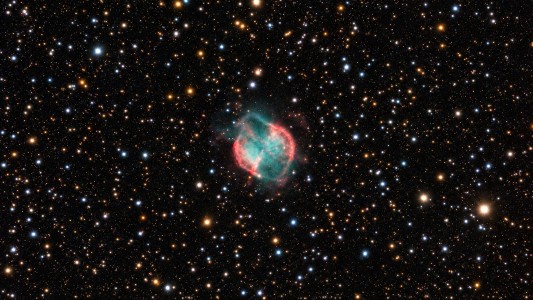
Largest Digital Survey of the Milky Way Released
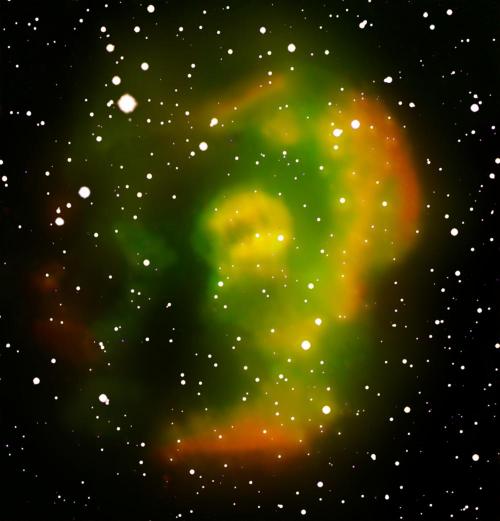
The IPHAS (INT Photometric H-alpha Survey)Consortium, led by the UK with partners in Europe, USA, and Australia have been working for the past five years to produce the first comprehensive optical digital survey of the Northern Galactic Plane of our Milky Way Galaxy.
Conducted by looking at light emitted by hydrogen ions, using the Isaac Newton Telescope (INT) in La Palma on the Canary Islands, the survey contains stunning images of nebulae and stars.
To date, the IPHAS survey includes some 200 million unique objects in the newly released catalogue. This immense resource will foster studies of the stellar demographics of the Milky Way and its three-dimensional structure.
Mr Nick Wright, of University College London, has dedicated his PhD studies to the survey. He said: “The current survey covers around 90 per cent of the Milky Way’s northern hemisphere and we’ve got an incredible amount of data, but we have many more years of work ahead of us to map the southern hemisphere. We’ve detected new stars and discovered amazing detail on many objects that we new existed.”
Dr Roger Wesson has been researching a newly identified nova inside a planetary nebula – the Nova Vul in the constellation of Vulpecula – a very rare star of its type and only the second ever discovered. “It’s very rare to catch dying stars at his stage. We had an image of it before it exploded, surrounded by a shell of gas, so the survey provides us with unprecedented picture of how stars evolve, and this is just one small aspect of the survey. This huge dataset of our galactic neighbourhood will also help us understand external galaxies.”
This initial data release is of observations of the Northern Plane of the Milky Way (the star filled section) that cover 1600 sq deg, in two broadband colours, and a narrow band filter sensitive to the emission of Hydrogen in the red part of the spectrum (H-alpha emission). The image resolution is high enough to permit the detection of individual stars exhibiting H-alpha emission, in addition to the diffuse gas that makes up the often-beautiful glowing nebulae that lower spatial resolution surveys have made known to us before.
The IPHAS database is already revealing a wealth of new science. For example, IPHAS team members from the University of Southampton, have led an effort to extract and catalogue the brighter H-alpha emission line stars revealed so far by the survey. This list of nearly 5000 objects is already the longest single list of its kind. The distribution of these special objects, across the northern sky, traces 'hot spots' of recently formed stars in our Galaxy much more convincingly than has been possible hitherto.
Professor Janet Drew of the University of Hertfordshire said “Using the distinctive Hydrogen marker we are able to look at some of the least understood stars in the Galaxy – those at the early and very late stages of their life cycles. These represent less than one in a thousand stars, so the IPHAS data will greatly improve our picture of stellar evolution.”
Professor Mike Barlow (UCL) added: “One of the most interesting things about the survey is how it will be shared among the astronomical community. As well as being published on the web, it is also utilising the AstroGrid Virtual Observatory interface, so it can be automatically cross-reference with other data and will allow astronomers to make greater use of the survey. It represents how astronomers will share information in the future.”
Dr Nic Walton of the University of Cambridge said “Using the standard Virtual Observatory interface is a very effective way of exploiting the IPHAS survey data. This is a substantial and significant survey, which aims to eventually contain 7-800 million objects. Access through the AstroGrid Virtual Observatory opens up a full range of analysis options and should allow astronomers to make greater use of the information. IPHAS is the largest dataset published primarily through Virtual Observatory interfaces to date, and as such heralds the future of survey data mining.”
The IPHAS survey will eventually be extended to cover the entire galactic plane of our galaxy, with a coverage approaching 4000 square degrees (for comparison, the moon on the sky as seen from Earth covers ~0.1 square degrees).
The Isaac Newton Group of Telescopes (ING) operates the 4.2m William Herschel Telescope (WHT), the 2.5m Isaac Newton Telescope (INT), which was used in this survey, and the 1.0m Jacobus Kapteyn Telescope (JKT) on behalf of the Science and Technology Facilities Council (STFC) of the United Kingdom, the Nederlandse Organisatie voor Wetenschappelijk Onderzoek (NWO) of the Netherlands, and the Instituto de Astrofísica de Canarias (IAC) in Spain. The ING is located at the Roque de Los Muchachos Observatory, La Palma, Canary Islands, Spain.
For more information:
http://www.ucl.ac.uk/news/news-articles/0712/07121201
http://www.scitech.ac.uk/PMC/PRel/STFC/redsky.aspx
http://astro.ic.ac.uk/Research/Halpha/North/gallery.shtml
http://www2.astrogrid.org/science/science-examples-stars/iphas-catalogue-images/iphas-idr-astrogrid
http://zuserver2.star.ucl.ac.uk/~nwright/imaging.html
http://www.ucl.ac.uk/star/research/stellarenvironment/cieresearch/iphas/index
Astromart News Archive:
http://www.astromart.com/news/search.asp?search=.+&search_btn=Go
