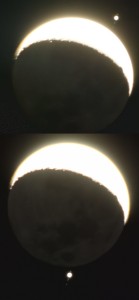
Lunar Impact of SMART-1 Orbiter Observed from Ground-Based Telescope
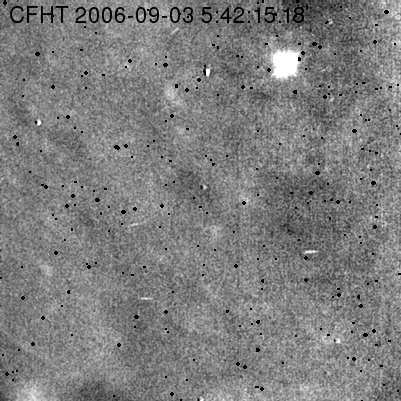
An impressive sequence of impact images of the European Space Agency (ESA) SMART-1 Lunar Orbiter was captured by the Canada-France-Hawaii Telescope, a 3.6-meter optical/infrared telescope located atop the summit of Mauna Kea, a 4200-meter volcano on Hawaii's Big Island.
The CFHT astronomers observing the projected impact area were rewarded with a beautiful image of a very short impact flash. While still to be confirmed, a preliminary assessment indicates the impact flash was possibly caused by thermal emission from the impact itself or by the release of spacecraft volatiles, such as the small amount of hydrazine fuel remaining on board.
"It was exciting to see the impact flash live from Hawaii, just after receiving the last radio signal from SMART-1," said Prof. Pascale Ehrenfreund, from Leiden University.
Many other observatories, including both professional and amateurs sky watchers, also participated in ground observation activities.
"We look forward to collecting worldwide reports from this impact. We call upon the community to search for the ejecta blankets and for future lunar orbiters to search for the SMART-1 crater," says Bernard H. Foing, ESA's SMART-1 Project Scientist.
SMART-1 was also observed by a network of five cooperating radio telescopes over several months leading up to Moon impact. The observatories' activities were coordinated by the Joint Institute for Very Long Baseline Interferometry (JIVE), hosted by ASTRON (the Netherlands Foundation for Research in Astronomy).
The participating observatories are capable of making highly sensitive observations, characterized by very accurate timing and the ability to detect very weak radio signals.
Starting in the spring of 2006, the cooperating telescopes observed radio signals emitted by SMART-1 and reflected from the Moon as part of a program to test and validate the very long baseline interferometry (VLBI) technique. VLBI allows ground-based telescopes to track spacecraft with very high accuracy.
In working with SMART-1, the radio telescopes applied the same techniques used by ground telescopes to track the descent of ESA's Huygens probe to the surface of Saturn's moon Titan in January 2005. This technique is also expected to be used in tracking China's Chang'e Moon missions, to be launched starting in 2007.
Right up to its final orbits, SMART-1 continued delivering valuable data, extending the mission's legacy as a technology and scientific success.
Originally designed to capture just four images per orbit, the probe exceeded all expectations and actually averaged 100 images per rotation, generating a final library of some 20,000 images.
Following the early decision to redesign the science orbit and lower the apolune (point of highest approach) from 10,000 to 3000 km over the lunar North pole, SMART-1 was able to adjust to the large number of imaging commands and complex operations that were introduced.
"This decision allowed SMART-1 to not only take sharp images of the South Pole as planned, but also to study the northern hemisphere from a much shorter range than initially foreseen," said Josset. "We now have an image library that will keep scientists and researchers busy for the next months and years," he added.
The volume of data generated during the mission is expected to keep scientists busy for some time. Among the remarkable results already determined was the first-ever remote detection of all the main elements which make up lunar minerals. This includes, for the first time, calcium.
Furthermore, scientists worldwide are analysing data gathered from the ground observation campaign (including the impact flash) to eventually obtain fresh information on impact physics, lunar surface science, and spacecraft behaviour during impact -- all expected to be useful for future lunar missions.
"By proving solar-propulsion and employing other technology including innovative ground control systems while gathering fantastic new data, SMART-1 has left a legacy of technology and scientific excellence," said Bernard Foing, ESA's SMART-1 Mission Scientist.
He added: "It will survive by continuing to contribute to our collective knowledge of Earth's nearest neighbour for many years, and it is only fitting that SMART-1 has found its final resting place on the Moon."
For More Information:
http://www.esa.int/esaCP/SEM2N58ZMRE_index_1.html#subhead6
http://www.esa.int/esaCP/SEMC378ZMRE_index_0.html
http://www.esa.int/esaCP/SEMV386LARE_index_0.html
Funding Member
