Mars Has Belts of Frozen Water Glaciers
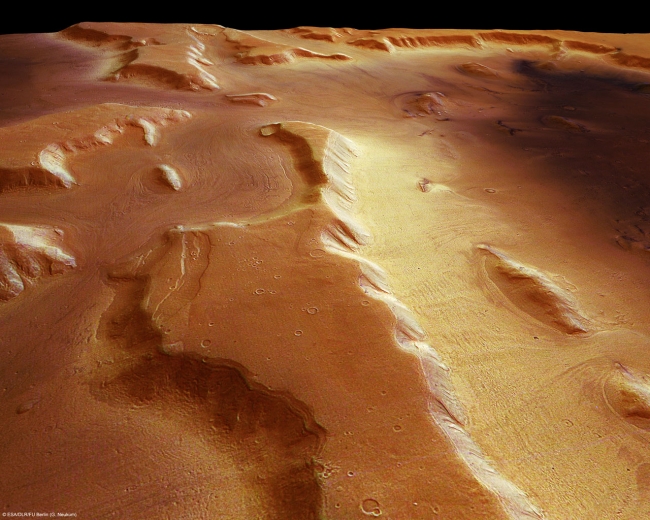
Mars has distinct polar ice caps, but Mars also has belts of glaciers at its central latitudes in both the southern and northern hemispheres. A thick layer of dust covers the glaciers, so they appear as surface of the ground. But radar measurements show that underneath the dust there are glaciers composed of frozen water. New studies have now calculated the size of the glaciers and thus the amount of water in the glaciers. It is the equivalent of all of Mars being covered by more than one meter of ice.
Comments:
If there actually is enough water-ice buried under layers of dust on Mars to cover the entire planet with a 1.1 meter layer of ice, doesn't this make the prospects for life on Mars much greater than for Europa - where miles of frozen ice lie above the (hypothetical) liquid water ?<br><br>If the answer is that tidal force heating on Europa creates the equivalent of Earth’s hydrothermal vent regions on Europa, well, then doesn't the possibility that there is a vast amount of water-ice on Mars make it easier (and less costly) for us to explore and determine if life exists below the surface of Mars rather than Europa ?<br><br>But perhaps more importantly, where might we find a more habitable location in our solar system with accessible water that can be used to sustain humans – Europa, or Mars?
For human habitation, Mars might be a better choice since it's a lot easier to reach (8X closer) than Jupiter and the radiation environment is more manageable. For current life (as we know it), I think liquid water is necessary but having significant amounts of ice on Mars indicates a higher probability of prior life.<br><br>For origin-of-life study, Europa sounds more interesting since any life there is likely to have originated independently while Mars and Earth are close enough to exchanged life-bearing material through meteor impacts.<br>
I realize we just don't want to give up the hope of finding some kind of life on Mars, but making the leap from water to life is a bit of a stretch, isn't it? I mean, you can place a glass of water on the counter and leave it there for a million years and living things aren't going to just magically appear in it. You could even add a few organic molecules to the mix, and still nothing is going to happen. Takes a bit more than just water to make life, not to mention that we really don't know what "life" is to begin with.
Funding Member
