Massive Black Hole at the Center of the Milky Way
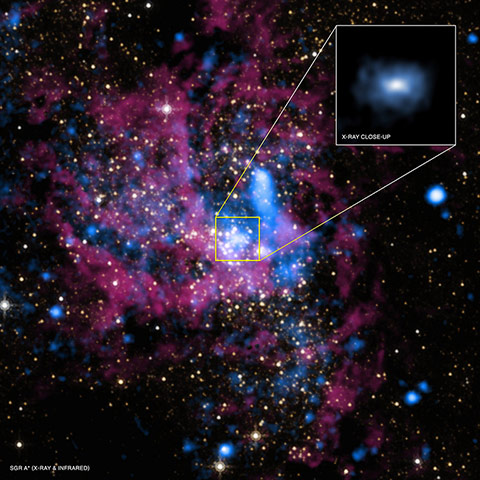
As it has become generally known, large galaxies like the Milky Way and M31, have massive (millions of solar masses) black holes at their centers. Viewing these objects directly is not possible because (1) they are black and (2)the obscuring effects of the dust and gas in the plane of the galaxy that lie between the Sun and the galactic center (in Sagittarius).
However, the gravitational effects of the black hole are detectable. No, not its exotic gravitational waves (we would possibly detect these if two black holes collided and merged). Rather, it affects the orbits of stars circling it in much the same way that Mercury's orbit is perturbed by being the nearest planet to the sun.
Mercury shows an overall precession of its perihelion (closest point in its orbit to the sun) by 574 arcseconds per century ("/century). First pointed out by French astronomer Urbain Jean Joseph LeVerrier in 1845, he used observations of Mercurian transits (across the sun's disk) and discovered irregularities in its orbital elements. He proposed the existence of an intra-Mercurian planet he named Vulcan to account for it but searches for Vulcan were never successful.
A detailed Newtonian treatment of the other planets on Mercury's inclined orbit predicted a precession of 531 "/century, leaving a small but significant difference of 43.11 "/century called the "anomalous advance". It remained unexplained until the development of general relativity in the early 20th century.
General relativity successfully predicted an amount of 42.94 "/century for Mercury' anomalous advance, very close to the observed value of 43.11 "/century. Both Mercury's large orbital eccentricity and small semi-major axis enhance this effect compared to the earth's anomalous advance which is much smaller, only 5.0 "/century.
The determination of the orbital parameters of a star, called S02, orbiting the massive black hole at the galactic center (denoted by its radio counterpart Sgr A*) shows a similar but much larger precession.
General relativity predicts a precession of 2820"/century for S02, nearly 66 times as great as the precession of perihelion of Mercury's orbit! Over the twenty year interval (1992 - 2012) that S02 has been observed the advance of the line of nodes is about 0.16 degrees. (The line of nodes is the intersection of the orbital plane of S02 with the plane of the sky.) This change is probably not yet detectable given that the angle of the line of nodes is uncertain by 5 degrees but future observations in the next few years may detect it.
