NASA Bids Farewell to the Rossi X-Ray Timing Explorer
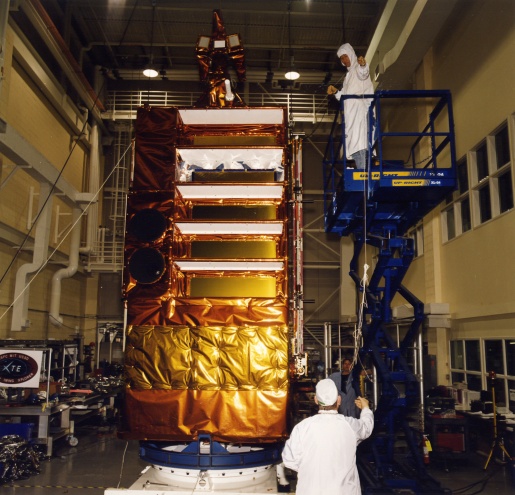
After 16 years in space, NASA's Rossi X-ray Timing Explorer (RXTE) has made its last observation. The satellite provided unprecedented views into the extreme environments around white dwarfs, neutron stars and black holes.
RXTE sent data from its last science observation to the ground early on Jan. 4, 2012. After performing engineering tests, controllers at NASA's Goddard Space Flight Center in Greenbelt, Md., successfully decommissioned the satellite on Jan. 5, 2012.
RXTE far exceeded its original science goals and leaves astronomers with a scientific bounty for years to come. Data from the mission have resulted in more than 2,200 papers in refereed journals, 92 doctoral theses, and more than 1,000 rapid notifications alerting astronomers around the globe to new astronomical activity.
"The spacecraft and its instruments had been showing their age, and in the end RXTE had accomplished everything we put it up there to do, and much more," said Tod Strohmayer, RXTE project scientist at Goddard.
The decision to decommission RXTE followed the recommendations of a 2010 review board tasked to evaluate and rank each of NASA's operating astrophysics missions.
"After two days we listened to verify that none of the systems we turned off had autonomously re-activated, and we've heard nothing," said Deborah Knapp, RXTE mission director at Goddard.
The 7,000-pound satellite is expected to re-enter the atmosphere between 2014 and 2023, depending in large part on solar activity.
RXTE opened a new window into the workings of neutron stars and black holes. Using its data, astronomers established the existence of highly magnetized neutron stars (known as magnetars) and discovered the first accreting millisecond pulsars, a previously unseen stage in the formation of "recycled" millisecond radio pulsars that were first glimpsed in the early 1980s. The observatory also provided the first observational evidence of "frame-dragging" in the vicinity of a black hole, an effect predicted by Einstein's general theory of relativity.
RXTE carried three instruments, the Proportional Counter Array (PCA) and the High Energy X-ray Timing Experiment (HEXTE), which could be directed to specific targets. The PCA was developed by Goddard to cover the lower part of the energy range. HEXTE was built by the University of California at San Diego for exploring the upper energy range.
The observatory's instruments measured variations in X-ray emission on timescales as short as microseconds and as long as months across a wide energy span, from 2,000 to 250,000 electron volts. For comparison, the energy of a typical dental X-ray is around 60,000 electron volts.
A third instrument, called the All-Sky Monitor, was developed by the Massachusetts Institute of Technology (MIT) in Cambridge. It scanned about 80 percent of the sky every orbit, giving astronomers the ability to monitor the variable and often unpredictable X-ray sky and to record long-term histories of bright sources.
The mission was launched as XTE aboard a Delta II rocket on Dec. 30, 1995, from Cape Canaveral Air Force Station in Florida. It was renamed RXTE in early 1996 in honor of Bruno Rossi, an MIT astronomer and a pioneer of X-ray astronomy and space plasma physics who died in 1993. RXTE was managed by Goddard.
For more information:
http://www.nasa.gov/topics/universe/features/rxte-complete.html
http://www.astromart.com/news/news.asp?news_id=479
http://www.astromart.com/news/news.asp?news_id=531
http://www.astromart.com/news/news.asp?news_id=638
AstroMart News Archive:
http://www.astromart.com/news/search.asp?search=.+
Funding Member
