
NASA's New Horizons is on Track for Pluto Flyby on July 14th
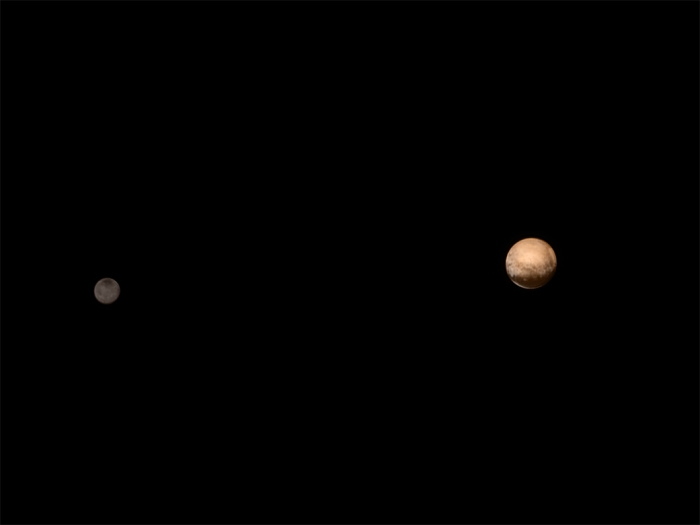
NASA's New Horizons is speeding towards the edge of our solar system for a July 14, 2015 flyby of Pluto. At its closest approach the spacecraft will be zipping by at about 7800 miles (12,500 kilometers) above the surface. It's the first mission to Pluto and the Kuiper Belt and it won't be making observations alone. NASA's fleet of observatories will also be busy gathering data before and after to help piece together what we know about Pluto. Sending this spacecraft on an almost 3 billion mile journey will help answer basic questions about the surface properties, atmospheres, and moons of the Pluto system.
"NASA is aiming some of our most powerful space observatories at Pluto," said Paul Hertz, Astrophysics Division Director at NASA Headquarters, Washington. "With their unique capabilities combined, we will have a multi-faceted view of the Pluto system complementary to New Horizons data."
Right around New Horizons' closest approach to Pluto, Cassini will take an image of the dwarf planet from its station in orbit around Saturn. Although Cassini is the closest spacecraft to New Horizons' distant location, the image of Pluto will be but a faint dot on a field of stars. Even so, the image will provide a scientific measurement of Pluto from a different vantage point that will complement data collected by New Horizons.
"The Cassini team has been pleased to provide occasional imaging support for New Horizons for several years to aid with the Pluto bound spacecraft's navigation. It's great to provide one last look at it soars through the Pluto system," said Earl Maize, Cassini project manager at NASA's Jet Propulsion Laboratory (JPL) in Pasadena, California.
Even after New Horizons flies past Pluto, the observations don't end there. On July 23, Spitzer Space Telescope will begin a seven day series of observations, gathering infrared data at 18 different longitudes. The data will reveal possible changes in ice on Pluto's surface.
"Spitzer is around 4.87 billion km (around 3 billion miles) from Pluto," said Noemi Pinella-Alonso from the University of Tennessee in Knoxville, and lead investigator of the Spitzer observations. "The spacecraft provides an effective tool to study the ice on the surface and search for other materials that have not yet been identified."
Beginning in October, the Kepler spacecraft in its new mission, K2, will train its unceasing gaze on Pluto for nearly three months. Similar to how Kepler detected distant planets by measuring the change in brightness of their host star, K2 will record the change in the reflected light off Pluto and its nearest and largest moon Charon. Scientists will learn more about the effects on the atmosphere and surface of Pluto imparted by the dwarf planet's eccentric and expanding orbit about the sun. The data may also reveal seasonal changes on this chilly world.
"K2 observations will expand the time coverage of the speedy New Horizons' flyby of Pluto, making observations of the dwarf planet-moon system every 30 minutes," said Steve Howell, project scientist for Kepler/K2 at NASA's Ames Research Center in Moffett Field, California. "We are excited to turn the planet hunting Kepler spacecraft's attention to this distant solar system object to provide additional scientific insight into this far off, mysterious world -- itself a miniature solar system of five moons in orbit about Pluto."
Prior to the New Horizons flyby, the SOFIA airborne observatory, an infrared telescope installed on a 747 aircraft, soared into the perfect position over the Southern Ocean on June 28, to be directly in line with Pluto and a distant star. As the dwarf planet and its atmosphere were backlit by the star, this occultation caused a faint shadow of Pluto to move across the surface of Earth at more than 53,000 mph, creating a ripe opportunity for SOFIA's mobile instruments to perform scientific analysis to help scientists understand the density and structure of Pluto's atmosphere.
"The New Horizons and SOFIA observations of Pluto provide a baseline measurement that will help track the evolving atmosphere of Pluto for years to come," said Pamela Marcum, SOFIA Program Scientist at NASA's Ames Research Center. "This unique opportunity to connect what SOFIA observes remotely with in-situ measurements from New Horizons will allow future analyses of Pluto from Earth by SOFIA and other observatories to be considerably enhanced."
Since its launch in 1990, the Hubble Space Telescope has provided the clearest Earth orbiting telescopic views of Pluto and Charon, mapped the dwarf planet's surface, and discovered four new moons. While monitoring Pluto in preparation for the New Horizons flyby, the telescope discovered the tiny moons Nix and Hydra. Kerberos and Styx were uncovered in 2011 and 2012 respectively. After analyzing several years of Hubble observations, astronomers reported this year that that the moons Nix and Hydra are tumbling chaotically along their orbits due partly to a dynamically shifting gravitational field caused by the system's two central bodies, Pluto and Charon. The moons are also football shaped, which contributes to the chaotic rotation. Hubble continues to monitor Pluto in support of the New Horizons flyby.
With the combined observations of the many missions, scientists will have a rich set of data to work with to better shed light on the shadowy dwarf planet. The data will be available to the public once it is processed.
The recovery from a July 4 anomaly that sent the New Horizons spacecraft into safe mode is proceeding according to plan. Mission managers reported during a July 6 media teleconference that New Horizons resumed operations on its main computer. The sequence of commands for the Pluto flyby have now been up-linked to the spacecraft and full science observations of Pluto, its moons, and the solar winds have resumed as planned.
The quick response to the weekend computer glitch assures that the mission remains on track to conduct the entire close flyby sequence as planned, including the July 14 flyby observations of Pluto.
"We're delighted with the New Horizons response to the anomaly," said Jim Green, NASA's director of planetary science. "Now we're eager to get back to the science and prepare for the payoff that's yet to come."
The investigation into the anomaly that caused New Horizons to enter safe mode on July 4 has confirmed that the main computer was overloaded due to a timing conflict in the spacecraft command sequence. The computer was tasked with receiving a large command load at the same time it was engaged in compressing previous science data. The main computer responded precisely as it was programmed to do, by entering safe mode and switching to the backup computer.
Thirty observations were lost during the three day recovery period, representing less than one percent of the total science that the New Horizons team hoped to collect between July 4 and July 16. None of the mission's most critical observations were affected. There's no risk that this kind of anomaly could happen again before flyby, as no similar operations are planned for the remainder of the Pluto encounter.
"This is a speed bump in terms of the total return we expect to receive from this historic mission," said Dr. Alan Stern, New Horizons principal investigator with the Southwest Research Institute (SWRI) in Boulder, Colorado. "When we get a clear look at the surface of Pluto for the very first time, I promise, it will knock your socks off."
For more information:
http://www.nasa.gov/feature/nasa-s-new-horizons-on-track-for-pluto-flyby
http://www.astromart.com/news/news.asp?news_id=1443
http://www.astromart.com/news/news.asp?news_id=1437
http://www.astromart.com/news/news.asp?news_id=645
http://www.astromart.com/news/news.asp?news_id=568
http://www.astromart.com/news/news.asp?news_id=436
http://www.astromart.com/news/news.asp?news_id=420
AstroMart News Archive:
http://www.astromart.com/news/search.asp?search=.+
Funding Member
