NASA's NuSTAR Black Hole Hunter to Launch from Kwajalein Atoll
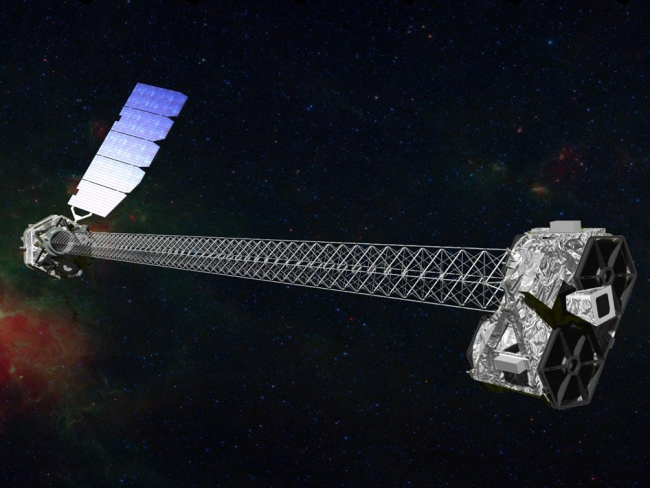
NuSTAR will use advanced optics and detectors to observe the high-energy X-ray sky with much greater sensitivity and clarity than any mission flown before. The mission will advance our understanding of how structures in the universe form and evolve. It will observe some of the hottest, densest, and most energetic objects in the universe, including black holes, their high-speed particle jets, ultra-dense neutron stars, supernova remnants and our sun.
The spacecraft will lift off on an Orbital Sciences Pegasus XL rocket, which will be released from a specially modified Lockheed L-1011 aircraft taking off from the Reagan Test Site on the Kwajalein Atoll in the Marshall Islands.
NuSTAR will be the very first high energy X ray telescope that can actually focus. That will allow it to create images that are ten times crisper and sharper than anything that's been made in this part of the electromagnetic spectrum before.
For the same reason dentists and doctors use X-rays to study what's going on inside, NuSTAR will use these high-energy X-rays to study what's going on near super-massive black holes.
One of NuSTAR's main scientific goals is to get a full census of black holes in the universe. NuSTAR will be a black hole hunter in the sense that it can point up in the sky and find black holes even if they're in galaxies hidden behind shrouds of dust and gas.
X-ray telescopes look something like a whole bunch of coffee cans all nested inside one another. Each coffee can intercepts some part of the incoming X-ray beam and deflects it to focus it on this detector 10 meters away.
An amazing discovery of the last 20 years is that every galaxy -- like our own Milky Way -- has a massive black hole at its heart. As dust and gas from this galaxy fall onto this central black hole, it radiates in the X-ray part of the spectrum. So if we look at the sky in visible light, we see stars. If we look at the sky in X-rays we see black holes.
One of the key measurements NuSTAR will make is how fast black holes are spinning. So, much like ice skaters spin faster and faster as they bring their arms in, material -- as it falls into a black hole -- starts spinning faster and faster as it gets closer into the black hole.
When two black holes merge, all of that rotation ends up in a single object, making it spin very fast. NuSTAR will measure how fast black holes are spinning, which gives us information about how the black holes formed and what role they play in the formation of galaxies.
NuSTAR will enable astrophysicists to see behind screens of dust and gas and study some of the most energetic phenomena in the universe - the hottest objects in regions of space where particles are moving very close to the speed of light.
A large number of galaxies are hiding black holes that we can't detect, and NASA's NuSTAR will use X-ray vision to find them.
To view a video on the NuSTAR mission:
http://www.nasa.gov/multimedia/videogallery/index.html?collection_id=80521&media_id=142531021
NASA's NuSTAR mission will launch into a low-Earth, near-equator orbit on a Pegasus XL rocket from Kwajalein Atoll in the Marshall Islands.
To view a video of the Pegasus XL Launch Vehicle:
http://www.nasa.gov/multimedia/videogallery/index.html?collection_id=80521&media_id=142531021
For more information:
http://www.nasa.gov/mission_pages/nustar/main/index.html
http://www.nasa.gov/multimedia/podcasting/jpl-nustar-20120507.html
AstroMart News Archive:
http://www.astromart.com/news/search.asp?search=.+
Funding Member
