
New Horizons Slingshots Past Jupiter on its Way to Pluto
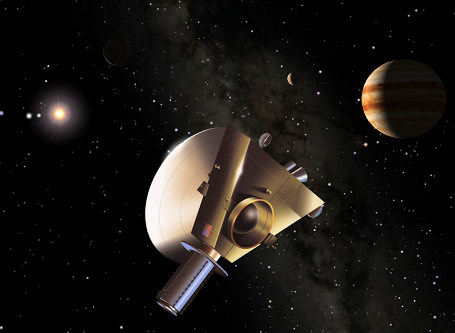
Just a year after it was dispatched on the first mission to Pluto and the Kuiper Belt, NASA’s New Horizons spacecraft is on the doorstep of the solar system’s largest planet — about to swing past Jupiter and pick up even more speed on its voyage toward the unexplored regions at the outer edge of the Solar System.
The fastest spacecraft ever launched, New Horizons will make its closest pass to Jupiter on Feb. 28, threading its path through an “aim point” 1.4 million miles (2.3 million kilometers) from the center of Jupiter. Jupiter’s gravity will accelerate New Horizons away from the Sun by an additional 9,000 miles per hour — half the speed of a space shuttle in orbit — pushing it past 52,000 mph and hurling it toward a pass through the Pluto system in July 2015.
At the same time, the New Horizons mission team is taking the spacecraft on the ultimate test drive — using the flyby to put the probe’s systems and seven science instruments through the paces of a planetary encounter. More than 700 observations of Jupiter and its four largest moons are planned from January through June, including scans of Jupiter’s turbulent atmosphere and dynamic magnetic cocoon (called the magnetosphere), mappings of the composition and topography of the large moons (Io, Europa, Ganymede, and Callisto), and an unprecedented look at volcanic activity on Io.
The flight plan also calls for the first-ever trip down the long “tail” of Jupiter’s magnetosphere, a wide stream of charged particles that extends tens of millions of miles beyond the planet, and the first closeup look at the “Little Red Spot,” a nascent storm south of Jupiter’s famous Great Red Spot.
“Our highest priority is to get the spacecraft safely through the gravity assist and on its way to Pluto,” says New Horizons Principal Investigator Dr. Alan Stern, of the Southwest Research Institute, Boulder, Colo. “But we also have an incredible opportunity to conduct a real-world-encounter stress test to wring out our procedures and techniques for Pluto, and to collect some valuable science data.”
The Jupiter test matches or exceeds the mission’s Pluto study in duration, data volume sent back to
Earth, and operational intensity. Like at Pluto, much of the data from the Jupiter flyby won’t be sent back to Earth until after closest approach, because the spacecraft’s main priority is to observe the planet and store data on its recorders before transmitting information home.
“We designed the Jupiter encounter to prove out our planning tools, our simulation capabilities, our spacecraft and our instrument sensors on a real planetary target, well before the Pluto encounter,” says Glen Fountain, New Horizons project manager at the Johns Hopkins University Applied Physics Laboratory (APL), Laurel, Md., which built and operates the spacecraft. “If the team needs to adjust anything before Pluto, we’ll find out about it now.”
New Horizons lifted off from Cape Canaveral Air Force Station, Florida, last Jan. 19, 2006. The spacecraft has undergone a full range of system and instrument checkouts. With closest approach to Jupiter coming 13 months after launch, New Horizons will reach the planet faster than any of its seven previous visitors. Pioneers 10 and 11, Voyagers 1 and 2, Ulysses, and Cassini all used Jupiter’s gravity to reach other destinations. NASA’s Galileo orbited the planet from 1995-2003.
New Horizons also provides the first close-up look at the Jovian system since Galileo, and the last until NASA’s Juno mission arrives in 2016. “The Jupiter system is incredibly dynamic,” says New Horizons Jupiter Encounter Science Team lead Dr. Jeff Moore, of NASA Ames Research Center. “From constant changes in Jupiter’s
magnetosphere and atmosphere, to the evolving surfaces of moons such as Io, you get a new snapshot every time you go there.”
After an eight-year cruise from Jupiter across the expanse of the solar system, New Horizons will conduct a five-month-long study of Pluto and its three moons in 2015, characterizing their global geology and geomorphology, mapping their surface compositions and temperatures, and examining Pluto’s atmospheric composition and structure. Then, as part of a potential extended mission, New Horizons will conduct similar studies of one or more smaller worlds in the Kuiper Belt, the region of rocky and icy bodies far beyond Neptune’s orbit.
For more information:
http://www.nasa.gov/mission_pages/newhorizons/main/index.html
http://www.astromart.com/news/news.asp?news_id=436
http://www.astromart.com/news/news.asp?news_id=568
http://pluto.jhuapl.edu
Funding Member
