New Mexico to Restore Status of Pluto as a Planet
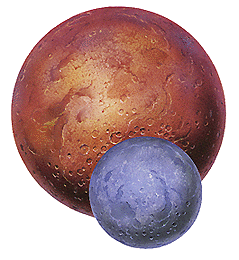
For many years, Pluto was thought of as the farthest known planet from the Sun. It has a very unusual orbit. Since the year 2000, astronomers realized that Pluto was not like the other eight planets but very much like a new group of objects found in the outer solar system. In 2006, the International Astronomical Union (IAU) re-classified Pluto to be a dwarf planet. Now New Mexico is restoring Pluto's status as a planet.
Comments:
It's a planet folks! The first time the politicians have got it right. <img class='' src='http://new.astromart.com/astromart/javascripts/sceditor/emoticons/smile.png' alt='smile' title='smile'/>
i will agree as well, i am from new mexico, glad we got something right <img class='' src='http://new.astromart.com/astromart/javascripts/sceditor/emoticons/grin.png' alt='grin' title='grin'/>
Let's hope this spark of lucidity spreads around the world. 8) <br><br>Bruce
Is it a politician's place to make that type of decision? Pluto is not in New Mexico!<br><br>-Jason
It's about time! The word planet was derived from the Greek term wanderer. Pluto wanders; plain and simple.
Sorry, Alan, but the Greeks only saw Mercury, Venus, Mars, Jupiter, and Saturn...by your definition they are the only TRUE planets because they were the only ones defined by the Greeks as wanderers...Norm
Just don't declare it the home of the Roswel aliens <img class='' src='http://new.astromart.com/astromart/javascripts/sceditor/emoticons/wink.png' alt='wink' title='wink'/>
I agree the fiasco that went on to take away Pluto's planetary<br>status was absurd.<br><br>Oscar
This comes from the same group that wants to establish a "space port" for millionaires at taxpayer expense!
Hi George<br><br>The spaceport is just another one of the idiotic initiatives supported by NM political forces.<br><br>Why don't they have initiatives to bring many high quality jobs to NM with futures? They are more interested in spaceports and movie studios.<br><br>Did you all know that microsoft wanted to start in Albuquerque, NM? The good old boy politicos at the time were not interested in giving them enough incentives, so they moved to redmond, and the rest is history. Another major goof by the incompetents in power.<br><br>Best wishes, <br><br>Bob
There were carefully reasoned scientific points why Pluto could not be classified as a planet. I've lived in NM for 17 years, and it never ceases to amaze me the idiotic things that are proposed by those in power.<br><br>If it were not for the laboratory work here, and the beautiful nature (and skies) I certainly would choose to live elsewhere. It is no wonder why all the educational, wage and standard of living numbers are at the bottom of the barrel compared to the rest of the US. A real third world 'country' down here, to be sure. This is just another example.<br><br>Best wishes,<br><br>Bob Campbell :S
Agreed!<br><br>The short time I lived in NM was quite an education in how stupid politicians can be. NM has Los Alamos and a great tourist-based economy.<br><br>Maybe tourism is the entire reason for spaceports and wasting resources on declaring planets.<br><br>Remember when the speed of light was legislated to the wrong number by the federal government 60 years ago?<br><br>David
I know how passionate people are about this whole Pluto thing, but I would like to through in my 2 centavos worth. As one who has had a near lifelong interest in astronomy I feel compelled to attempt to clarify the actions of the IAU in re-categorizing Pluto from a planet to a minor planet. I think most of the controversy can be eliminated by a small change in perspective of the situation. I present my own perspective.<br><br>Pluto as we can all agree has never been and never will be a typical "planet" as compared with the other eight. This can be attested to by its very small size, its composition, its highly eccentric orbit and its vastly exaggerated orbital inclination. It has always been and always will be rouge. Having said this, I want to make it clear that any of these aforementioned attributes in no way trivialize Pluto as a member of our solar system.<br><br>Most of the controversy has been in the semantics. Pluto has not physically changed through all of this. It is still the same size, still shines, albeit dimly, in the night sky, still has 3 moons. The change in classification has in no way changed the object itself. It has merely clarified some confusion and made us think of exactly how we want to classify the objects that inhabit our solar system.<br><br>As we all know, orbiting closest to the Sun we have the 4 inner terrestrial planets (Mercury, Venus, Earth, and Mars). Following this is a boundary of objects we choose to call asteroids, made up of fragments of rocky and metallic debris which never coalesced into a single object, a failed planet, if you will. Next we have the 2 majestic gas giants (Jupiter and Saturn). Finally we have the ice giants (Uranus and Neptune). Now comes the little guy that has been causing all the trouble. He doesn't fit into any of the classic categories and doesn't even seem to belong where he is. NOW! Along come several discoveries of objects far beyond Pluto. One is even said to be larger than Pluto. The main feature, however, is that these new objects are identical, so far, in many ways to our little oddity we call Pluto. Now what?<br><br>As happens throughout history, when new discoveries are made it forces us to look at things in a new light. Remember when we thought the earth was flat? Remember when we thought the earth was the center of the solar system? Following these discoveries, our entire view of the solar system was turned upside-down. There were groups who maintained these nonsensical views long after they were proven erroneous. Even today I hear the argument that traditionally Pluto has been considered a planet and thus should continue to be considered a planet. If we use that argument, then by tradition we live on a flat planet in the center of the solar system and that is the way it should be. Period! After all, we certainly believed the earth was flat and the center of the solar system for much longer than we have belived otherwise! <br><br>I know many have thought that Pluto, and its good name, was trashed in this process, but I think nothing could be further from the truth. Pluto now holds the GREAT distinction of being the prototypical object of all the distant objects yet discovered called Kuiper Belt Objects. Yes, Pluto was #1, numero uno. And instead of looking at it that Clyde Tombaugh was a loser that discovered a loser planet...I see it that through his hard work and dedication he was the discoverer of the VERY FIRST Kuiper Belt Object. He did this by using primitive equipment and acute, refined powers of observation. The next one discovered took the use of unbelievably complex technology and 70 more years of time. This discovery was no trivial object and no trivial feat by Clyde Tombaugh!<br><br>I applaud the IAU in their thankless job of classifying the countless objects out there trying to make some sense and order of our vast universe. The new classification of Pluto does not make me think any less of the object OR its discoverer. Remember this was the first object of its type discovered by back-breaking, grueling dedication to a cause...this marks a new beginning in our understanding of our solar system. THIS IS THE REBIRTH OF PLUTO AS A UNIQUE TYPE OF NEW OBJECT, NOT ITS DEMISE!<br><br>
<br><br><blockquote class="blockquote"><div class="italic"><i>Mike Sutherland said:</i><br><br>"Pluto as we can all agree has never been and never will be a typical "planet" as compared with the other eight." NW<br><br>Sorry Norman, I don't agree. <img class='' src='http://new.astromart.com/astromart/javascripts/sceditor/emoticons/shocked.png' alt='shocked' title='shocked'/> Actually I do agree that Pluto is unique. But what I don't agree to is that the other eight are somehow "typical". Just put huge, featherlight, fluffy Saturn next to dense, sterile, tiny Mercury and tell me these are the same thing. 8O <br><br>All 10 planets are unique in their own way. It's time for the scientific community and the IAU in particular to enter the 21st century and accept that as technology and our understanding of this solar system as well as countless other solar systems grow, that we will continue to discover new and exciting phenomenon. Rather than design a convoluted formula who's intent was to exclude Pluto, they should have settle on the simpler, more scientific planet definition and accept the inevitable additions as they are discovered. Now THAT's exciting! <img class='' src='http://new.astromart.com/astromart/javascripts/sceditor/emoticons/grin.png' alt='grin' title='grin'/> <br><br>Mike</div></blockquote><br>Mike,<br><br>You need to read my post a little more carefully. When I said "typical" I included more than just size! The orbital inclination (17 degrees off the ecliptic) and eccentricity are vastly atypical from the other planets of our solar system. Remember Pluto sneaks inside Neptune's orbit for about 20 years each revolution...any other planets do that? These facts combined WITH size makes for Pluto's unusual situation. Interesting that other Kuiper Belt objects more closely resemble Pluto in form and function than they do the other planets, therefore they all should be in their OWN classification. Again, minor planet classification in no way trivializes their significance.
<blockquote class="blockquote"><div class="italic"><i>Mike Sutherland said:</i><br><br>"Pluto as we can all agree has never been and never will be a typical "planet" as compared with the other eight." NW<br><br>Sorry Norman, I don't agree. <img class='' src='http://new.astromart.com/astromart/javascripts/sceditor/emoticons/shocked.png' alt='shocked' title='shocked'/> Actually I do agree that Pluto is unique. But what I don't agree to is that the other eight are somehow "typical". Just put huge, featherlight, fluffy Saturn next to dense, sterile, tiny Mercury and tell me these are the same thing. 8O <br><br>All 10 planets are unique in their own way. It's time for the scientific community and the IAU in particular to enter the 21st century and accept that as technology and our understanding of this solar system as well as countless other solar systems grow, that we will continue to discover new and exciting phenomenon. Rather than design a convoluted formula who's intent was to exclude Pluto, they should have settle on the simpler, more scientific planet definition and accept the inevitable additions as they are discovered. Now THAT's exciting! <img class='' src='http://new.astromart.com/astromart/javascripts/sceditor/emoticons/grin.png' alt='grin' title='grin'/> <br><br>Mike</div></blockquote><br>As for your statment about Saturn and Mercury...read my post again. I said there are 4 inner "terrestrial" planets and 4 outer "giants" grouped into the gas giants (Jupiter and Saturn)and the ice giants (Neptune and Uranus).<br><br>I agree with your idea that we have to get used to "inevitable additions" to our solar system, however, those additions may and DO have quite different characteristics than do the existing inhabitants of our solar system, hence the need for a better form of classification.<br><br>Norm
Funding Member