Newly Discovered Asteroid Could Hit Mars Next Month
A recently discovered asteroid which passed close to the Earth in November, is now headed towards a very close passage by Mars in late January, and there is a small chance that it could hit that planet. The probability of a collision is only 1 chance in 75, but scientists are excited about the possibility.
"We're used to dealing with odds like one-in-a-million," said Steve Chesley, a scientist at JPL. "Something with a one-in-a-hundred chance makes us sit up straight in our chairs."
"Normally, we're rooting against the asteroid," when Earth is the target, Chesley said. "This time we're rooting for the asteroid to hit."
In the likely event that the asteroid misses Mars, it could come back to the vicinity of the Earth years or decades later, but our routine hazard monitoring shows that there is no threat of an impact with the Earth.
Designated 2007 WD5, the asteroid was discovered on Nov. 20, 2007 by the NASA-funded Catalina Sky Survey using a 1.5m telescope on Mt. Lemmon, near Tucson. The object had already passed within 7.5 million km (5 million miles) of the Earth on Nov. 1, before it was discovered. Based on its magnitude, the asteroid is believed to be about 50 meters (160 feet) across.
When it closes in on Mars, it will approach from the day side, and would then be very difficult to observe from any of the spacecraft on or around Mars. Current best estimates predict that the asteroid will miss Mars by 50,000 km, but the miss distance is highly uncertain because the asteroid's path is not known with sufficient accuracy. The zone of potential impact on the surface of Mars is approximately 800 km wide, and sweeps across the Martian equator from southwest to northeast.
The asteroid is becoming increasingly difficult to observe, since it is receding from the Earth and the waxing Moon is approaching the same part of the sky. But it should become observable again early in January. These new measurements will lead to a significant improvement in the orbit accuracy, and NASA astronomers will then be able to refine the probability that the asteroid might collide with Mars.
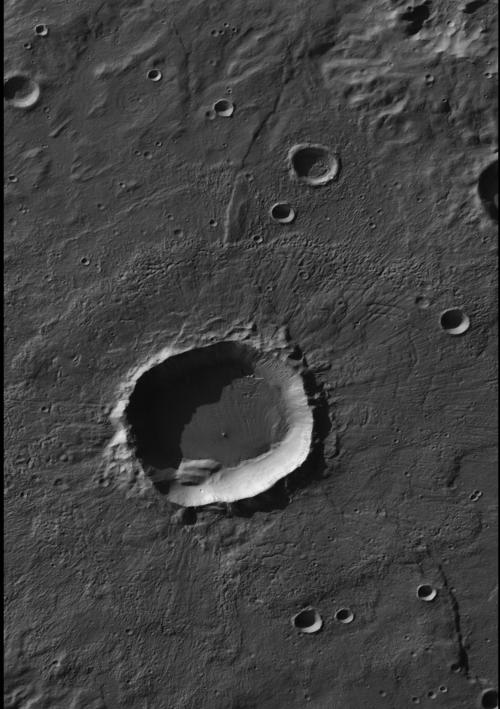
If the asteroid is indeed on a collision course, it would hit Mars with a velocity of about 13.5 km/s (8.4 miles per second), and would produce an explosion equivalent to about 3 MegaTons of TNT. We can only speculate as to the effects of such an impact, but it would be reasonable to expect a crater nearly a kilometer across and a significant amount of dust lifted into the atmosphere.
"Right now asteroid 2007 WD5 is about half-way between the Earth and Mars and closing the distance at a speed of about 27,900 miles per hour," said Don Yeomans, manager of the Near Earth Object Office at JPL. "Over the next five weeks, we hope to gather more information from observatories so we can further refine the asteroid's trajectory."
NASA detects and tracks asteroids and comets passing close to Earth. The Near Earth Object Observation Program, commonly called "Spaceguard," plots the orbits of these objects to determine if any could be potentially hazardous to our planet.
Asteroid 2007 WD5 was first discovered on Nov. 20, 2007, by the NASA-funded Catalina Sky Survey and put on a "watch list" because its orbit passes near the Earth. Further observations from both the NASA-funded Spacewatch at Kitt Peak, Ariz., and the Magdalena Ridge Observatory in New Mexico gave scientists enough data to determine that the asteroid was not a danger to Earth, but could potentially impact Mars. This makes it a member of an interesting class of small objects that are both Near Earth Objects and "Mars crossers."
"We estimate such impacts occur on Mars every thousand years or so," said Steve Chesley. "If 2007 WD5 were to thump Mars on Jan. 30, we calculate it would create a crater more than half-a-mile wide." The Mars Rover Opportunity is currently exploring a crater approximately this size. NASA and its partners will continue to track asteroid 2007 WD5. The Opportunity rover is close to the southern edge of this possible impact zone but clearly outside it.
An impact on Mars would not be unprecedented: 21 fragments of Comet Shoemaker-Levy 9 impacted Jupiter in July, 1994. Those impacts were predicted with near certainty almost a year before the impact. But, with a 1-in-75 chance, this asteroid's possible impact with Mars is far from certain.
For more information:
http://neo.jpl.nasa.gov/news/news151.html
http://neo.jpl.nasa.gov/news/news152.html
Astromart News Archive:
http://www.astromart.com/news/search.asp?search=.+&search_btn=Go
Funding Member
