Now is the Best Time to View Comet Pojmanski
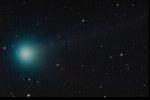
Comet Pojmanski, the first comet discovered in 2006, is now at its maximum brightness in the eastern sky at dawn, not far from Venus, which dominates the morning sky. At magnitude 5.4, the green colored comet is just bright enough now to be a good target for early-risers with binoculars. The comet made its closest approach to Earth (just over 100 million kilometers away) on March 5th.
Dr. Grzegorz Pojmanski of the Warsaw University Astronomical Observatory discovered the comet on CCD images taken on January 1, 2006. The discovery images that Dr Pojmanski analyzed were taken as part of the All Sky Automated Survey (ASAS) at Las Campanas, Chile. The ultimate goal of the ongoing ASAS project is the photometric monitoring of over 10 Million stars that are brighter than Magnitude 14.
About seven hours after Dr. Pojmanski reported his find, Dr Kazimieras Cernis of the Institute of Theoretical Physics and Astronomy in Vilnius (Lithuania) also spotted the comet while scanning the SOHO (Solar and Heliospheric Observatory) website and studying ultraviolet images taken a few days earlier. The cometary nature of the new object was confirmed on a CCD image acquired by an astronomer from Los Molinos Astronomical Observatory in Montevideo, Uruguay.
The above image was captured by a remote observer using the RAS Observatory, which operates five separate remote telescope systems. The observatory operator, Arnie Rosner commented, “All 5 systems were trained on the comet at the same time this morning (March 5th). There were observers from Germany, Italy, Ohio USA, California USA and the Netherlands all imaging simultaneously.”
“Almost every clear night, we see folks with little or no experience log into our systems and take their own deep space images. The results are absolutely astounding. They can’t believe their own eyes.” He grinned. "It is almost like operating a ground based Hubble telescope," he concluded.
For More Info:
http://www.saao.ac.za/assa/html/cometc2006a1pojmanski.html
http://www.astrouw.edu.pl/~gp/asas/asas_c2006.html
http://www.prweb.com/releases/2006/3/prweb354635.htm
Funding Member
