
Omega Centauri Globular Cluster May Hide a Black Hole at its Center
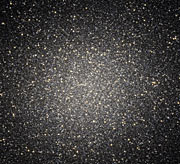
Omega Centauri has been known as an unusual globular cluster for a long time. The NASA/ESA Hubble Space Telescope and the Gemini Observatory reveal that the explanation behind Omega Centauri’s peculiarities may be a black hole hidden in its centre. One implication of the discovery is that Omega Centauri may not be a globular cluster at all, but rather a dwarf galaxy stripped of its outer stars.
Comments:
A couple of things come to mind. I read many, many years ago that Omega Cen is a "galactic star cluster," closer in mass to a small galaxy than to other globulars. Rightly or wrongly, I filed Omega Cen away in my mind as a small galaxy.<br><br>Conversely, is there a principle that states that an object having a central black hole is <i>ipso facto</i> a galaxy?<br><br>dei
Considering it's size, out of round shape, and various star ages, I also consider it the remains of a galactic core.<br>Doug
The article states that "there is no widely accepted mechanism" for how an intermediate-mass black hole could form. At a mass of 40,000 solar masses, in the center of a relatively dense cluster of stars, I don't understand why simple accretion isn't a viable possibility. Massive stars will tend to sink to the center of the cluster, and go supernova, forming small black holes which could coalesce to form a central black hole. Subsequent massive stars could get swallowed by such a black hole; as the black hole grows, this process would proceed at an ever faster rate.<br><br>Even assuming a uniform rate, absorbing a massive star on the order of once every ten million years or so would be enough to grow the black hole to 40,000 solar masses, over a period of 10 billion years.<br><br>So what's wrong with this picture?<br><br>Terry (astrotrf)<br>
It would make sense that some collision of galaxies would sometimes result in an object that superficially resembles a globular cluster.<br><br>On its first few passes through, it gets striped of its gas/ dust complexes. That results in bursts of star formation, each with a distinct age that can be spectroscopically accertained.<br><br>The stars from outlining regions get striped off (or ejected), leaving only those close enough the the central black hole gravitionally bound. The mass also slowly gets compacted, with the excess angular momentum carried away by the ejected stars, leaving the remains in a tighter cluster.<br><br>The orbit of this changed object also becomes more circular like true globular clusters.<br>
Funding Member
