Over a 1000 Miles Walked on National Astro Day!
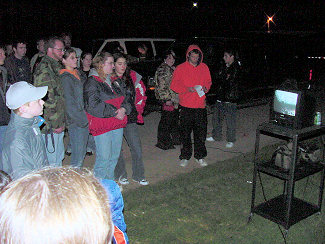
Hundreds of people from the upper midwest enjoyed their most pleasant National Astronomy Day weekend since 1999. The main attraction was my 8th annual Walk Through the Solar System. The Walk is a true-to-scale model of the solar system from the Sun to Pluto. All 260 of Albert Lea, Minnesota's 6th graders and their teachers attended the Walk on Friday, May 5 in advance of the main event, the nighttime Walk Through the Solar System on National Astronomy Day, Saturday, May 6.
On Saturday night, 290 members of the general public came from around Minnesota, Wisconsin, and Iowa to experience the true emptiness of our part of the universe. The scale of the Walk (1"=56,105 miles) was determined by the 15.25" frosted glass light fixture globe that represents the sun. Each year the Walk takes place on a barricaded section of a straight, unlit, level, and uninhabited gravel road in Hollandale, Minnesota. Walkers receive a passport at the lit sun and proceed down the road to each planet. Upon reaching a realistically painted but tiny planet, visitors are greeted by a friendly volunteer who shares a few interesting facts about that unique world. After walking 1.1 mile and reaching Pluto (a tiny 1/16" pellet mounted in a plastic frame), the Walkers are told of the new discoveries like 2003 UB313 ("Xena") and the vast distance to reach the next star. Even at the Walk's scale, participants would each have to walk another 7,800 miles to reach Proxima Centauri! All chose to return toward our own sun instead...
On Saturday night, 290 members of the general public came from around Minnesota, Wisconsin, and Iowa to experience the true emptiness of our part of the universe. The scale of the Walk (1"=56,105 miles) was determined by the 15.25" frosted glass light fixture globe that represents the sun. Each year the Walk takes place on a barricaded section of a straight, unlit, level, and uninhabited gravel road in Hollandale, Minnesota. Walkers receive a passport at the lit sun and proceed down the road to each planet. Upon reaching a realistically painted but tiny planet, visitors are greeted by a friendly volunteer who shares a few interesting facts about that unique world. After walking 1.1 mile and reaching Pluto (a tiny 1/16" pellet mounted in a plastic frame), the Walkers are told of the new discoveries like 2003 UB313 ("Xena") and the vast distance to reach the next star. Even at the Walk's scale, participants would each have to walk another 7,800 miles to reach Proxima Centauri! All chose to return toward our own sun instead...
Funding Member
