Pan-STARRS 1 Sees First Light - Will Study Exploding Stars and 'Killer' Asteroids
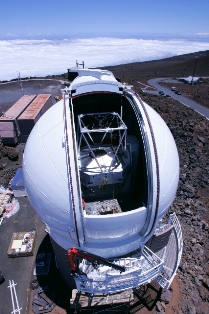
Astronomers from Queen’s University in Belfast, in conjunction with several other major research institutions in Europe and the US, have signed an agreement with the University of Hawaii to use the Pan-STARRS 1 (PS1) telescope, the most advanced telescope system ever built to rapidly scan the skies.
The astronomers will utilize the revolutionary new survey telescope on the top of Haleakala, which is expected to discover billions of new stars, galaxies, and solar system objects, including potential ‘killer asteroids’ that threaten the Earth.
A primary goal of the Pan-STARRS project will be to survey nearby space for asteroids and comets that could collide with the Earth in the future -- so-called Near-Earth Objects (NEOs). While current searches are sensitive to asteroids a kilometer across or larger, Pan-STARRS will be the first telescope to discover large numbers of smaller NEOs as well.
Professor Alan Fitzsimmons of Queen’s University will be studying these new objects to investigate what fraction are comets and what they are made of. Speaking about Queen’s University involvement in the project he said: “We will be concentrating on the smallest Near-Earth Objects, as we know very little about these bodies. Yet they hit our Earth much more frequently than large asteroids and comets, so we need to know their physical and chemical make-up if we want to understand the risk posed by them.
By monitoring the whole sky every week, Pan-STARRS will also become the world's leading search observatory for exploding stars and supernovae -- fantastically energetic explosions that occur at the end of the life of a very massive star. Supernovae are billions of times brighter than the sun and can be seen in the distant Universe.
Explaining further how Pan-STARRS will be used to measure the energies released in the explosions and the nature of the exploding stars themselves, Professor Stephen Smartt, from Queen’s University added: "These supernovae produced the elements of oxygen, calcium, silicon, and iron, which are fundamental to the evolution of the Universe and life itself.
“We were created from supernovae residue, and our aim is to understand the physics of the explosions and how the elements are produced. The Pan-STARRS project gives Queen's University an opportunity to be a world leading voice in this exciting area of astrophysics".
Having achieved ‘First Light’ in June of this year, the PS1 telescope will also shortly be fitted with the world’s largest digital camera, currently under construction at the University of Hawaii Institute for Astronomy under the leadership of John Tonry. With a resolution of 1.4 billion pixels, about 300 times as many as a typical commercial digital unit, the camera will be used to capture images generated by the telescope’s mirror which measures 1.8 meters in diameter.
Over 30 world-renowned scientists and their graduate students have committed themselves to analyzing the unprecedented flood of data from PS1 over the next three and half years and Kenneth Chambers, from the University of Hawaii, who is responsible for carrying out the PS1 survey said: "We decided to recruit a number of top astronomers to join us in order to make the best use of this fantastic instrument.”
For More Information:
http://www.qub.ac.uk/home/TheUniversity/GeneralServices/News/PressReleases/#3
http://pan-starrs.ifa.hawaii.edu/public/
