Planets Discovered in a Double Star System
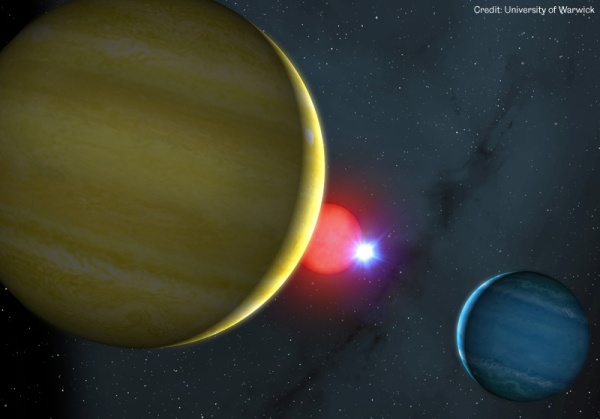
Two massive planets have been found orbiting a binary star system, thanks to research by an international consortium including astronomers at the Universities of Sheffield and Warwick in the UK. While the new research has detected the planets, scientists are unsure exactly how the planets have formed. There are currently at least 490 known exoplanets. Very few of these planets, however, are in binary systems.
Comments:
Multiple star systems are quite common, and it seems odd to me that finding planets orbiting a binary system would bring into question the process about how they formed there, as if the formation of a "planet" as a part of this multi-object system would be somehow unique. The universe, particularly within the confines of a galaxy system, is chock full of gas and dust. Gravity results in great gobs of gas and dust forming out of this stuff. Stars are just much bigger gobs of gas and dust than "planets". We just can't <i>see </i>the smaller gobs (planets) with the exception of those in our own solar system. We can "detect" other "planets" by transit techniques or doppler wobbling of their associated stars, but there simply have to be GAZILLIONS of non-stellar gobs of material out there that aren't associated with "stars" at all, let alone the ones orbiting stars that have taken on the title of "planets". More of them than stars by huge magnitudes, we just can't see them because our technology isn't up to it. So how did these "planets" form? Simple, they formed by the same processes that form multiple star systems, these are just too small to be "stars".
