Pluto's Two Small Moons Officially Named Nix and Hydra. Plus, a Story About Hubble's Recent ACS Problems.
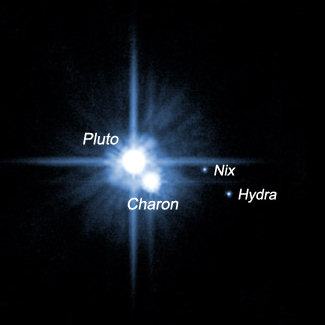
The names were approved this week by the International Astronomical Union (IAU), the recognized authority for assigning designations to celestial bodies.
In Greek mythology, Nyx is the goddess of the night. Among her many offspring was Charon, the boatman who ferried the dead across the river Styx into the Underworld. (Because asteroid 3908 already bears the Greek name Nyx, the IAU changed Nyx to its Egyptian equivalent, Nix.) The mythological Hydra was a nine-headed serpent with poisonous blood. The Hydra had its den at the entrance to Hades, where Pluto and his wife Persephone entered the Underworld.
The team of researchers who selected the names, out of a list of more than two- dozen candidate names, used Hubble images to make the discovery in support of NASA's New Horizons mission to Pluto and the Kuiper Belt beyond. Team members are based at Southwest Research Institute (SwRI) in Boulder, Colo., the Johns Hopkins University Applied Physics Laboratory (APL) in Laurel, Md., the Space Telescope Science Institute in Baltimore and Lowell Observatory in Flagstaff, Ariz.
"You're going to be hearing a lot more about Nix and Hydra in coming years, says co-leader of the discovery team, Alan Stern of SwRI. "Astronomers are already applying for telescope time to study their orbits and physical properties. And when New Horizons flies by Pluto in the summer of 2015, each moon will be mapped in detail."
In making the selection, team members explained that Nix and Hydra honor the search for new satellites and the New Horizons mission to Pluto by starting with the letters "N" and "H." The first letter of Hydra also honors the Hubble Space Telescope that was used to detect the satellites. This has historical tradition. Pluto's name begins with the letters "P" and "L" to honor Boston astronomer Percival Lowell, who inaugurated the search that led to Pluto's discovery. (Lowell did not live to see Pluto's discovery, which was made by Clyde Tombaugh at Lowell Observatory in 1930.)
Click here for more about this subject. -Ed.
ACS SUSPENDS OPERATIONS
On Monday, 19 June 2006, at 1:15 pm EDT (17:15 UT), the Advanced Camera for Surveys (ACS) issued status buffer messages indicating that the +15V and +5V power supply voltages in the CCD Electronics Box (CEB) were above their high limits, causing the ACS to suspend. This event occurred in a period with no ACS commanding and outside the SAA. A dump of the relevant data showed that a total of 36 CEB items exceeded limits at the time of the event.
At this point, the ACS is in a safe configuration, and further analysis is ongoing. Preliminary reviews of the telemetry and technical details about possibly affected components of ACS have been carried out. However, the root cause for the ACS suspend is still unknown. Further analysis and testing revolves around low-voltage power supplies as well as analog to digital converters. Analysis of ACS images taken before the suspend event shows no anomalies of any kind.
The further course of action will simultaneously prepare for further testing of the Side 1 electronics, which has been used since the installation of ACS, while preparing for a potential switch to the Side 2 electronics. The Side 1 tests will commence later this week, after verification that the tests will not harm the instrument. These tests will check various registers and voltages to pin down the location of the cause for the suspend.
Preparations for a switch to Side 2 involve procedure verification, Flight Software changes, as well as the definition of calibration and verification programs to be executed before the full ACS science program could hopefully continue. A switch to Side 2 could come as early as the week of 26 June, if the tests successfully show that this would be beneficial.
For the time being, no ACS science observations will be carried out. Measures are being taken to advance non-ACS observations to fill the available time.
Click here for more about this subject. -Ed.
Funding Member
