Pulsar Spinning at an Incredible 716 Revolutions per Second
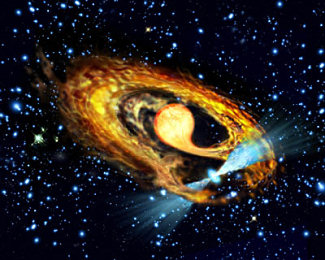
Pulsars are spinning neutron stars that sling "lighthouse-like beams" of radio waves around as they spin. A neutron star is what is left after a massive star explodes at the end of its "normal" life. With no nuclear fuel left to produce energy to offset the stellar remnant's weight, its material is compressed to extreme densities. The pressure squeezes together most of its protons and electrons to form neutrons -- hence, the name "neutron star." Their material is compressed to densities so extreme that a teaspoon of neutron star matter is thought to weigh billions of tons. British radio astronomers discovered Pulsars in 1967.
Originally detected at radio wavelengths, they were later detected in the gamma-ray range a few years later. In fact, Pulsars were the first astronomical sources detected at gamma-ray energies. But the method by which Pulsars produce their powerful beams of electromagnetic radiation has remained a mystery.
Pulsars have tremendously intense magnetic fields and from the poles of these magnetic fields they emit narrow beams of radiation and accelerate particles to high velocities. We detect this radiation on Earth as regular pulses as the beam sweeps by like a lighthouse.
A team of astronomers led by Jason Hessels of McGill University in Montreal has discovered the fastest-spinning Pulsar ever found. The 20-mile diameter superdense Pulsar, spinning at 716 revolutions per second, whirls twice as fast as the average kitchen blender. For reference, the fastest speeds of common kitchen blenders are 250 to 500 Hz.
The team made the discovery using the National Science Foundation's Robert C. Byrd Green Bank Telescope in Green Bank, West Virginia. Their work yields important new information about the nature of one of the most mysterious astronomical objects in the universe.
"We believe that the matter in neutron stars is denser than an atomic nucleus, but it is unclear by how much," Hessels said. "Our observations of such a rapidly rotating star set a hard upper limit on its size, and hence on how dense the star can be."
The astronomers discovered the pulsar in a cluster of stars called Terzan 5, located 28,000 light-years from Earth in the constellation Sagittarius. The newly discovered pulsar is spinning 716 times per second, readily beating the previous record of 642 Hz from a pulsar discovered in 1982.
"Neutron stars are incredible laboratories for learning about the physics of the fundamental particles of nature, and this pulsar has given us an important new limit," explained Scott Ransom, an astronomer at the National Radio Astronomy Observatory.
The scientists say the object's fast rotation speed means that it cannot be any larger than about 20 miles across. According to Hessels, "If it were any larger, material from the surface would be flung into orbit around the star."
The spinning pulsar has a companion star that orbits it once every 26 hours. The companion passes in front of the pulsar, eclipsing the pulsar about 40 percent of the time. The long eclipse period, probably due to bloating of the companion, makes it difficult for the astronomers to learn details of the orbital configuration that would allow them to precisely measure the masses of the pulsar and its companion.
"If we could pin down these masses more precisely, we could then get a better limit on the size of the pulsar. That, in turn, would then give us a better figure for the true density inside the neutron star," explained Ingrid Stairs, a professor at the University of British Columbia and another collaborator on the work.
Using the Green Bank Telescope, the astronomers so far have found 30 new fast "millisecond pulsars" in the cluster Terzan 5, making 33 pulsars known in the cluster in total. This is the largest number of pulsars ever found in a single globular cluster.
For More Information:
http://www.mcgill.ca/newswire/?ItemID=18168
http://www.nrao.edu/pr/2006/mspulsar/
Funding Member
