
Rare Double-Pulsar System Provides More Support for General Relativity
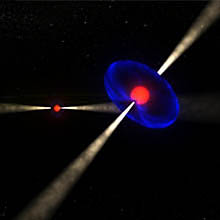
McGill University Astronomers have measured an effect, predicted by Albert Einstein's Theory of General Relativity, in the extremely strong gravity of a pair of superdense Pulsars. Essentially, the famed physicist's 93-year-old theory has passed yet another test.
Comments:
I hear the theory of general relativity is proven all the time, but I couldn't explain it with a gun to my head. How does a "Precess" or wobble prove anything. The article seems to presume we all understand general relativity, and how this is proven each time someone studies a massive gravity source. Why is the distortion of space/time important anyway? <br>If you can explain that, I'd really love to hear an explanation of special relativity. I love how physicists blurt out "If you travel 99.9% of the speed of light, time stops while in the rest of the universe time passes quickly". Really! How in God's name do you know that, or calcualte, or prove it. An explantion to a simple mind like mine would be greatly appreciated. (though it has to be easier than the calculations for an exit pupil :S ).
Let me start with special relativity. There are any number of texts accessible to the layman that present arguments for SR's assertion that "moving clocks run slow". They are detailed, though, and best done with accompanying illustrations, so I'm going to skip that. But as to "proving" it, let me describe an easily-understandable observation that demonstrates it.<br><br>Cosmic rays hitting particles in the upper atmosphere generate showers of particles called muons, which have a relatively short half-life (in other words, they decay rapidly into other particles) as measured at slow speeds in a laboratory. These muons should not live anywhere NEARLY long enough to reach the ground, yet many of them do. Why?<br><br>Special relativity provides the mechanism and the numerical predictions that are borne out by measurements of this. The muons reach the ground because time is running more slowly for the muons; they decay in what they perceive to be the correct amount of time, but because their time moves more slowly, they live longer as measured by our fast-moving clocks. Thus, they travel farther than they "should".<br><br>By the way, time doesn't *stop* at 99.9% the speed of light; it stops at 100%. But time moves more and more slowly as you approach that speed more and more closely. The calculation of this rate of slowing is no harder than the calculation for an exit pupil (except maybe for the square root <img class='' src='http://new.astromart.com/astromart/javascripts/sceditor/emoticons/wink.png' alt='wink' title='wink'/> ).<br><br>Terry (astrotrf)<br>
To understand Einstein's contribution, start with Newton's and Kepler's work. Their formulas predict where 2 objects should be, with respect to each other, at any time. But observations of some things (like double pulsars) show the formula aren't exact. The observations show a periodic wobble, or precession, or difference, or whatever you want to call it. <br><br>Einstein's work claims there are corrections to these formulas, and it quantifies those corrections. <br><br>So the proofs you hear about are when observation matches the classical calculation, when corrected by the amount Einstein predicted. <br><br>It's pretty cool, actually. Because it means the model we have of the object - our concept of it - has some consistency and truth to it. It becomes something you can build on and use, rather than just speculate about.<br>
As to special relativity, it may help to understand a bit about what led Einstein to propose such a thing as "moving clocks run slow" in the first place.<br><br>One fundamental observation that led Einstein to SR was that the speed of light is always the same. This sounds unremarkable at first, but consider that if a car is moving toward you on the highway at 60 mph, and the driver shines a flashlight at you, you will measure the speed of light of the flashlight as *exactly the same* as if the car was standing still. The measurement is NOT (speed of light) plus 60 mph; the motion of the car has no effect on the speed of light coming toward you from the flashlight.<br><br>This was first demonstrated by the Michelson-Morley experiment, conducted in 1887. Leaving out a lot of details, and distorting history somewhat, they essentially showed that if you measure the speed of a beam of light moving in the same direction as the Earth's motion around the Sun, and in a direction at right angles to that motion, the speed measured is precisely the same. In other words, again, motion has no effect on the measurement of the speed of light.<br><br>Special relativity is essentially the reasoned working-out of the consequences of this fact, which includes the effect that time slows down for moving objects.<br><br>Terry (astrotrf)<br>
<blockquote class="blockquote"><div class="italic"><i>Norm Peer said:</i><br>Why is the distortion of space/time important anyway? <br></div></blockquote><br>Well, in a nutshell, it's important because it provides corrections to the simple picture of gravity given by Newton's original theory. It turns out that, in really strong gravitational fields, Newton's equation is only *approximately* correct; one demonstration of its inexactness is the fact that the planet Mercury does not exactly follow the orbit calculated from Newtonian gravity.<br><br>General relativity looks at gravity from the point of view of a curvature of space rather than as an attractive force. The consequences of this yield a somewhat different result for the orbit of Mercury, which turns out to be correct.<br><br>In fact, as the double-pulsar article shows, general relativity gives us the correct answers when we calculate the way in which theory says the double pulsar should behave. Under Newton's theory, some aspects of what the pulsar pair does would be calculated incorrectly or be completely inexplicable. It's this comparison of theory with observation that yields confirmations of GR.<br><br>These corrections are not merely academic; as an example, the satellite-based Global Positioning System would not work if the corrections of relativity theory were not applied.<br><br>(As to "proof": theories are not exactly "proven", they're just borne out by observation. You push the theory as far as you can, and see where it breaks down. When it breaks down, the theory is revised, extended, or discarded in favor of another view. Newton's theory of gravity turned out to break down in strong gravitational fields -- there are effects that are unanticipated by his theory; general relativity explains them by looking at gravity in a different way. And, in fact, as you might expect, GR yields Newton's equation in "weak" gravitational fields. GR itself doesn't explain gravity at the quantum level, and it yields infinities if you squeeze a non-infinite amount of matter into a non-infinitely-small volume of space and create a black hole. So there are limits beyond which it apparently doesn't apply.<br><br>It may turn out that a revision to GR might handle the singularities inside a black hole; it may turn out that a completely different viewpoint is required to handle quantum gravity. And so it goes ...)<br><br>Terry (astrotrf)<br>
