
Researchers Pinpoint the Edge of Space -- The Boundary Between Earth’s Atmosphere and Outer Space
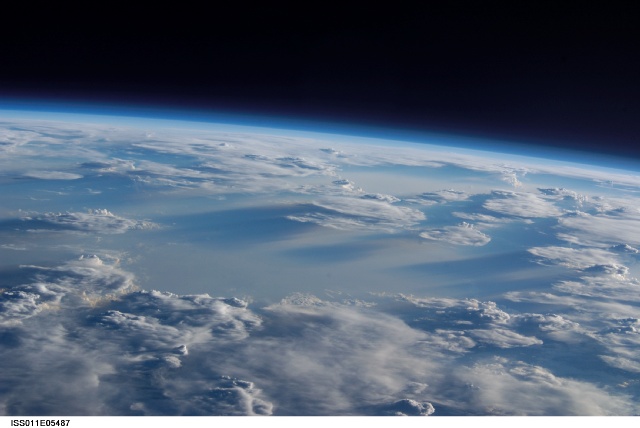
Where does space begin? Scientists at the University of Calgary (U of C) have created a new instrument that is able to track the transition between the relatively gentle winds of Earth’s atmosphere and the more violent flows of charged particles in space—flows that can reach speeds well over 1,000 km/hr. And they have accomplished this in unprecedented detail.
Data received from the U of C-designed instrument sent to space on a NASA launch from Alaska about two years ago was able to help pinpoint the so-called edge of space: the boundary between the Earth’s atmosphere and outer space.
With that data, U of C scientists confirmed that space begins 118 kilometre above Earth.
The instrument—called the Supra-Thermal Ion Imager—was carried by the JOULE-II rocket on Jan. 19, 2007.
The Canadian Space Agency invested $422,000 in the development of the Supra-Thermal Ion Imager instrument on JOULE-II.
The ability to gather data in that area is significant because it’s very difficult to make measurements in this region, which is too high for balloons and too low for satellites.
“It’s only the second time that direct measurements of charged particle flows have been made in this region, and the first time all the ingredients—such as the upper atmospheric winds—have been included,” says David Knudsen, associate professor in the Department of Physics and Astronomy at the University of Calgary.
Knudsen and his former PhD student Laureline Sangalli were the lead researchers.
The U of C-designed instrument is being used as a prototype for three instruments currently being readied to fly on the European Space Agency's "Swarm" satellite mission, set to launch late next year and to collect data for four years.
“Understanding the boundary between the Earth’s atmosphere and outer space is fundamental to the bigger picture of the effects of space on the Earth’s climate and environment,” says Russ Taylor, the director of ISIS and head of the Department of Physics and Astronomy at the U of C. “This detection is part of a long history of success by ISIS researchers in designing and building innovative instruments flown on rockets and satellites to image the flow of matter and energy between the Earth and Space.”
For more information:
http://www.ucalgary.ca/news/utoday/april13-09/edgeofspace
AstroMart News Archive:
http://www.astromart.com/news/search.asp?search=.+
Funding Member
