RIT Astronomers Peek into a Black Hole
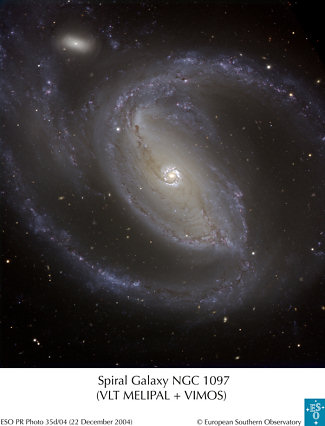
An international team of scientists led by Kambiz Fathi at Rochester Institute of Technology measured the internal motions of gas surrounding the nucleus of the active galaxy NGC1097. Using sophisticated spectroscopic techniques with the Gemini South Telescope in Chile, the team measured the motion of matter streaming from the galaxy's
spiral arms to the heart of the galaxy. The observations zoomed in 10 times closer to the supermassive black hole than ever before, to see clouds of material within 10 light-years of the galactic core. Previous observations of this type of environment have detected gas clouds located between 100 and 1,000 light-years from the galaxy’s nucleus.
“It is the first time anyone has been able to follow gas this close to the supermassive black hole in the center of another galaxy,” says Fathi. “The work of our team confirms the main theories that have never been observationally confirmed at this level. We have been able to show that it is possible to measure these velocities down to these scales.”
Modeling the galaxy’s spectra revealed the dynamic shifts in the gas and showed the spiral arms pulling gas from about a thousand light-years out from the center to the nucleus at 52 kilometers (31 miles) per second. Previous imaging by the Hubble Space Telescope and the European Southern Observatory (ESO) Very Large Telescope (VLT) have been used to show structure inside the central ring of NGC 1097 and, in unprecedented detail, show how matter spirals toward the black hole at the center of the galaxy. The Gemini South Telescope data complements this with a velocity map of the gas inside the ring.
“When we extrapolate our last data points, about 30 light-years from the black hole, this is where we find that it would take about 200,000 years for the gas to travel the last leg of its one-way journey to the supermassive black hole,” says Fathi.
The team measured the streaming motions toward the black hole by using two-dimensional spectroscopy to capture spectral data at several thousand points surrounding the nucleus of the galaxy.
“The resolution of this data is unprecedented when you look at how we were able to isolate so many different points around the nucleus of this galaxy and acquire a spectrum for each point at once,” says team member Thaisa Storchi Bergmann of Instituto de Fisica in Brazil. “This paints an incredibly detailed picture of the region around the black hole and gives us a new glimpse at something we could only imagine before.”
"This is the first time that a detailed view of the channelling process of matter, from the main part of the galaxy down to the very end in the nucleus, is released," says Almudena Prieto of the Max-Planck Institute.
"These observations provide astronomers with new insights on how supermassive black holes lurking inside galaxies get fed" adds Dr Witold Maciejewski from the University of Oxford.
For More Information:
http://www.rit.edu/~930www/webnews/viewstory.php3?id=1781
http://www.cfa.harvard.edu/press/pr0604.html
Funding Member
