
Russian Manned Mission to Orbit the Moon by 2012
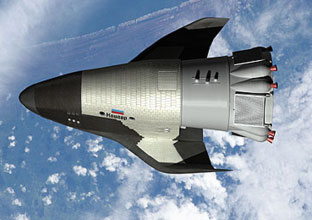
Russia's Rocket and Space Corporation Energia will create a new spaceship capable of flying to the Moon and Russia plans to conduct its first manned flight around the Moon in 2011-2012, according to RIA Novosti, the Russian News and Information Agency.
"We have started developing the final design of a modernized spaceship that has been given the working name of Soyuz-K," Nikolai Sevastyanov, the president of Energia said.
"The new version will be equipped with digital control systems and is being designed in such a way that it could be launched both from the Baikonur space center and the equatorial Kourou space center located on a peninsula in French Guiana," he said.
Sevastyanov said Soyuz-K will be able to fly to the Moon and to re-enter the Earth's atmosphere on its return.
"The Energia Rocket and Space Corporation plans to explore the Moon in three stages: a Soyuz spacecraft flight to the Moon, the construction of a permanent base on the Moon (from 2010 to 2025), and the industrial exploration of space around the Earth's satellite," Nikolai Sevastyanov said.
He said the main goals of the lunar exploration would be to conduct astrophysical research from its surface and to extract raw materials, including helium-3, to meet increasing energy demand on the Earth.
Helium-3 is a rare earth metal, which is abundant on the Moon, and is used in nuclear power reactors as well as being a conductor. It is also used in microchip and related technologies.
Russia is planning to use a modernized version of the Soyuz manned spacecraft, the workhorse of the Russian space fleet, for the flights to the Moon, Sevastyanov said, adding that the first spacecraft would be ready in 2010.
Sevastyanov said the Russian Space Agency and the European Space Agency had already expressed their support for the project and the first modernized Soyuz would be launched in 2010.
In addition, the company's president said Energia is continuing design work to create a new Russian space shuttle, the Kliper.
Sevastyanov also said the first flight to Mars would be conducted after 2025 and the expedition will use the Russian-made Kliper shuttle with a four-man crew and will last two-and-a-half years, he said.
The Kliper, a six-person spacecraft similar to the U.S. space shuttle, is designed to replace the Soyuz and Progress carrier rockets in making regular flights to the International Space Station, and even the Moon and Mars.
"Work on the Kliper is continuing. On the whole, the image of this spaceship is clear, but there are still several critical technologies whose development will take time, but we are convinced we will succeed," Sevastyanov said.
For More Info:
http://www.energia.ru/english/
http://en.rian.ru/russia/20061018/54922208.html
http://en.rian.ru/russia/20060831/53358620.html
