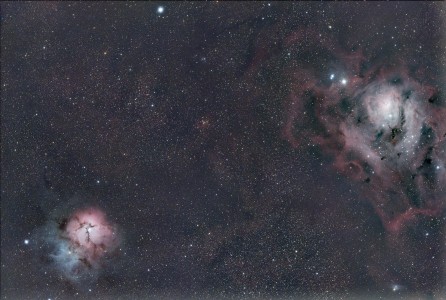
Image of the day

Captured by
Michael Scherman

Lagoon and Triffid Celestron C6 Hyperstar4

My Account

New to Astromart?

Register an account...

Need Help?

Snowball Earth Glaciation Dramatically Changed the Carbon Cycle

05/08/2010 05:14PM

Snowball Earth Glaciation Dramatically Changed the Carbon Cycle

For insight into what can happen when the Earth's carbon cycle is altered, scientists are looking at an event that occurred some 720 million years ago, when global glaciers reached the equator. New data from a Princeton University-led team of geologists suggest that an episode called Snowball Earth, which resulted in the continents and oceans being covered in a thick sheet of ice, produced a dramatic change in the carbon cycle. The glaciation was global in scope, literally encasing the planet in ice. Later, after the carbon cycle settled to more of a steady state similar to how it functions today, increased levels of oxygen in the atmosphere provided the conditions that were necessary for the explosive diversification of animal life that started about 540 Million Years ago.


Comments:

  • mcvman [David Kernberger]
  • 05/10/2010 02:15AM
To me, this article never really got down to the direct description of what the carbon cycle is or what actual change took place in it during the period in question. It continually seemed to me to be talking all around it. it may be I am simply not enough of a scientist to understand such a sophisticated description but I normally read, understand, and enjoy these articles on the AM website. I wonder if anybody else had a similar reaction??<br><br>Sincerely,<br>Dave K.
Dave:<br><br>You are right.<br><br>After re-reading this news item, it seems to jump right into a discussion of changes in the carbon cycle without ever explaining what it is. Often with articles like this, I'll add a paragraph or two as a short introduction to the topic, but in this case I didn't.<br><br>Here's a short intro to help set the stage:<br><br>On Earth, the element carbon is found in great quantities on the land (in limestone sediments, for example), dissolved in the ocean, in the atmosphere (carbon dioxide), and throughout the Earth’s interior (in molten rock). Carbon constantly changes, or cycles, through states. Sometimes it is a solid, sometimes a gas, sometimes a solid dissolved in ocean water, etc.<br><br>The carbon cycle discussed in this news item is a geological carbon cycle that takes place over hundreds of millions of years. Other forms include biological carbon cycles like photosynthesis or the carbon cycle where vast amounts of carbon dioxide are exchanged from the surface of warm ocean water into the atmosphere.<br><br>In the geological carbon cycle, carbon moves between rocks and minerals, seawater, and the atmosphere. Carbon dioxide in the atmosphere reacts with minerals on the ground to form the mineral calcium carbonate (limestone). This mineral is then dissolved by rainwater and carried to the oceans. Once there, it can precipitate out of the ocean water, forming layers of sediment on the sea floor. As the Earth’s plates move, through the processes of plate tectonics, these sediments are subducted underneath the continents. Under the great heat and pressure far below the Earth’s surface, the limestone melts and reacts with other minerals, releasing carbon dioxide. The carbon dioxide is then re-emitted into the atmosphere through volcanic eruptions and the cycle starts again. <br><br>The Princeton study in this news item suggests that there was a major interruption to the carbon cycle when the Earth froze over 750 Million Years ago. Carbon in the air could not interact with ground minerals and carbon in the oceans could not release into the atmosphere. The ice formed a barrier, in effect, at the important interfaces where carbon would normally get exchanged.<br><br>Hope this helps.<br><br>Thanks,<br><br>Guy Pirro<br><br><br><blockquote class="blockquote"><div class="italic"><i>David Kernberger said:</i><br><br> To me, this article never really got down to the direct description of what the carbon cycle is or what actual change took place in it during the period in question. It continually seemed to me to be talking all around it. it may be I am simply not enough of a scientist to understand such a sophisticated description but I normally read, understand, and enjoy these articles on the AM website. I wonder if anybody else had a similar reaction??<br><br>Sincerely,<br>Dave K.</div></blockquote>
