Spitzer Finds a Massive Cluster of Red Supergiant Stars
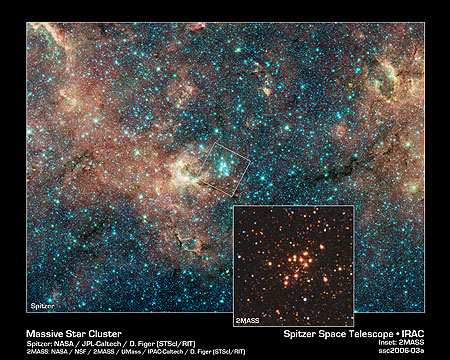
Astronomers from the Rochester Institute of Technology (RIT) have discovered a massive cluster of red supergiants — super-sized stars on the verge of exploding. The cluster was discovered in the Milky Way, about 18,900 light-years from Earth, by a group of astronomers using the Spitzer Space Telescope’s infrared technology to penetrate the thick dust that cloaks much of the galaxy.
Only a few hundred such red supergiant stars are known to exist in our galaxy. These are the biggest stars -- A single red supergiant at the center of the solar system, for example, would reach the orbit of Jupiter.
“It seems odd that here is a spectacularly bright cluster and that we are only seeing it now,” says Don Figer, an astronomer at RIT. “We didn’t have infrared technology until recently and so people are rescanning the whole galaxy.” He adds: “This gives us the richest sample of stars getting ready to explode. We still don’t understand what they do in their last stage.”
Figer’s finding may poke holes in some massive star formation models, which suggest that conditions are no longer favorable for this type of massive cluster formation. Ancient globular clusters, containing even more stars, were thought to have been born only very early, at the time of the formation of the galaxy. “But that’s probably not true because we’re starting to see more massive clusters,” Figer notes, adding that further infrared observation will probably reveal more examples.
"This observation also is a rare chance to study huge stars just before they explode. Normally, we don't get to see stars before they pop off." Figer stated. The 14 red supergiants in this cluster represent almost three times as many as in any other star cluster in our galaxy. The runner-up, open cluster NGC 7419 in the constellation Cepheus, has five.
Figer relied on data from a variety of telescopes, including the Spitzer Space Telescope, to confirm that the infrared colors of the suspected red supergiants are consistent with those of known red supergiants. The red supergiants discovered by Figer's team are very bright, indicating that the cluster is relatively young at about 8 to 10 million years old. The cluster has to be young enough for astronomers to see these short-lived stars before they explode, yet old enough to have stars that have evolved to the red supergiant stage.
The cluster is the first of 130 massive star cluster candidates that Figer and his team will study over the next five years using a variety of telescopes, including the Spitzer and Hubble Space telescopes. "We can only see a small part of our galaxy in visible light because a dusty veil covers most of our galaxy," Figer said. "I know there are other massive clusters in the Milky Way that we can't see because of the dust. My goal is to find them using infrared light, which penetrates the dusty veil."
For More Information:
Click here for more about this subject. -Ed.http://hubblesite.org/newscenter/newsdesk/archive/releases/2006/03/full/
Click here for more about this subject. -Ed.http://www.spitzer.caltech.edu/Media/releases/ssc2006-03/release.shtml
Click here for more about this subject. -Ed.http://www.rit.edu/~930www/webnews/viewstory.php3?id=1782
Funding Member
