Spitzer Gives Scientists Depth Perception
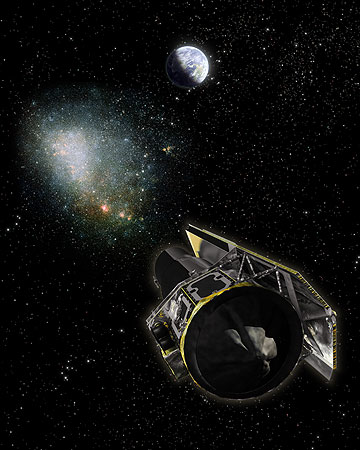
Astronomers now have a new method for determining the distance to certain mysterious bodies in and around our Milky Way galaxy. By taking advantage of the unique position of the NASA Spitzer Space Telescope about 40 millions miles from Earth, and a depth-perceiving technique called parallax, they are now able to pin down the location of dark matter object in and aroung our galaxy. Once this technique is perfected, astronomers will be able to more accurately measure the distances to these dark matter objects.
Comments:
Jim, I am also waiting for the answers.
<br>Jim:<br><br>Your analysis and understanding is correct.<br><br>Parallax does lose its effectiveness as objects are at greater distances from the two endpoints (in effect the base of the triangle).<br><br>Hipparcos, a European Space Agency (ESA) mission, pinpointed the positions of the closest 100 Thousand stars to very high precision using parallax (and more than One Million stars to a somewhat lesser precision).<br><br>Parallax is an effective technique for determining the distance to objects within our Milky Way Galaxy and just outside of our galaxy in the halo portion, but cannot be used for measuring the distance to far away galaxies. Other techniques are needed for that.<br><br>One such technique is measuring the changing brightness of Cepheid variable stars in nearby galaxies within our Local Group. Cepheid variables are a class of very predictable pulsating stars that can used as "milepost markers."<br><br>But even the Cepheid variable approach loses effectiveness as we try to measure the distance to more far away galaxies. At those distances, astronomers turn to other techniques, like measuring the relative brightness of SuperNovas.<br><br>The farthest we can measure using parallax is when we use the distance from the Sun to the Earth as the components of the base of the triangle. The greatest parallax occurs when the Earth is at the ends of its orbit around the Sun. Let's say an astronomer takes a photograph of a nearby star on January 1st. Then on July 1st, when the Earth is at the other side of its orbit around the Sun, the astronomer takes another photograph. The effective base of the triangle is 93 Million miles + 93 Million miles, or a total of 186 Million miles. By measuring the perceived motion of the star against more distant background objects, the distance to the star can be calculated using trigonometry.<br><br>What is unique about the technique discussed in this posting is that astronmoers are now learning how to apply a parallax-based approach to finding the distance to dark objects by looking for the microlensing caused by the interaction of gravity with light from a background source.<br><br>Hope this helps,<br><br>Guy Pirro<br><br><br>---------------------------------------<br><br>Jim Babcock said:<br><br>It has been a long time since I have had a Physics class, so please bear with my amateur questions and thoughts.<br><br>Does this technique lose its effectiveness as objects are at greater distances from the to viewpoints? I would expect the farther apart the 2 viewpoints, the further the effectiveness. If all of this is true, then this technique will be useless for DSO's but useful for relatively close objects. The good part is that the viewpoints are moving apart, so therefore we can measure closer objects first and overtime both increase the depth based on this approach, and also increase it as we gain experience do so. Finally, this should be useful for far more than just measuring the distance to dark matter that it is initially being used for.<br><br>Is my understanding correct?<br><br>If so, then are there formulas for projecting the maximum distances that this approach is currently useful at? And what are some of the other more interesting things this can be used for?
Funding Member
