Subaru Discovers the Most Distant Galaxy to Date
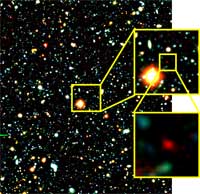
Astronomers using the Subaru telescope in Hawaii have looked 60 million years further back in time than any other astronomers, to find the most distant known galaxy in the universe. In doing so, they are upholding Subaru's record for finding the most distant and earliest galaxies known. To date, nine of the top ten furthest galaxies have been discovered by Subaru. Their most recent discovery is of a galaxy called I0K-1 that lies so far away that astronomers are seeing it as it appeared 12.88 billion years ago.
This discovery indicates that galaxies existed only 780 million years after the universe came into existence about 13.66 billion years ago as a hot soup of elementary particles.
To detect the light from this galaxy, the astronomers used Subaru telescope's Suprime-Cam camera outfitted with a special filter to look for candidate distant galaxies. They found 41,533 objects, and from those identified two candidate galaxies for further study using the Faint Object Camera and Spectrograph (FOCAS) on Subaru. They found that IOK-1, the brighter of the two, has a redshift of 6.964, confirming its 12.88 billion-light-year distance.
The discovery challenges astronomers to determine exactly what happened between 780 and 840 million years after the Big Bang. IOK-1 is one of only two galaxies in the new study that could belong to this distant epoch. Given the number of galaxies that have been discovered from 840 million years after the Big Bang, the research team had expected to find as many as six galaxies at this distance. The comparative rarity of objects like IOK-1 means that the universe must have changed over the 60 million years that separate the two epochs.
One interpretation of what happened is that we are seeing an event known to astronomers as the reionization of the universe. In this case, 780 million years after the Big Bang, the universe still had enough neutral hydrogen to block our view of young galaxies by absorbing the light produced by their hot young stars. Sixty million years later, there were enough hot young stars to ionize the remaining neutral hydrogen, making the universe transparent and allowing us to see their stars.
Another interpretation of the results says that there were fewer big and bright young galaxies 780 million years after the Big Bang than 60 million years later. In this case, most of the reionization would have taken place earlier than 12.88 billion years ago.
No matter which interpretation finally prevails, the discovery signals that astronomers are now excavating light from the "Dark Ages" of the universe. This is the epoch when the first generations of stars and galaxies came into existence, and an epoch which astronomers have not been able to observe until now.
The Subaru telescope is particularly well suited for the search of the most distant galaxies. Of all the 8- to 10-meter-class telescopes in the world, it is the only one with the ability to mount a camera at prime focus. The prime focus, at the top of the telescope tube, has the advantage of a wide field of view. As a result, Subaru currently dominates the list of the most distant known galaxies, discovering nine of the top ten most distant galaxies. Many of these are in a region of the sky in the direction of the constellation Coma Berenices called the Subaru Deep Field that the research team selected for intense study at many wavelengths.
To put this Subaru accomplishment into context, it is important to review what we know about the history of the early universe. The universe began with the Big Bang, which occurred about 13.66 billion years ago in a fiery chaos of extreme temperature and pressure. Within its first three minutes, the infant universe rapidly expanded and cooled, producing the nuclei of light elements such as hydrogen and helium but very few nuclei of heavier elements. In 380,000 years, things had cooled to a temperature of around 3,000 degrees. At that point, electrons and protons could combine to form neutral hydrogen.
With electrons now bound to atomic nuclei, light could travel through space without being scattered by electrons. We can actually detect the light that permeated the universe back then. However, due to time and distance, it has been stretched by a factor of 1,000, filling the universe with radiation we detect as microwaves (called the Cosmic Microwave Background). The Wilkinson Microwave Anisotropy Probe (WMAP) spacecraft studied this radiation and its data allowed astronomers to calculate the age of the universe at about 13.66 billion years. In addition, these data imply the existence of such things as dark matter and the even more enigmatic dark energy.
Astronomers think that over the first few hundred million years after the Big Bang, the universe continued to cool and that the first generation of stars and galaxies formed in the densest regions of matter and dark matter. This period is known as the "Dark Ages" of the universe. There are no direct observations of these events yet, so astronomers are using computer simulations to tie together theoretical predictions and existing observational evidence to understand the formation of the first stars and galaxies.
Once bright stars are born, their ultraviolet radiation can ionize nearby hydrogen atoms by splitting them back into separate electrons and protons. At some point, there were enough bright stars to ionize almost all the neutral hydrogen in the universe. This process is called the reionization of the universe. The epoch of reionization signals the end of the Dark Ages of the universe. Today most of the hydrogen in the space between galaxies is ionized.
For more information:
http://www.naoj.org/Pressrelease/2006/09/13/index.html
Funding Member
