"Supermoon" Total Lunar Eclipse to be Visible on Sunday Night
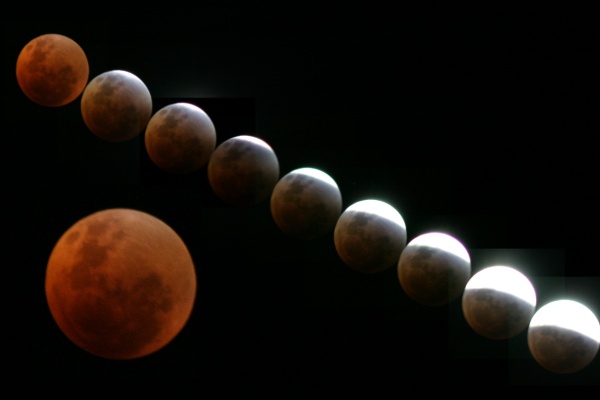
For the first time in more than 30 years, we'll be able to witness a "Supermoon" in combination with a total lunar eclipse. Late on Sunday, September 27, 2015, in the USA and in much of the world, a total lunar eclipse will mask the moon's face for more than an hour.
So, what makes this a "Supermoon" total eclipse? On September 27th, we're going to have a perigee full moon -- That is the moon will be at its closest point to the Earth for the year. The timing of the total eclipse will coincide with the perigee full moon and the moon will appear about 14 percent larger and 30 percent brighter in the night sky than during an apogee full moon.
"Because the orbit of the moon is not a perfect circle, the moon is sometimes closer to the Earth than at other times during its orbit," said Noah Petro, Deputy Project Scientist for the Lunar Reconnaissance Orbiter at NASA's Goddard Space Flight Center in Greenbelt, Maryland. "When the moon is farthest away it's known as apogee, and when it's closest it's known as perigee. On September 27th, we're going to have a perigee full moon -- the closest full moon of the year."
At perigee, the moon is about 31,000 miles closer to Earth than at apogee. Its looming proximity makes the moon appear about 14 percent larger and 30 percent brighter in the sky than an apogee full moon, which sparked the term "Supermoon."
"There's no physical difference in the moon," Petro said. "It just appears slightly bigger in the sky. It's not dramatic, but it does look larger."
A lunar eclipse typically puts on an even greater show. For more than an hour, Earth's shadow swallows up the moon as the planet comes between the sun and the moon. Lunar eclipses typically occur at least twice a year. While people such as the Incas and Mesopotamians historically viewed lunar eclipses as random and frightening occurrences, they're actually quite predictable.
Scientists at Goddard have predicted eclipses a thousand years into the future. Petro said it's just a matter of knowing where Earth, the Sun, and the moon are at a given point in time.
As for the Supermoon and a lunar eclipse occurring simultaneously, Petro said, "It's just planetary dynamics. The orbit of the moon around Earth is inclined to the axis of Earth and the orbital plane of all these things just falls into place every once in a while. When the rhythms line up, you might get three to four eclipses in a row or a Supermoon and an eclipse happening."
But the proverbial stars only align for this event once every few decades, making this phenomenon much rarer than a Supermoon or a lunar eclipse separately. The last Supermoon-lunar eclipse combination occurred in 1982 and the next won't happen until 2033. "That's rare because it's something an entire generation may not have seen," said Petro.
The total eclipse will last one hour and 12 minutes and will be visible in North and South America, Europe, Africa, and parts of West Asia and the eastern Pacific. Viewers can see the Supermoon unmasked after nightfall. In the US, Earth's shadow will begin to dim the Supermoon slightly beginning at 8:11 PM. EDT. A noticeable shadow will begin to fall on the moon at 9:07 PM, and the total eclipse will start at 10:11 PM.
For more information:
https://www.nasa.gov/feature/goddard/nasa-scientist-sheds-light-on-rare-sept-27-supermoon-eclipse/
http://www.astromart.com/news/news.asp?news_id=798
http://www.astromart.com/news/news.asp?news_id=713
http://www.astromart.com/news/news.asp?news_id=139
http://www.astromart.com/news/news.asp?news_id=1135
AstroMart News Archive:
http://www.astromart.com/news/search.asp?search=.+
Funding Member
