Ten-year-old Amateur Astronomer Discovers a Supernova
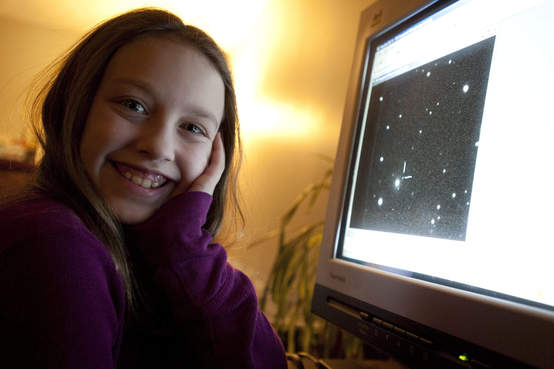
The Royal Astronomical Society of Canada (RASC) has announced the discovery of a supernova by a ten-year-old amateur astronomer — the youngest person ever to have made such a discovery.
Ten-year-old Kathryn Gray of Fredericton, New Brunswick, Canada along with her father Paul
Gray and David Lane reported the discovery of a magnitude 17 supernova in galaxy UGC 3378
in the constellation of Camelopardalis.
The galaxy was imaged on New Year's Eve 2010 by David Lane, and the supernova was discovered on January 2, 2011 by Kathryn and Paul Gray.
Supernovas are stellar explosions that signal the violent deaths of stars several times more massive than our sun. Supernovas are interesting to astronomers because they manufacture most of the chemical elements that went into making the earth and other planets, and also because distant supernovas can be used to estimate the size
and age of our universe.
Supernovas are rare events in any one galaxy. The last one in our galaxy occurred several hundred years ago, before the invention of the telescope.
The odds of discovery can be increased by repeatedly checking many other galaxies. A new supernova reveals itself as a bright point of
light that wasn't there the last time the galaxy was checked. Since a supernova can outshine millions of ordinary stars it is easy to spot with a modest telescope, even in a distant galaxy like UGC 3378 which is about 240 million light-years away.
After being reported, the discovery was soon verified by Illinois-based amateur astronomer Brian Tieman and Arizona-based amateur astronomer Jack Newton. It was then reported to the International Astronomical Union (IAU) Central Bureau for Astronomical Telegrams.
This is Mr. Lane’s fourth supernova discovery, Mr. Gray's seventh, and Kathryn's first.
"It's fantastic that someone so young would be passionate about astronomy. What an incredible discovery. We're all very excited," said Deborah Thompson of RASC.
One other interesting astronomical twist to this story -- Kathryn's middle name is Aurora --Kathryn Aurora Gray.
For more information:
http://www.rasc.ca/artman/uploads/sn2010lt-pressrelease.pdf
http://www.davelane.ca/aro/sn/sn2010lt.html
http://www.bbc.co.uk/news/world-us-canada-12110747
AstroMart News Archive:
http://www.astromart.com/news/search.asp?search=.+
