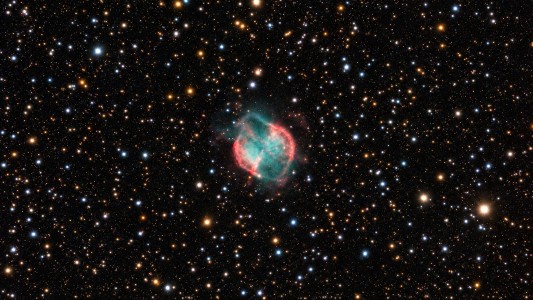
The 200 Inch Hale Reflector at Palomar Celebrates 60th Anniversary
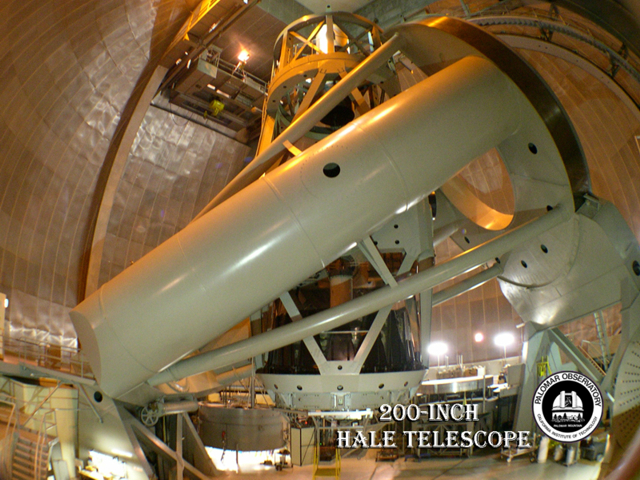
The 200-inch Hale reflector saw first light sixty years ago this week, on January 26, 1949. This telescope, the principal instrument at the Palomar Observatory of the California Institute of Technology, was dedicated to the memory of George Ellery Hale, whose leadership and vision were responsible for its creation.
The dome of the Palomar Observatory is 135 feet high and 137 feet in diameter and divided into two sections. The solid lower concrete portion is immovable while the upper aluminum and steel section can be rotated to permit the telescope to observe any section of the sky through the open shutters. The base section houses photographic dark rooms, telescope-control computers, library, lounge, storerooms, air-conditioning equipment, photographic plate storage vault, motor generators, massive switchboards, elevators, and an oil pumping system that supplies the main bearings of the telescope. The uppermost floor of the solid section houses the telescope. Adjacent to the telescope is a glassed-in observatory gallery from which visitors can view the instrument during daylight hours.
The movable upper section of the dome weighs 1000 tons and moves on tracks to permit the observation of any section of the sky. It rotates on 32 four wheel trucks which move so smoothly that no vibration is transmitted to the telescope. It is driven by two four-horsepower motors. The two shutters weigh 125 tons each and roll together at the end of each night's observation to seal the interior of the dome against the heat of the day and inclement weather.
The most important requirement in the design of the dome was good insulation. For this reason there is a four-foot gap between the concrete walls which form the base of the building. The interior wall is filled with aluminum foil insulation. There is also a four foot gap between the inner and outer walls of the steel dome. The inner face of the dome is made of aluminum panels built in the shape of boxes and filled with crumpled aluminum foil. The outside of the dome is composed of steel plates, 3/8-inch thick, butt-welded and molded to form a strong but smooth hemispherical dome. As the warm air rises through the double walls of the building and the double layers of the dome, cool air enters below, thus preventing the heating of the dome from the Sun's rays during the day.
The foundation of the dome is anchored to the mountain while the foundation for the telescope is separately built on a base of crushed granite to protect the telescope from jar and vibration in the event of an earthquake.
The main telescope tube carries the 200-inch mirror at its bottom end. This structure is supported on ball-bearing trunnions anchored in a large yoke, which consists of two 10-foot-diameter inclined tubular girders tied together at the south end by a cross member supported on a pivot bearing, and at the north end by a giant horseshoe bearing. The tube weighs 150 tons.
When in operation, light from the sky is concentrated by the 200-inch concave mirror into an image at the "prime focus" at the upper end of the tube. Longer focal lengths--and hence larger images--can be provided by inserting one or the other of two convex mirrors just ahead of the prime focus. The first of these, known as the Cassegrain secondary mirror, reflects the light down the tube through a hole in the center or the main mirror to a focus just below the bottom of the tube. If a still larger image is desired, the second convex mirror is substituted. With the aid of a diagonal flat mirror its sends the light down through the south polar-axis to a constant-temperature room in the stationary portion of the dome.
The horseshoe bearing mounting permits the main telescope tube to see the North Pole without interference. Oil is pumped though the pads supporting the horseshoe bearings at a pressure of 300 pounds per square inch, sufficient to lift the horseshoe and its load a few thousandths of an inch. Between these two bearings the entire 530 tons of moving parts of the telescope are "floated" on films of oil, providing virtually friction-free operation.
The right ascension drive consists of two large gears that are used to move the telescope; one gear slews the telescope east and west into the required position, while the other makes it follow the stars. A computer system is connected to the telescope to aim this system.
The east and west declination trunnions are the pivotal bearings on which the telescope tube tilts north and south in declination. Located in each trunnion is an array of small motors and gear trains that provide slow motion fine adjustments of the declination setting.
The 200-inch primary mirror is the heart of the Hale Telescope. All of the other parts of the telescope have only one purpose--to make possible for the mirror to perform its light-gathering function as efficiently as possible. The mirror is supported at the bottom of the telescope tube on 36 delicate counterbalance supports to maintain rigidity. The delicate reflecting surface of the mirror is protected by covers that close like the petals of a flower over the glass disk.
The aluminizing chamber is a large steel tank located on the main floor of the dome next to the telescope. When necessary, the mirror is removed from the telescope and placed in the aluminizing chamber to replace the aluminum coating that provides the reflectivity for the mirror. The prime-focus observing capsule is located at the top of the telescope tube. The capsule contains a seat for the use of the observing astronomer. On the bottom of the observer's cage are hyperboloidal convex mirrors capable of changing the focal length of the telescope to suit various observing requirements.
The Cassegrain and Coude secondary mirrors are used to change the focal length of the telescope. With the use of this system, the focal length of the 200-inch mirror can be changed from 660 inches to an effective focal length of 6000 inches.
The Cassegrain-Coude diagonal mirror is mounted in line with the declination trunnions. This mirror reflects the image formed by the main mirror either into the yoke girder or down the south polar-axis to the Coude-spectrograph room.
The Coude-spectrograph room contains four spectrograph mirrors of different focal lengths. The room is light-tight and serves as a camera. The astronomer chooses the mirror with the focal length he requires and rolls it into the light beam on its carriage to make his observations.
New auxiliary equipment for the 200-inch Hale reflector is continually under development to enhance the light-gathering capabilities of the instrument and to keep it as one of the foremost research instruments in astronomy and astrophysics in the world today.
For more information:
http://www.astro.caltech.edu/palomar/overview.html
http://www.astro.caltech.edu/palomar/history.html
http://www.nps.gov/history/history/online_books/butowsky5/astro4e.htm#photos
Astromart News Archive:
http://www.astromart.com/news/search.asp?search=.+
