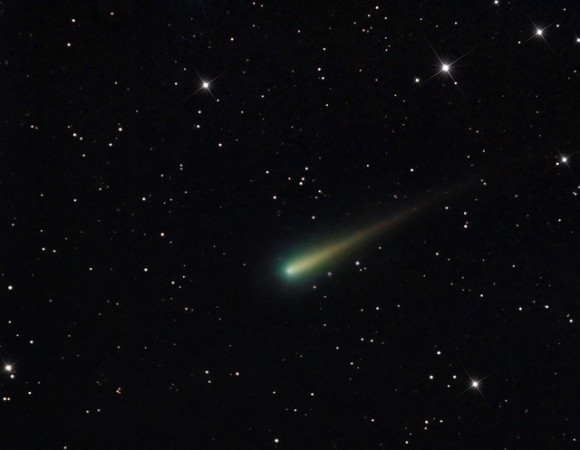
The Approach of Comet Nevski-Novichonok (Comet ISON)
In the fall of 1965, I was a teenager delivering Sunday newspapers in California on my bicycle, peddling along, straining under the weight of two heavily loaded canvas bags. Standing on my pedals to better balance myself, I headed east, my head lowered by the effort to keep the bags off the ground. Looking up, I briefly saw the barest beginnings of dawn when suddenly, I glimpsed a long, glowing object paint brushed on the sky, stars visible through its tail. I started, lost my balance and fell off the bike, my landing cushioned by newspapers.
I lay there, gaping up at the sheer beauty of Comet Ikeya-Seki, my rear wheel spinning round and round. The comet later broke into three pieces just before it went behind the sun. These pieces moved away in almost identical orbits, the comet reappearing in the morning sky in late 1965, again with a very bright tail. By early 1966, it had faded from view as it receded to whence it came. But at least it had an official name by then, known as C/1965 S1.
A digression about designating comets. They are "officially" named following the conventions of the International Astronomical Union (IAU) adopted in 1994. The "C/" prefix tells us that it is a "non-periodic" comet, that is, a one time visitor to the inner solar system. (Technically it has an "open" orbit, a parabola or hyperbola, as opposed to a "closed" orbit, such as an ellipse or circle. This classification also includes comets that orbit the sun no more than once every 200 years.) Halley's Comet, on the other hand, is perhaps the best known of the "periodic" comets, coming around every 76 years or so, and has the official name of P/Halley (as the first year and month of its discovery are unknown). The other elements of the name specifically date the discovery: 1965 is the year it was discovered, S indicates the second half of September (following the convention A = 1st half of January, B = 2nd half of January and so on) and it was the first (1) comet discovered during the second half of September.
Decades later, it was discovered that Comet Ikeya-Seki is the brightest (so far) member of a family of comets, labeled the Kreutz sun grazers. This bold family is characterized by elongated orbits taking them extremely close to the Sun at perihelion (the closest point of their orbit to the sun). They are believed to be fragments of one large comet that broke up centuries ago and are named for the German astronomer, Heinrich Kreutz, who first demonstrated in 1888 that various comets (C/1843 D1, C/1880 C1 and C/1882 R1) are related.
Comet ISON (C/2012 S1) was discovered by two Russian astronomers (Vitali Nevski and Artyom Novichonok) on September 21st, 2012. ISON stands for the International Scientific Optical Network, after the team who discovered it. It should really be commonly referred to as Comet Nevski–Novichonok, after its discoverers so as not to be confused with any other comets discovered by the ISON team. But the popular press is not concerned with this nicety.
Despite sharing the same half of it discovery month with Comet Ikeya-Seki and also being a sun grazer, Comet ISON is NOT a member of the Kreutz family. It is now within sight of amateur astronomers' telescopes as it travels the inner solar system, making its closest approach to the sun on Nov. 28, 2013, when it will sail within 730,000 miles of the sun's surface. Its trajectory is hyperbolic, which suggests that it is a dynamically new comet coming freshly from the Oort Cloud (a huge region of space surrounding the solar system where many comets are thought to reside).
C/2012 S1 is expected to be brightest, of course, when it is closest to the Sun; however, it may be less than 1 degree from the Sun at that time, making it difficult to see because of the glare of the Sun. In December, C/2012 S1 will grow dimmer, but assuming that it remains intact, it should be visible from both hemispheres of Earth, possibly with a long tail. C/2012 S1 will be well placed for observers in the northern hemisphere during mid to late December 2013. After perihelion, it will move north on the sky, passing within two degrees of Polaris (The North Star) on January 8, 2014.
Funding Member
