
The Elusive Massless Weyl Fermion Discovered After 85 Years
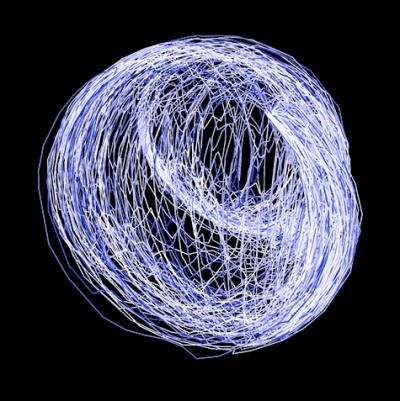
Princeton University scientists have discovered the elusive Weyl fermion, a massless particle that was theorized 85 years ago. Proposed by the mathematician and physicist Hermann Weyl in 1929, Weyl fermions have been long sought by scientists because they are regarded as possible building blocks of other subatomic particles and are even more basic than the ubiquitous electron. Since Weyl fermions are massless and possess a high degree of mobility, they could give rise to faster and more efficient electronics, especially in quantum computing applications.
Comments:
Thank you, Guy, once again ! These reports are all just jaw dropping....obscure science discoveries ends up helping us .<br>Pete Hallock<br>Orcutt, California <br><br>North coastal edge of Santa Barbara county, California
<br>Pete:<br><br>I'm glad you enjoyed this News Item and thanks for the kind words.<br><br>I derive a great deal of satisfaction out of posting News Items like this that describe potentially significant scientific discoveries that do not get much media attention.<br><br>Thanks,<br><br>Guy<br><br><br><br><blockquote class="blockquote"><div class="italic"><i>Peter Hallock said:</i><br><br>Thank you, Guy, once again ! These reports are all just jaw dropping....obscure science discoveries ends up helping us .<br>Pete Hallock<br>Orcutt, California <br><br>North coastal edge of Santa Barbara county, California</div></blockquote>
After reading this fascinating article this morning, I wondered for much of the day if the unusual properties of tantalum were in some way due to the bizarre Weyl Fermion. I haven't been able to find much info on the crystal formed with the arsenide blend, but I have always replaced small value electrolytic capacitors on circuit boards with tantalum caps. They have a higher volumetric capacity and have appeared to work better than their electrolytic cousins in every situation I have tried. It's interesting these discoveries are still being made with materials that are already here. Buckyballs have been forming in melted candle wax since candles were first made and now the Weyl in tantalum arsenide crystals. Really interesting times we live in. Thanks for the article.
<br>George:<br><br>That's a very interesting point you bring up. <br><br>As you mention, tantalum capacitors have a high capacitance per weight and volume. But they also have another important property -- They have a low ESR (Equivalent Series Resistance). Could these unique performance properties be the result of Weyl fermions?<br><br>The article mentions that Weyl fermions were found to exist in tantalum arsenide crystals. I wonder if they also exist in the powdered tantalum metal that is used to make tantalum capacitors?<br><br>Also, the researchers mentioned "that Weyl fermions can be used to create massless electrons that move very quickly with no backscattering, wherein electrons are lost when they collide with an obstruction. In electronics, backscattering hinders efficiency and generates heat."<br><br>That's also what happens when you have a high ESR -- as you know, more resistance leads to less efficiency and more heat.<br><br>So, to your point, I wonder if the performance of tantalum capacitors has somehow been related to the unique properties of Weyl fermions all along?<br><br>Thanks,<br><br>Guy<br><br><br><br><blockquote class="blockquote"><div class="italic"><i>George Blahun said:</i><br><br>After reading this fascinating article this morning, I wondered for much of the day if the unusual properties of tantalum were in some way due to the bizarre Weyl Fermion. I haven't been able to find much info on the crystal formed with the arsenide blend, but I have always replaced small value electrolytic capacitors on circuit boards with tantalum caps. They have a higher volumetric capacity and have appeared to work better than their electrolytic cousins in every situation I have tried. It's interesting these discoveries are still being made with materials that are already here. Buckyballs have been forming in melted candle wax since candles were first made and now the Weyl in tantalum arsenide crystals. Really interesting times we live in. Thanks for the article. </div></blockquote>
Sounds like an important research discovery, my daughter most likely will experience what developes.
Great physics and great discovery with potential applications, but the news presentation is somewhat misleading.<br><br>This is not a discovery of a new fundamental particle, but of the so-called quasi-particle, a complex collective excitation of electrons in a crystal, which happens to have the same mathematical properties of the so-called "Weyl fermion."<br><br>They are "more fundamental" than electron only because they have simpler mathematical representation than electrons, not because real electrons are made of them.<br><br>This is a new frontier in physics, not towards very small or very large, but towards understanding of the behavior of complex, many body systems: "more is different."<br>
Funding Member
