The Gran Telescopio Canarias (GTC) is Inaugurated
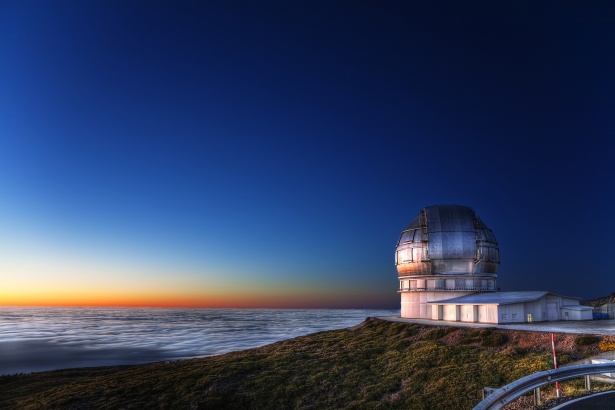
The Gran Telescopio Canarias (GTC) was inaugurated on July 24th, 2009, by their Majesties the King and Queen of Spain. With a total surface equivalent to a 10.4m single circular mirror in diameter, GTC is currently the biggest and also one of the most advanced telescopes in the world.
The GTC primary mirror is formed by 36 hexagonal components. The GTC has also a secondary mirror and a tertiary mirror in order to feed the foci where the scientific instruments would be placed.
The telescope mount, mechanical steel structure that holds the mirrors, is altazimuth, in other words, the movements are done following the physical axis, the horizontal and vertical ones. The telescope will be able to observe the optical and infrared light coming from the celestial objects.
GTC will be the last of the so called generation of 8-10 meter telescopes. Therefore it has tried to improve the design of the predecessors, learning from their experiences.
At the time of it scientific operations, it will be the telescope with the largest light collecting surface: 75.7 square meters. Apart from its large collecting surface another key feature would be the image quality. GTC will make use of two techniques to optimize image quality, namely active optics and later, adaptive optics.
Active optics allows the telescope to align, deform, and move the segments that form the primary mirror. It also allows movement and alignment of the secondary mirror, with the aim of keeping its position fixed in a precise way, independently of the external conditions (climate, temperature, gravity, manufacture faults, etc.) in order to avoid any imaging degradation.
Adaptive optics is an advanced technique that, by applying very fast corrections in real time with deformable mirrors (of the order of thousands of corrections per second), manages to keep the light focused as it makes its way through the atmosphere.
In addition, the telescope itself is protected by a dome built to avoid degradation of the images due to the possible external and internal turbulences. The dome also includes a mechanical structure designed to allow astronomical observations free of vibrations which could reduce the imaging quality.
The GTC plans to maximize the observing time by using an observing queue system. This procedure will allow observers to choose automatically what type of instrumentation and observing are best suitable for the atmospheric conditions and the installation provided every time.
The Observatorio del Teide (Tenerife) and Observatorio del Roque de los Muchachos (La Palma) are currently home to telescopes and other instruments belonging to 60 scientific institutions from 17 different countries. These observation facilities, together with the scientific and technological resources of the IAC's Instituto de Astrofísica at La Laguna (Tenerife) and Centro de Astrofísica en La Palma (CALP) at Breña Baja (La Palma), make up the "European Northern Observatory" (ENO).
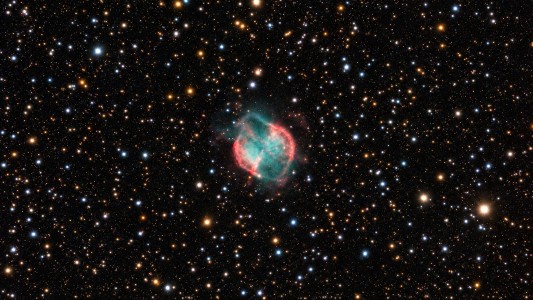
A team of University of Florida (UF) astronomers is among the first in the world to make scientific-quality observations of the heavens using the newly completed Gran Telescopio Canarias.
The team headed by Eric Ford, an assistant professor of astronomy, used the Canary Islands-based GTC to observe a known star and its Jupiter-sized orbiting planet as part of an effort aimed in part at learning how planets contract in size as their stars age. With analysis of the data from the observations now under way, the team also hoped to glean insights about how to tune the GTC’s capabilities to study not only huge, gaseous Jupiter-size planets but also Neptune-sized or “super-Earth”-sized planets that could be closer in composition to Earth.
“The excellent site and large size of the GTC plus the unique filtering capabilities of its detectors will allow astronomers to minimize the effects of Earth’s atmosphere,” Ford said. “By repeatedly measuring the color of exoplanets’ host stars, astronomers can study the atmospheres of exoplanets — and distinguish small planets from other phenomena such as large star spots or binary stars.”
The UF team’s late-May observations were among several announced earlier this week by the Instituto de Astrofisica de Canarias that marked the long-awaited scientific debut of the GTC, first launched in 2000 on the island of La Palma, and only recently completed. UF contributed $5 million to the roughly $180 million telescope and owns a 5 percent share – the only U.S. institution with an ownership stake in the telescope. The Spanish government owns 90 percent, with Mexico owning the remaining 5 percent.
UF astronomers say they will use the telescope to learn more about what occurred in the earliest years of the universe, how stars, planets and galaxies come into being, and to discover and learn more about planets outside our solar system.
“We made this investment because we want our excellent faculty and students to have as much opportunity as possible for top-class research,” said Stan Dermott, chairman of the astronomy department. “In astronomy, that requires access to the best facilities.”
“The University of Florida is a partner not just in the observing sense,” Dermott said. “We are also a partner in the sense of being the major builder of instruments for the telescope.”
For more information:
http://www.gtc.iac.es/en/pages/gtc/gtc.php
http://news.ufl.edu/2009/06/18/gtc-first/
AstroMart News Archive:
http://www.astromart.com/news/search.asp?search=.+&search_btn=Go
