The Hunt Goes On - Superheavy Element 114 Confirmed
Scientists at the U.S. Department of Energy’s Lawrence Berkeley National Laboratory have been able to confirm the production of the superheavy element 114, ten years after a group at the Joint Institute for Nuclear Research in Dubna, Russia first claimed to have made it. Using Berkeley Lab’s 88-Inch Cyclotron, the researchers were able to confirm the creation of two individual nuclei of element 114, each a separate isotope having 114 protons but different numbers of neutrons, and each decaying by a separate pathway.
Comments:
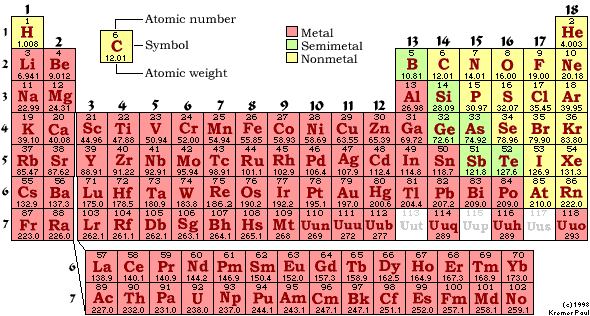
I've been picking up where I left off 30 years ago, working on a tetrahedral pyramidal representation of the periodic system.<br><br>Back then I was a young undergrad chemistry student, and noticed that you could stack the s,p,d, and f blocks of the elements into a tetrahedral arrangement if you assumed that element 120 was the end of the local system. If you do this, then the s block is 8 layers deep (the system ends at 8s2, or element 120), then the p block is 6 layers deep (ending at 7p6, since it starts at 2p, not 1p), the d block is 4 deep (starting at 3d and ending with 6d10), and the f block is 2 deep (starting at 4f and ending at 5f14). When all this is done the periods end up being sized 2, 2, 8, 8, 18, 18, and 32, 32 (or symmetrically 2, 8, 18, 32, 32, 18, 8, and 2). Interestingly summing like numbers (equivalent to doubling them) gives squares (4, 16, 36, and 64) of even integers, while halving does the same (1, 4, 9, and 16) for integers. <br><br>Turns out that tetrahedra are intimately related to squares, and to Pascal's triangle, so the association of the above to a tetrahedral mapping is natural, as well as compact and elegant.<br><br>You place the z-axis through the very center of each block, between elements at the central '4-corners'.<br><br>To make this an equilateral figure, though, one had to halve the width of each block, which doesn't seem right (so two elements per cell), since this is not the way elemental electrons are added to the orbitals. However, something interesting does show up- the sum of the halved width plus the length of each block is always 9: 1+8, 3+6, 5+4, and 7+2 for s, p, d, and f blocks respectively. Note the curious use of rising odds and descending evens in tandem.<br><br>Many years later a fellow named Valery Tsimmerman independently rediscovered this tetrahedral relation and took it further (see www.perfectperiodictable.com)- where he managed to label edges of the tetrahedron with three quantum numbers (the fourth, m sub s which defines the up and down spin of electrons, is ignored, as is true of my model then as well).<br><br>He also uses close packed spheres- 120- to make the tetrahedron- but because of this whole block width halving thing, he doubles up two elements into 60 spheres, and only every other layer is occupied- leaving the other 60 as spacers or filler.<br><br>I wasn't happy with this inefficient use of real estate, and for the past several months have played with various different configurations of the spheres mapped to the periodic system to try to optimize things. A couple of weeks ago I succeeded, and have been looking for new relations since.<br><br>The new tetrahedral table is radically different from the one at the URL above, and has never been seen before. It captures all the elements one per sphere, includes all four quantum numbers in perfectly symmetrical ways, and also maps out less well known effects such as secondary periodicity, diagonals, and so called knight's move connectivity that have no other obvious motivation, but are geometrically motivated in the new system, following different natural axes and cuts of the tetrahedron, as do the half and full shells.<br><br>Element 114 is nearly to the end of the system that only contains s, p, d, and f orbitals- the next set is g, where it dominates for another 100 elements (two periods). However physicists say we will never get to that closed shell (at least under normal conditions) because a) relativistic effects will prevent the electron cloud from functioning, and b) the nucleus will not hold together. Maybe there is that island of stability, but it hardly goes very far past 120, and 120 closes a major set of shells, and is a good place for Mother Nature to stop.<br><br>Me too.<br>Jess Tauber
Fascinating reply. <br><br>Good luck.<br><br>-Albert
Does an nucleus maintain integrity in a black hole? May be a dumb question, but you are probably qualified to answer and even elaborate.
Is Plutonium still considered an element? <img class='' src='http://new.astromart.com/astromart/javascripts/sceditor/emoticons/wink.png' alt='wink' title='wink'/>
Given its primary use perhaps you might want to put an h- in front of 'element'. <br><br>Jess Tauber