The Nancy Grace Roman Space Telescope to Launch Later this Month
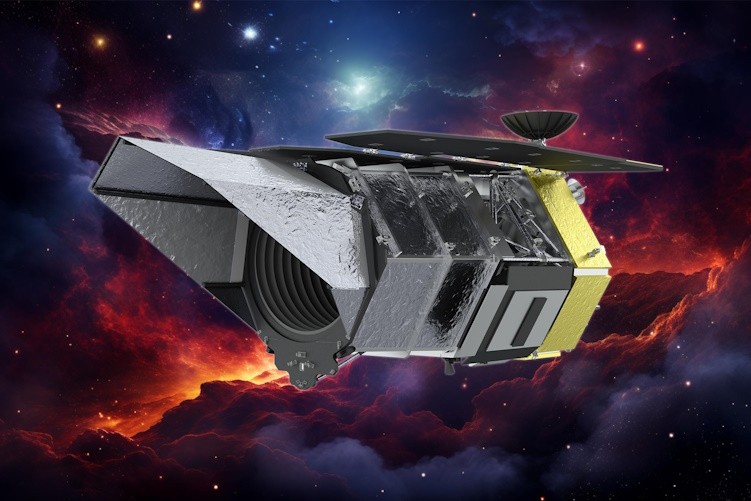
The Nancy Grace Roman Space Telescope is a NASA observatory designed to settle essential questions in the areas of dark energy, exoplanets, and infrared astrophysics. Roman’s barrel-like shape will help block out unwanted light from the Sun, Earth, and Moon, and the spacecraft’s distant location will help keep the instruments cool. The telescope has a primary mirror that is 2.4 meters in diameter (7.9 feet) and is the same size as the Hubble Space Telescope's primary mirror. The Roman Space Telescope will have two instruments, the Wide Field Instrument, and the Coronagraph Instrument technology demonstration. While just as sensitive as Hubble's cameras, the Roman Space Telescope's 300-megapixel Wide Field Instrument will image a sky area 100 times larger. This means a single Roman image will hold the equivalent detail of 100 pictures from Hubble. (Image Credit: NASA Goddard Space Flight Center)
The Nancy Grace Roman Space Telescope to Launch Later this Month
The Roman telescope is slated to launch on Sunday, August 30, 2026 aboard a SpaceX Falcon Heavy rocket from Launch Complex 39A at NASA’s Kennedy Space Center in Florida. Named after NASA’s first chief astronomer, the Nancy Grace Roman Space Telescope will have a deep, panoramic view of the cosmos, generating never-before-seen pictures that will revolutionize our understanding of the universe. The observatory will usher in a new era of cosmic surveys, unveiling troves of celestial objects and shedding light on some of the universe’s most profound mysteries, including phenomena we can’t see. Roman also will showcase cutting-edge technology, including a test of the most advanced technology ever flown in space to directly image planets around nearby stars, a key step in NASA’s search for life on other worlds.
To make Roman’s sensitive measurements possible, the telescope will observe from a vantage point about 930,000 miles (1.5 million km) away from Earth in the direction opposite the Sun. At this special place in space, called the second Sun-Earth Lagrange point, or L2, gravitational forces balance to keep objects in steady orbits with very little assistance.
Roman’s barrel-like shape will help block out unwanted light from the Sun, Earth, and Moon, and the spacecraft’s distant location will help keep the instruments cool. The thermal stability of an observatory at L2 will provide a ten-fold improvement beyond Hubble in much of the data Roman will gather.
The amount of detail these observations will reveal is directly related to the size of the telescope’s mirror, since a larger surface gathers more light. Roman’s primary mirror is 7.9 feet (2.4 meters) across. While it’s the same size as the Hubble Space Telescope’s main mirror, it is less than one-fourth the weight. Roman’s mirror weighs only 410 pounds (186 kilograms) thanks to major improvements in technology.
The primary mirror, in concert with other optics, will send light to Roman’s two science instruments: the Wide Field Instrument and Coronagraph.
The Wide Field Instrument will have a field of view at least 100 times larger than Hubble's, capturing more of the sky with less observing time. As the primary instrument, the Wide Field Instrument will measure light from a billion galaxies over the course of the mission lifetime. It will perform a microlensing survey of the inner Milky Way to find more than 1,000 exoplanets. The Coronagraph Instrument technology demonstration will perform high contrast imaging and spectroscopy of individual nearby exoplanets.
The Roman Space Telescope will have a primary mission lifetime of 5 years, with a potential 5 year extended mission.
The Nancy Grace Roman Space Telescope will function as Hubble’s wide-eyed cousin. While just as sensitive as Hubble's cameras, the Roman Space Telescope's 300-megapixel Wide Field Instrument will image a sky area 100 times larger. This means a single Roman image will hold the equivalent detail of 100 pictures from Hubble.
Who was Nancy Grace Roman?
Known as the "Mother of the Hubble Space Telescope," Nancy Grace Roman was born May 16, 1925 in Nashville, Tennessee, and died December 25, 2018.
From a young age, Roman showed an interest in astronomy, and when she was 11 years old she organized a club with her classmates in Reno, Nevada. In this club they learned about constellations and celestial objects from a book.
By high school, Roman realized that she had a passion for astronomy and wanted to pursue it. Her academic prowess was highlighted when she participated in an accelerated program and graduated in three years from Baltimore's Western High School.
In 1946 Roman received her Bachelor of Arts degree in Astronomy from Swarthmore College in Pennsylvania. During her time there she worked at the Sproul Observatory. In 1949 she received her Ph.D. from the University of Chicago, and stayed at the university for a further six years working at the Yerkes Observatory, and sometimes the McDonald Observatory in Texas. During this period, she observed the star AG Draconis and discovered that its emission spectrum had completely changed in comparison to earlier observations. This discovery helped to raise her profile within the astronomical community.
As a female in astronomy, Dr. Roman faced many challenges throughout her career. From a young age she was discouraged from going into astronomy by those around her, and while in the field struggled with its male dominance and the roles perceived as appropriate for women. During her time at the University of Chicago it became evident that due to her gender she would not obtain tenure, and as such she left.
After leaving the University of Chicago she went to work at the Naval Research Laboratory (NRL) from 1955-1959, and entered into the new field of radio astronomy. During her time at NRL she used non-thermal radio source spectra and conducted geodetic work. Within this program she became the head of the microwave spectroscopy section. Her experiences at NRL helped her adapt to an engineering environment, which became essential in her future career.
While attending a lecture by Harold Urey, Dr. Roman was approached by Jack Clark who asked if she knew anyone who might be interested in creating a program for space-based astronomy at NASA. Dr. Roman took this inquiry by Clark as an invitation to apply, and in early 1959, six months after NASA formed, she joined the team. Dr. Roman was the first female executive at NASA and became the first Chief of Astronomy. She held various other positions in NASA, including Chief of Astronomy and Solar Physics and Chief of Astronomy and Relativity.
Part of Dr. Roman's job included planning a program of satellites and rockets. She also administered a significant program of grants to support the astronomical community. One of the biggest challenges of her career was getting the Hubble Space Telescope approved by the U.S. Congress. It is through her work with this mission that she was coined "the mother of Hubble" by her colleagues, specifically by Edward J. Weiler, her successor at NASA as Chief of Astronomy following her retirement in 1979.
When asked what she thought was the most interesting discovery by Hubble, her reply was "dark energy"! Hubble confirmed the astounding initial measurements that the expansion of the universe was accelerating, and extended those measurements to higher redshifts. These discoveries excited Dr. Roman, as well as the astronomical community. It is therefore with great pleasure that we dedicate NASA's next major space observatory tasked with increasing our understanding of dark energy, the universe, and our place in it, to Dr. Nancy Grace Roman, the pioneer of modern space-based astronomy who made such telescopes a reality.
The Roman telescope is managed at NASA Goddard with participation by the agency’s Jet Propulsion Laboratory in Southern California; Caltech/IPAC in Pasadena, California; the Space Telescope Science Institute in Baltimore; and a team of scientists from various research institutions. The primary industrial partners are BAE Systems Inc., L3Harris Technologies, and Teledyne Scientific & Imaging. Contributions to Roman also are made by ESA (European Space Agency), JAXA (Japan Aerospace Exploration Agency), the French space agency CNES (Centre National d’Études Spatiales), and the Max Planck Institute for Astronomy in Germany.
For more information:
https://science.nasa.gov/mission/roman-space-telescope/
https://science.nasa.gov/mission/roman-space-telescope/roman-observatory/
https://science.nasa.gov/mission/roman-space-telescope/introducing-the-roman-space-telescope/
Astromart News Archives:
https://www.astromart.com/news/search?category_id=3&q=.+&from=&to=
This is my personal deep sky observing list. I use it to line up my DSO targets on any particular night:
Check out some of my favorite Words of Wisdom:
https://www.astromart.com/news/show/words-of-wisdom-some-are-deep-others-not-so-much
https://www.astromart.com/news/show/words-of-wisdom-my-favorite-proverbs-from-around-the-world
Do you enjoy reading these postings?
Then click here and buy the Astromart crew a cup of coffee (and maybe even some donuts):
https://www.astromart.com/support-options
Funding Member