The Study of Tidal Streams in Andromeda Reveals a Violent History of Galactic Cannibalism
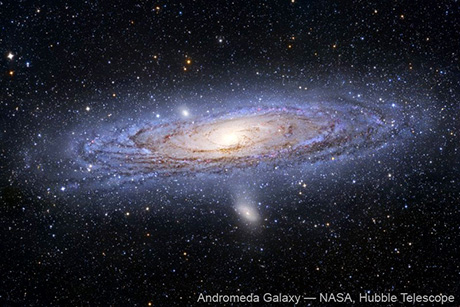
University of California, Santa Cruz astronomers, working in collaboration with an international team of researchers, have identified two new tidal streams in the Andromeda galaxy, which are the remnants of dwarf galaxies that were consumed by our large galactic neighbor. Analysis of the stars in Andromeda's tidal streams and other components of its extended halo is yielding new insights into the violent processes involved in the formation and evolution of massive galaxies like Andromeda and our own Milky Way.
Comments:
Like many of you, I have enjoyed looking at the pics of "colliding" galaxies. What I have noticed, however, is that there are differences in the manner in which the two galaxies affect each other's material.<br><br>The appearance of a "light bridge" between M110 and M31 makes it look like M110 passed through M31 and has a tail. Interestingly this connection lacks the distortion of space time seen in the Antennae galaxies, and others which have peculiar swirls and twists.<br><br>This appears to indicate that these "collisions" may - in cases of tiny satellite galaxies and giant "Mother" galaxies seem to act in line with Newtonian physics. <br><br>But it appears that another set of rules governs galaxies as their sizes become more similar. <br><br>Galaxies like M87 must be the oldest within our light grasp. But the real mystery is how the galaxy appears to be emitting jets at superlight velocities. It is as if M87's immediate neighborhood is like a whole "universe" into itself. As always, M87 is perhaps the greatest enigma in our study of galaxies.