Total Lunar Eclipse to be Visible on Monday Night
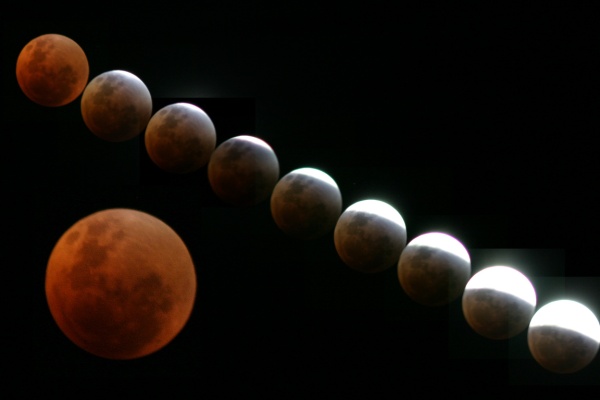
An extraordinary total lunar eclipse will be visible from the United States in the early morning hours of Tuesday, Dec. 21, 2010. Weather permitting, sky gazers in North and Central America and a tiny sliver of South America will have the best seats to 2010's only total eclipse of the moon.
The eclipse will start Monday night on the West Coast of the US and during the early hours Tuesday on the East Coast. Western Europe will only see the start of the spectacle while western Asia will catch the tail end.
The subtle beginning of the eclipse will take place about a half hour before midnight on Dec. 20, with the real spectacle beginning at about 12:32 a.m. on Dec. 21 and the moon becoming fully immersed in the shadow of the Earth by 1:40 a.m., according to University of Wisconsin - Madison Space Place Director Jim Lattis.
The eclipse, Lattis notes, occurs on the same day as the winter solstice, making it the most northern lunar eclipse that can possibly be seen from the Earth.
The moon is normally illuminated by the sun. During a total lunar eclipse, the full moon passes through the shadow created by the Earth blocking the sun's light. Some indirect sunlight will still manage to pierce through and give the moon a ghostly color.
Since the eclipse coincides with winter solstice, the moon will appear high in the sky — a boon for skywatchers. With recent volcanic eruptions around the globe dumping tons of dust into the atmosphere, scientists predict the moon may appear darker than usual during the eclipse, glowing an eerie red or brown instead of the usual orange-yellow tinge.
North and Central America should be able to view the entire show, which is expected to last 3 1/2 hours if skies are clear. Total eclipse begins at 11:41 p.m. PST Monday or 2:41 a.m. EST Tuesday. The totality phase — when the moon is entirely inside Earth's shadow — will last a little over an hour.
"It's perfectly placed so that all of North America can see it," said eclipse expert Fred Espenak of NASA's Goddard Space Flight Center.
NASA, which has a camera mounted at its Marshall Space Flight Center in Huntsville, Ala. will stream live video of the eclipse over the Internet.
Unlike solar eclipses which require protective glasses, lunar eclipses are safe to watch with the naked eye.
U.S. Naval Observatory spokesman Geoff Chester finds solar eclipses more exciting than the lunar counterpart. But solar eclipses tend to occur in remote parts of the world while lunar eclipses are usually visible from an entire hemisphere.
"If you get skunked by bad weather, all you have to do is wait a few years for the next one to come around," Chester said.
There are two total lunar eclipses in 2011 — in June and December. North America will miss the June show and witness only a part of next December eclipse.
For more information:
http://www.news.wisc.edu/18792
http://www.npr.org/templates/story/story.php?storyId=132182929
http://www.astromart.com/news/news.asp?news_id=798
AstroMart News Archive:
http://www.astromart.com/news/search.asp?search=.+
Funding Member
