
Two Records in Two Weeks -- Heaviest Stellar Black Holes on Record Discovered
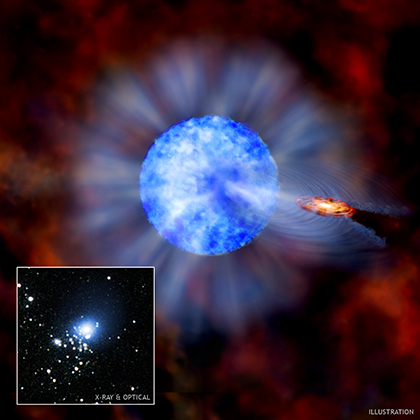
Astronomers have located an exceptionally massive black hole in orbit around a huge companion star. This result has intriguing implications for the evolution and ultimate fate of massive stars.
The black hole is part of a binary system in M33, a nearby galaxy about 3 million light years from Earth. By combining data from NASA's Chandra X-ray Observatory and the Gemini telescope on Mauna Kea, Hawaii, the mass of the black hole, known as M33 X-7, was determined to be 15.7 times that of the Sun. This makes M33 X-7 the most massive stellar black hole known. A stellar black hole is formed from the collapse of the core of a massive star at the end of its life.
"This discovery raises all sorts of questions about how such a big black hole could have been formed," said Jerome Orosz of San Diego State University.
M33 X-7 orbits a companion star that eclipses the black hole every three and a half days. The companion star also has an unusually large mass, 70 times that of the Sun. This makes it the most massive companion star in a binary system containing a black hole.
"This is a huge star that is partnered with a huge black hole," said Jeffrey McClintock of the Harvard-Smithsonian Center for Astrophysics in Cambridge, Mass. "Eventually, the companion will also go supernova and then we'll have a pair of black holes."
The properties of the M33 X-7 binary system - a massive black hole in a close orbit around a massive companion star - are difficult to explain using conventional models for the evolution of massive stars. The parent star for the black hole must have had a mass greater than the existing companion in order to have formed a black hole before the companion star.
Such a massive star would have had a radius larger than the present separation between the stars, so the stars must have been brought closer while sharing a common outer atmosphere. This process typically results in a large amount of mass being lost from the system, so much that the parent star should not have been able to form a 15.7 solar-mass black hole.
The black hole's progenitor must have shed gas at a rate about 10 times less than predicted by models before it exploded. If even more massive stars also lose very little material, it could explain the incredibly luminous supernova seen recently as SN 2006gy. The progenitor for SN 2006gy is thought to have been about 150 times the mass of the Sun when it exploded.
"Massive stars can be much less extravagant than people think by hanging onto a lot more of their mass toward the end of their lives," said Orosz. "This can have a big effect on the black holes that these stellar time-bombs make."
Team member Wolfgang Pietsch used Chandra observations to report that M33 X-7 is the first black hole in a binary system observed to undergo eclipses. The eclipsing nature enables unusually accurate estimates for the mass of the black hole and its companion.
"Because it's eclipsing and because it has such extreme properties, this black hole is an incredible test-bed for studying astrophysics," said Pietsch.
The length of the eclipse seen by Chandra gives information about the size of the companion. The scale of the companion's motion, as inferred from the Gemini observations, gives information about the mass of the black hole and its companion. Other observed properties of the binary were used to constrain the mass estimates.
--------------------------------
NEWS FLASH: NEW RECORD ANNOUNCED
October 30, 2007
http://cfa-www.harvard.edu/press/2007/pr200728.html
http://www.nasa.gov/centers/goddard/news/topstory/2007/overweight_hole.html
Massive Black Hole Smashes Record Set Two Weeks Ago
Using two NASA satellites, astronomers have discovered a black hole that obliterates a record announced just two weeks ago. The new black hole, with a mass 24 to 33 times that of our Sun, is the heftiest known black hole that orbits another star.
The record-breaker belongs to the category of "stellar-mass" black holes. Formed in the death throes of massive stars, they are smaller than the monster black holes found in galactic cores. The previous record holder for largest stellar-mass black hole is a 16-solar-mass black hole in the galaxy M33, announced on October 17, 2007.
"We weren’t expecting to find a stellar-mass black hole this massive," says Andrea Prestwich of the Harvard-Smithsonian Center for Astrophysics in Cambridge, Mass. "We now know that black holes that form from dying stars can be much larger than we had realized."
The black hole is located in the nearby dwarf galaxy IC 10, 1.8 million light-years from Earth in the constellation Cassiopeia. Prestwich’s team could measure the black hole’s mass because it has an orbiting companion: a hot, highly evolved star. The star is ejecting gas in the form of a wind. Some of this material spirals toward the black hole, heats up, and gives off powerful X-rays before crossing the point of no return.
In November 2006, Prestwich and her colleagues observed the dwarf galaxy with NASA’s Chandra X-ray Observatory. The group discovered that the galaxy’s brightest X-ray source, IC 10 X-1, exhibits sharp changes in X-ray brightness. Such behavior suggests a star periodically passing in front of a companion black hole and blocking the X-rays, creating an eclipse. In late November, NASA’s Swift satellite confirmed the eclipses and revealed details about the star’s orbit. The star in IC 10 X-1 appears to orbit in a plane that lies nearly edge-on to Earth’s line of sight, so a simple application of Kepler’s Laws show that the companion black hole has a mass of at least 24 Suns.
There are still some uncertainties in the black hole’s mass estimate, but as Prestwich notes, ”Future optical observations will provide a final check. Any refinements in the IC 10 X-1 measurement are likely to increase the black hole’s mass rather than reduce it.”
The black hole’s large mass is surprising because massive stars generate powerful winds that blow off many Suns worth of gas before the stars explode. Calculations suggest massive stars in our galaxy leave behind black holes no heavier than about 15 Suns.
The IC 10 X-1 black hole has gained mass since its birth by gobbling up gas from its companion star, but the rate is so slow that the black hole would have gained no more than 1 or 2 solar masses. "This black hole was born fat; it didn’t grow fat," says astrophysicist Richard Mushotzky of NASA Goddard Space Flight Center in Greenbelt, Md., who is not a member of the discovery team.
The progenitor star probably started its life with 60 or more solar masses. Like its host galaxy, it was probably deficient in elements heavier than hydrogen and helium. In massive, luminous stars with a high fraction of heavy elements, the extra electrons of elements such as carbon and oxygen “feel” the outward pressure of light and are more susceptible to being swept away in stellar winds. But with its low fraction of heavy elements, the IC 10 X-1 progenitor shed comparatively little mass before it exploded, so it could leave behind a heavier black hole.
"Massive stars in our galaxy today are probably not producing very heavy stellar-mass black holes like this one," says Roy Kilgard of Wesleyan University in Middletown, Conn. "But there could be millions of heavy stellar-mass black holes lurking out there that were produced early in the Milky Way’s history, before it had a chance to build up heavy elements."
For more information:
http://advancement.sdsu.edu/marcomm/news/releases/fall2007/pr101707.html
http://chandra.harvard.edu/press/07_releases/press_101707.html
http://chandra.harvard.edu/chronicle/0407/m33x7/index.html
http://www.astromart.com/news/news.asp?news_id=638
Funding Member
