UK Researchers Discover the Most Massive Star Ever Found
A team of international astronomers led by Paul Crowther, Professor of Astrophysics from the University of Sheffield Department of Physics and Astronomy, used the ESO Very Large Telescope and data from the Hubble Space Telescope to study the R136a cluster of stars. The research may provide an answer to the question as to how massive stars can be.
RMC 136a (more commonly known as R136a), a cluster of young, hot stars, is found within the Tarantula nebula, itself within the Large Magellanic Cloud, a neighboring galaxy to the Milky Way.
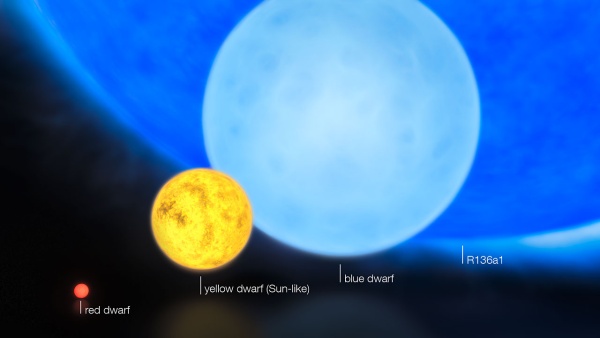
The most massive star ever found, R136a1 within the R136a cluster, has a current mass of 265 solar masses, and it is thought its birthweight was as much as 300 times that of the Sun. It is also the most luminous star ever found, close to ten million times that of the Sun. Within R136, only four stars out of an estimated 100,000 stars in the cluster weighed more than 150 solar masses at birth, yet they account for nearly half of the solar wind and radiation in the entire cluster.
Such massive stars have the potential of creating exceptionally bright "pair instability supernovae" at the end of the lives, blowing themselves completing apart without any remnants, and dispersing up to ten solar masses of iron into their surroundings.
Professor Paul Crowther said: "Unlike humans, these stars are born heavy and lose weight as they age. Being a little over a million years old, the most extreme star R136a1 is already "middle-aged" and has undergone an intense weight loss program, shedding a fifth of its initial mass over that time, or more than fifty solar masses. Owing to the rarity of these monsters, I think it is unlikely that this new record will be broken any time soon.
Due to the short lives of these very rare, high mass stars, it remains a challenge for astronomers to identify how they originated. Paul Crowther added: "Either they were born so big or smaller stars merged together to produce them."
If R136a1 replaced the Sun at the center of our solar system, it would outshine our star by as much as the Sun currently outshines the Moon. Raphael Hirschi, from Keele University, added: "It would bathe the Earth in incredibly intense ultraviolet radiation, rendering life on our planet impossible."
(Note: Although R136a1 is the most massive star ever found, VY Canis Majoris, a red hypergiant star located in the constellation Canis Major is the biggest star found in terms of diameter. At between 1800 and 2100 solar radii (approx 2.7 billion km across or 1.7 billion miles), it weighs 30 to 40 times the mass of the Sun, so it is a lightweight when compared to R136a1.)
For more information:
http://www.shef.ac.uk/mediacentre/2010/1713.html
http://www.astromart.com/news/news.asp?news_id=1044
http://www.astromart.com/news/news.asp?news_id=1021
http://www.astromart.com/news/news.asp?news_id=971
AstroMart News Archive:
http://www.astromart.com/news/search.asp?search=.+&search_btn=Go
Funding Member
