
US Navy Shoots Down Errant Satellite
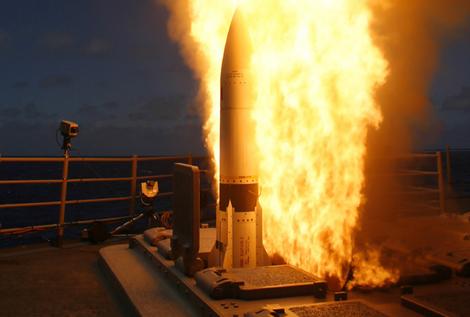
The US Navy shot down a malfunctioning US satellite on February 20, 2008 because of the likelihood that the satellite could release hydrazine, a toxic chemical used as a maneuvering fuel, if it re-entered the atmosphere and crashed in a populated area.
"The likelihood of the satellite falling in a populated area is small, and the extent and duration of toxic hydrazine in the atmosphere would be limited," Jeffrey said. "Nevertheless, if the satellite did fall in a populated area, there was the possibility of death or injury to human beings beyond that associated with the fall of satellites and other space debris."
The window for shooting down the satellite opened up on February 20th and would have remained open for as many as seven or eight days, said Marine Gen. James E. Cartwright, vice chairman of the Joint Chiefs of Staff.
"We are very comfortable that this is a decision made carefully, objectively and safely," NASA Administrator Michael Griffin said.
In late January, the U.S. government notified other nations that the satellite was unresponsive and would make an uncontrolled reentry in late February or early March.
The Navy modified three SM-3 missiles aboard Aegis ships to strike the satellite, Cartwright said. The USS Lake Erie (CG 70) launched the missile and intercepted the satellite at a point just above the atmosphere in order to bring it down in an unpopulated area. It is believed that the intercept ruptured the hydrazine tank.
Intercepting the satellite at about 130 nautical miles altitude reduced the risk of debris in space. Once the satellite was hit, officials hoped that 50 percent of the debris would come to Earth in the first two orbits and the rest shortly thereafter.
The satellite belonged to the National Reconnaissance Office and was launched Dec. 14, 2006. It weighed 5,000 pounds, and computer models showed that roughly 2,800 pounds would remain intact and survive re-entry if not intercepted.
"What is different here is the hydrazine," Cartwright said. "In this case, we have some historical background that we can work against for the tank that contains the hydrazine. We had a similar one on Columbia that survived re-entry. We have a pretty reasonable understanding that, if the tank is left intact, it would survive the re-entry."
The tank was circular with a radius of 20 inches and helds about 1,000 pounds of fuel.
While details of the satellite are classified -- DoD officials will not release who built it or how much it costs -- that had no bearing on the decision to shoot it down, Cartwright said. The temperatures from re-entry would burn up any classified system on the satellite, he said.
Hydrazine is similar to chlorine or ammonia in that it affects lung tissue. People inhaling it would feel a burning sensation. "If you stay close to it and inhale a lot of it, it could be deadly," Cartwright said.
If the military did not shoot down the satellite, the hydrazine would disperse over an area roughly the size of two football fields, the general said. Those who breathed it would need medical attention.
For more information:
http://www.navy.mil/search/display.asp?story_id=35015
Astromart News Archive:
http://www.astromart.com/news/search.asp?search=.+&search_btn=Go
Funding Member
