Vanderbuilt Astronomers Map the Star Forming Winds of M42 -- the Orion Nebula
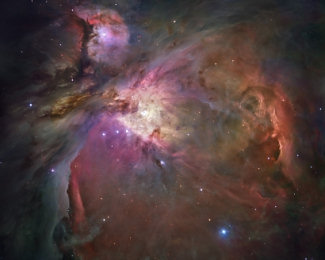
Located at a distance of about 1,600 light years from Earth, M42 -- the Orion Nebula -- is the brightest diffuse nebula in the sky and is visible to the naked eye. M42 is the closest stellar nursery similar to the one in which the Sun was born. For the past few months, Vanderbuilt University astronomers have been mapping the winds blowing in M42 to get an idea of how long major currents have been flowing and how stars have been forming. New data from the Hubble Space Telescope has given the Vanderbilt astronomers the information needed to measure these stellar winds with unprecedented detail.
“Determining how stellar winds interact with the ambient material in stellar nurseries like Orion is a critical factor in understanding the process of star creation,” says Bob O’Dell, distinguished research Professor of Astrophysics at Vanderbuilt and an international authority on the Orion Nebula.
All stars, including the Sun, give off a stream of particles as they burn. In young, hot stars like those that form the “Trapezium” at the heart of Orion this stream of particles is millions of times more dense and energetic than the solar wind. Newborn stars, which are still shrouded in thick veils of dust and gas, often eject gas and dust from their polar regions in narrow jets, rather than broadcasting them outward in all directions. When these stellar winds impact floating clouds of dust and gas, they produce shock waves that erode and shape the clouds in a fashion similar to the way in which terrestrial winds sculpt sand dunes. When they are strong enough, such shock waves also can compress the free-floating clouds of dust and gas, triggering the formation of new stars.
O’Dell is using these shock waves as celestial “wind socks” to plot the direction of these winds in different parts of the nebula. By back-tracking older, more distant shock waves to their likely points of origin, the astronomer can also get an idea of how long major currents have been flowing.
“When you look closely enough, you see that the nebula is filled with hundreds of visible shock waves,” the astronomer says.
Using these markers, the astronomer has mapped the outflow from regions of star formation in the nebula. The specific objects that are producing these winds are not visible to optical telescopes but they stand out as hot spots in infrared images. By tracking back the farthest shockwaves produced by these outflows, O’Dell has established that the winds blowing from one region for 900 to 1,100 years, while those from another region have been going on for 200 to 1,500 years.
These observations were made during 104 orbits of the Hubble and provide the most comprehensive picture ever obtained of the Orion Nebula. The data will be combined with other Hubble and ground-based telescope observations to create a widely available archive for research scientists interested in this region, in addition to acting as a base for a detailed study that should provide new insights into the conditions required for creating stars like the sun.
For More Information:
http://www.vanderbilt.edu/news/releases?id=23966
http://hubblesite.org/newscenter/newsdesk/archive/releases/2006/01/full/
http://sci.esa.int/science-e/www/object/index.cfm?fobjectid=38598
