View a Prime Time Total Lunar Eclipse on Wednesday Night
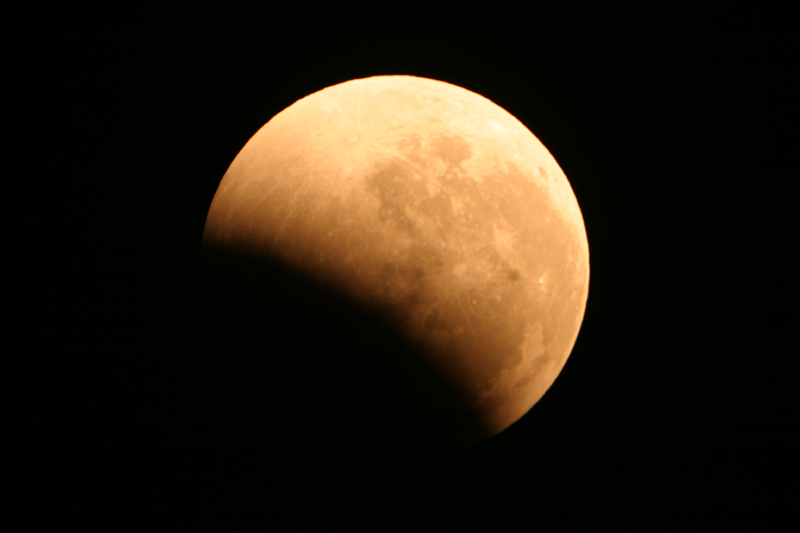
The full moon will turn an eerie color for several hours on the night of February 20, 2008 as it passes through Earth's shadow in a total lunar eclipse. The entire event will be visible from all of North and South America as well as Europe, Africa and western Asia. Viewers will see the moon's color gradually change from bright silver to dull copper as Earth's shadow engulfs it.
Even if the weather is cold, this eclipse will be worth the effort to watch. It will happen during convenient evening hours, with the moon in fine view in a dark sky. The next total lunar eclipse won't happen until December 2010.
The moon will first edge into our shadow at 8:43 p.m. EST on Feb. 20 (1:43 Universal Time on Feb. 21), but that won't be noticeable at first. It will take a while for the moon to darken enough for casual observers to see that something unusual is happening. The actual total eclipse will begin at 10 p.m. EST and end at 10:52 p.m. EST, providing almost an hour of totality to enjoy.
As totality begins and the sky near the moon grows darker, the surrounding stars of the constellation Leo the Lion will suddenly become visible. Leo's brightest star, Regulus, will be just above the eclipsed moon, and the yellow planet Saturn will be the same distance to the moon's lower left.
As the moon emerges from the shadow, it will gradually regain its normal color until it is finally in the clear again at 12:09 a.m. EST (5:09 Universal Time).
The moon's unusual color during a total lunar eclipse is caused by the orange light of sunsets and sunrises around Earth's rim being bent into Earth's shadow by the atmosphere (the same way a prism works). This orange light then reflects from the moon's surface the way sunlight normally does, making the moon appear anywhere from dark red to bright orange. Binoculars will make the moon's color brighter and easier to see, but they are not necessary for viewing the eclipse.
Weather can have varying effects on the moon's color during an eclipse, and so can atmospheric pollution and debris of various kinds, so an exact prediction of the moon's appearance is not possible.
"This event is wonderful to see from the back yard with no optics, but it is also fun to watch the lunar mountains and craters as they move into the shroud of Earth’s shadow," says Maynard F. Jordan Planetarium Director Alan Davenport at the University of Maine.
Davenport says many people assume that the phases of the moon are caused by the Earth’s shadow falling on it. That is only the case, however, during lunar eclipses. This image of the partially eclipsed Moon clearly shows the edge of Earth’s shadow and how much larger it is than the Moon’s phase shadows.
"During totality, our natural satellite will be spookily dark but visible in the deep orange glow from earth’s atmosphere," says Davenport. "Eclipse watchers are always anxious to see what brightness and color the Moon will wear when in totality, because it is different every time."
The Earth’s atmosphere bends the Sun’s red light around the curved edge of the Earth, he explains. The exact color of the glow and its darkness depend on the aerosol levels in our atmosphere. It is affected by recent volcano eruptions, cloud cover, storm activity and human pollution around the globe.
Nearby, the moon, the planet Saturn and the bright star Regulus in Leo the Lion will beam brightly during the total eclipse, Davenport says, and telescopes can capture other deep space objects during that dark 51 minutes of totality.
For more info:
http://newsinfo.iu.edu/news/page/normal/7360.html
http://www.umaine.edu/news/article.asp?id_no=2022
http://sunearth.gsfc.nasa.gov/eclipse/eclipse.html
www.ags.dk
Astromart Archive:
http://www.astromart.com/news/search.asp?search=.+&search_btn=Go
